Tuesday, February 14, 2012

Connections

What does Llewellyn Park, New Jersey have to do with Bix Beiderbecke, the jazz trumpeter?   They are connected, if only through my web meandering yesterday. Maybe everything is connected at some level but I thought I might share with you the path of my meanderings as an example of what you can learn along the way.

I was looking at a book that is a chronology of automobile events. In the chapter on pre-automobile events, I found this entry:

1856
Alexander Jackson Davis designs Llewellyn Park, New Jersey, the first suburban subdivision in the United States. Planned in the romantic style with curving, non-gridiron streets.
That got me curious about both Llewellyn Park and Alexander Jackson Davis, which sent me off to Wikipedia. Today, Llewellyn Park is home to perhaps a few hundred extremely wealthy individuals. From the beginning, the community was planned to provide beautiful mountainside vistas to the residents. Estates varied in size from a couple of acres to ten acres, all nestled within the woods and highly-planned landscaping for a suburban Eden. The development was the brainchild of Llewellyn Solomon Haskell, a prominent New York City businessman who asked the architect, Alexander Jackson Pope to design his new suburban community. When it was built, Llewellyn Park was as close to downtown Manhattan as was Central Park. Thomas Edison built his palatial estate, Glenmont, in Llewellyn Park.
Glenmont, Edison's Estate

U.S Customs House, New York City
Not to belabor Llewellyn, I started to look at what else Alexander Jackson Davis had designed. Davis was one of the preeminent architects of the first half of the 19th century. He was famous for both his Greek Revival designs (like the New York Custom's House) and his Italianate homes.  One of those homes was the Blandwood Mansion in Greensboro, North Carolina - within an hour of my home. The Blandwood Mansion was the home of Governor John Motley Morehead. The home was originally constructed in 1795 but Morehead had the house redesigned by Davis in 1844 in the Italianate style. Davis had never been to Italy but the pictures he saw inspired him to design many grand homes in the style. Blandwood was the furthest south of all of Davis's designs.

Blandwood Mansion
Governor Morehead's family lived in the mansion until around 1900. in 1907, Blandwood was sold to Col. William H. Osborne to be the location of the North Carolina franchise of the Keeley Institute.  The Keeley Institute was based in Dwight, Illinois.


The Keeley Institute was probably the first U.S. institution to treat alcohol and drug addiction as a disease, rather than a moral failing. The founders of the Institute were Leslie E. Keeley, a doctor in Dwight, John R. Oughton, a local druggist, and a Fargo, N.D. merchant named Curtis Judd. The treatment they devised was an injectable concoction that they termed "bi-chlorides of gold".

The first Keeley Institute was opened in Dwight, Ill in 1879 with the slogan, "Drunkenness is a disease and I can cure it." The treatment which consisted of four injections a day plus other remedies plus rest became known as the "Keeley Cure". The Cure turned out to be a huge moneymaker for Dr. Keeley and his compatriots. They built a complex of buildings consisting of offices, laboratories, and a hotel to house their patients. By sheer coincidence, I had come across  a Detroit Photographic Company image of the Keeley office building a while back in Dwight - a magnificent Richardsonian structure with an enormous portal - taken sometime before 1902 when the building complex burned in a fire.

Keeley Institute Office circa 1902
The buildings were rebuilt and the facade of the office building was reused - albeit in a heavily modified design. The Keeley Institute itself stayed in operation until 1965. The treatments were controversial as to their effectiveness but at least they treated alcoholism as a disease. The Institute was sort of the Betty Ford Center of its day. Many thousands of people passed through its portals including many celebrities.

Bix Beiderbecke
And finally, this brings us to Bix Beiderbecke, the young jazz trumpeter of the 1920s who played in Paul Whitman's Orchestra. Beiderbecke was never healthy but seemingly he was bent on self destruction through drug and alcohol abuse. In 1929, when he was only in his mid-20s, he went to Dwight to the Keeley Institute to dry out. He was there a month and seemed in good shape when he left. But the Depression left him without much work in his native Midwest and he returned to New York City with all of its temptations. He died of his alcohol addiction in 1931 at the age of 28 .

And so that is how Llewellyn Park is connected to Bix Beiderbecke. It is a connection built on links between seemingly-unrelated subjects. Yet, the world is connected through just such random links. I love the internet but I sometimes hate it when I get off on one of these tangents. Nonetheless, I learned a lot for just one day.  May you be so blessed (or cursed).

Monday, February 13, 2012

The Serpent and the Telegraph

It's interesting how connections sometimes come about. I am on an email list for the Library of Congress and there was a post on their blog about Hans Christian Andersen (yes, the same Andersen of fairy tale fame). The blog post was announcing that an American family had donated some letters between one of their family members and Andersen that were written in the 1860s and 1870s. The blog mentioned that some of Andersen's stories, including "The Great Sea Serpent", had first appeared in english language publications such as Scribner's magazine.  The "Serpent" appeared in the January, 1872 issue.

"The Great Sea Serpent" is a fairy tale of how the fishes and sea creatures reacted to the laying of the Trans-Atlantic Telegraph Cable in 1866.  In the story, the cable is thought to be some great sea serpent that originated from the creatures on the surface. The fish were trying to decide whether to bite it in two because they despised its presence in their world. The wise ones among them advised the more adversarial fish to leave it alone. The story ended with this paragraph:

Good for nothing!” said all the creatures in the sea, and held fast to the sea-cow’s opinion, so as to have an opinion. The little fish had its own thoughts. “That exceedingly long, thin serpent is perhaps the most wonderful fish in the ocean. I have a feeling it is.

The very most wonderful,” say we human folks, and say it with knowledge and assurance. It is the great sea-serpent, long ago the theme of song and story. It was born and nourished and sprang forth from men’s cunning and was laid upon the bottom of the sea, stretching from the Eastern to the Western land, bearing messages, quick as light flashes to our earth. It grows in might and in length, grows year by year through all seas, round the world, beneath the stormy waves and the lucid waters, where the skipper looks down as if he sailed through the transparent air, and sees the swarming fish, brilliant fireworks of color. Down, far down, stretches the serpent, Midgard’s snake, that bites its own tail as it encircles the earth. Fish and shell beat upon it with their heads—they understand not the thing—it is from above. Men’s thoughts in all languages course through it noiselessly. “The serpent of science for good and evil, Midgard’s snake, the most wonderful of all the ocean’s wonders, our—GREAT SEA-SERPENT!

I always find it interesting when technology intersects with art and literature. Who would have thought that something like the Trans-Atlantic Telegraph Cable would inspire a fairy tale? And yet, through the form of the fairy tale, we see Andersen revering the cable as one of mankind's greatest achievements. He was not alone.  The cable of 1866 (there had been an earlier attempt that failed in the 1850s) would connect the continents and that connection would never again be broken.

Now, of course, the telegraph looks so terribly antiquated.  We can hardly imagine that messages would have taken two weeks to travel in letters from England to America before the advent of the Trans-Atlantic telegraph. I wonder if Hans Christian Andersen was alive today, would he write a fairy tale about the internet? Would we have something like "The Great Spider Web of Communications"?  It would be nice to think so - but somehow I doubt it.

Tuesday, January 17, 2012

What's Needed for Successful Innovation?

In Sunday's New York Times, Susan Cain, who is an author and essayist, published a piece entitled, "The Rise of the New Groupthink". In this very well-written essay she more or less bursts the bubble of the current trend which prioritizes group activities over solo efforts. As she writes in her opening paragraph,


Solitude is out of fashion. Our companies, our schools and our culture are in thrall to an idea I call the New Groupthink., which holds that creativity and achievement come from an oddly gregarious place. Most of us now work in teams, in offices without walls, for managers who prize people skills above all. Lone geniuses are out. Collaboration is in. 
But there's a problem with this view. Research strongly suggests that people are more creative when they enjoy privacy and freedom from interruption. 

I couldn't agree with her more. In my 35 years of experience working in, and directing, R&D labs, I saw numerous examples of the best ideas coming from the solitary work of individuals. Team meetings had their place but not at the creative front end. This was the territory of the individual, not the team.

In thinking about what makes successful innovation tick, I see four things that are needed for successful (in this case, commercial) innovations:
  1. Very bright people who have the spark to think in new ways.
  2. Freedom for those individuals to explore their ideas without close supervision.
  3. Extreme persistence that provides the energy to surmount the inevitable naysayers.
  4. A very smart commercialization team that knows how to get the innovation to market.
When I was running R&D labs, I saw my job as identifying those people who had the really glorious new ideas and giving them space, time, and resources to flesh out their ideas. Often, my "management" meant wandering into their labs from time to time to have them show me what they were up to. Being willing to give them the support they needed quickly opened the door to their enthusiastically showing me their early ideas. The worst thing I could do would be to assign a team to them too early before the creative work was well along.

Our labs would often have fifty to a hundred technical people in them but not everyone had the creative spark. Many were more comfortable shepherding the creative ideas of others along the path to commercialization. It was never easy to pick out the really creative people during the hiring process.  Sometimes, those who seemed creative were just blowing smoke.  It often turned out that the quiet people were the really creative individuals. They were comfortable in the world of ideas more than they were in interacting with people.

Even so, getting a new innovation underway often took the combined efforts of both the innovator and supportive management. There was always a reason that the really creative ideas were deemed by upper management to be impractical or unattractive from a marketing perspective.  The innovator was often the best person to explain the technical nuances of his or her idea. My role in management was to wrap the idea in the acceptable attire of our business so that it wasn't seen as too outside the box to be acceptable. Often, ideas would percolate for years before suddenly becoming "obvious" to everyone that they should be commercialized.

At that point, getting a really good team of people together to go through the paces of manufacturing, marketing, perhaps regulatory approvals, and sales became the priority. Great teams could do wonders to get the idea out the door. But not all teams were great and many good ideas would languish for want of a strong commercialization team.

The inventors and innovators were often gratified to see their ideas go all the way through commercialization but that wasn't what motivated them. Their motivation came from the freedom to do it again -- to come up with another new idea.  They basked in the knowledge that they were appreciated for what they could create.  We all crave the approval of our peers. For them it came not through promotion to becoming a team leader but through the ability to have the space to explore their ideas.

In Ms. Cain's Times' essay, she quotes Steve Wozniak, the engineer who designed the Apple II computer:

Most inventors and engineers I've met are like me... they live in their heads. They're almost like artists. In fact, the very best of them are artists. And artists work best alone... I'm going to give you some advice that may be hard to take. That advice is: Work alone... Not on a committee. Not on a team. 

I couldn't agree more.

Thursday, January 12, 2012

Twittered to Distraction

For the last month or two, I decided to try to see if Twittering on technology topics would be useful. The result of my test is that I think Twitter can drive you to distraction and not add much to the conversation.  Let me explain my observations a little more carefully.

I Tweet under the handle @techalmanac1.  I decided that in addition to my sporadic blogs, I would look at what was going on the Twitter-sphere and pass on the best and most relevant posts on technology. I was following a host of technology sites including Scientific American, the Smithsonian, Science aggregators, Fast Company, Fortune, Forbes, and many others. I was less interested in the "what I am doing right now" sort of Tweet compared to links to news articles and reports. Over the month or two I was doing this, I found it took me hours each day to scan even the 100+ feeds I was following and review them for distribution. My reward? I grew my Followers from under ten to maybe 50 or so.  I appreciated the followership. In the positive column, I found that I was reading more about current and future technology and was more aware of what was the buzz of the day.  The negative was that there was very little being written that appeared on Twitter about the history of technology - my primary interest.

I'm calling a halt to the experiment. If I see something particularly relevant, I will pass it on but I would rather spend my time developing my own ideas than re-Tweeting someone else's work.  So if you are one of my 50 or so followers, thanks for following. I hope that by focusing on my own ideas, I will add more value to the conversation. I will still put items up from time to time but I won't be as focused on it as I have been in the last couple of months.

This experiment leads me to ponder how much time is used up in general with little to show for it.  The constant scanning of Twitter, Facebook, Google +, let alone email, has lead to a huge loss of human productivity. I know there are those who would argue that the connectivity leads to innovation. Sometimes, it probably does. Most of the time, it is lost energy. I also realize that this sounds like the kind of argument someone from my generation, i.e., older, makes about the way young people live their lives - lives connected via their iPhones and computers to their friends and working colleagues.  I understand that I don't understand, but I will still argue for less distraction and fragmentation and for more focus and integration. It is impossible for anyone to keep up with the ever-growing amount of data out there on the web.  It seems to me that figuring out what you are passionate about and pursuing it with as much energy as you can muster is still the formula for making the world a better place.

So here's to focus! May it re-emerge into the mainstream of our daily lives.

Sunday, January 1, 2012

Amtrak Video

I took a video class this fall and I had to put together a little video on something that interested me. I made a (very) short little story about the Amtrak trains that run through the small North Carolina town I call home. Hope you like it.


Thursday, December 29, 2011

Small Can Be Beautiful

I realize that the title of this post is something of a rip on E.F. Schumacher's book, Small is Beautiful, but small is not always beautiful. Sometimes small just leads to being crushed.  I started thinking about this when I was listening to an interview on the Diane Rehm Show on NPR. She was talking to  Stanford historian, Richard White, about his book, Railroaded: The Transcontinental and the Making of Modern America.

In his book, White lays out the mostly-sordid business history of the building of both the Transcontinental Railroad and other major expansions of the railroads in the late 19th Century. Railroads were the first large corporations in America. It was not possible to build something as capital intensive as a railroad without major investment. It was also not possible to operate such a large enterprise without layers of management. The Transcontinental Railroad was built mostly through political favors, bribes, and kickbacks. There was no business reason at the time of the Civil War that could justify building a rail line through mostly unpopulated areas. But the railroad got built because there was money to be made in railroad construction costs, land grants, and subsidies.

My purpose here is not to revisit the seamy sides of the railroad business. What got me thinking was how the railroads were once the dominant transportation system in the United States - at least for passenger travel. The over-used term of the time was how railroads "collapsed time and space", and it was true. Travelers depended on the railroads to get where they wanted to go. And in the late 19th Century, you could get almost everywhere on a railroad. Of course, you had to travel on the railroad's timetable and if the town you wanted to get to wasn't on a rail line, you were on your own.

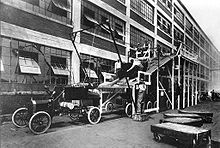
Model-T Assembly Line
At the end of the 19th Century, a laughably obscure technology began its unstoppable derailment of railroad passenger travel.  I refer, of course, to the automobile. From the very beginning, people loved the idea of being able to decide where and when to travel. Roads of the day weren't great, but people started to lobby for better roads. When Henry Ford's assembly line made the Model T affordable to almost every middle-class family, the automobile exploded onto the roadways.  For trips under a hundred miles, people would drive rather than take the train. They could leave on their own schedule and get to any town served by a road - even a bad road.  The family didn't have to have invest in a massive corporation to be able to drive. The large corporations like Ford Motor Company put the individual in charge of their own transportation.  It took decades, but gradually the railroads stopped running passenger trains and the country is now laced with interstate highways that carry the bulk of ground travel.  In the end, the individual would rather have control than give it to a large corporation. Small can be beautiful,

A second example is the main frame computer. When computing  came of age after World War II, it was the large companies like IBM that controlled the industry.  Once again, development was helped by government support - mostly from the Defense Department. Users were allowed limited access to these huge computing machines, mostly through leases to other corporations and universities.  The large capital required to build and operate these machines called for huge corporate investments and specialized technical people to operate the machines.

Then in the early 1980s, the personal computer became available from both Apple and IBM (and a host of smaller players). Computing was now available directly to the individual without an intermediary. People loved it. PCs were found in more and more homes and businesses. The individual became empowered and took control of computing virtually overnight. It didn't take the decades it took to move from the railroads to the automobile. Within a decade, PCs were ubiquitous. And those PCs when hooked to the emerging network called the internet gave people even more individual freedom to communicate and create thousands of new uses for the personal computer. Today, personal computers are in your pocket, in your smart phones, and tablets are becoming the new laptops. Given a choice, people will always opt for more control of their technology.

With these examples in mind, I started to muse about what the next big waves of personal control might be?  The starting point is to look for high capital intensity today. What demands a large corporation to provide the capital to make the technology possible?  I think it would be fair to eliminate those corporations that supply network services like power and oil companies. But even as I write this I think of Skype which has done a lot to eat into the phone companies' business. Maybe the two areas that might come to pass next are manufacturing and health care.

Right now, if you want a new widget, you have to look for someone who makes it and offers it for sale. But 3-D printing is changing the paradigm. Now, you can design or scan an object and send it directly to a 3-D printer that can pop a widget out in nothing flat. The technology is still early and you won't find a 3-D printer in your neighbor's house but give it a decade or two and see where we are. I predict that  manufacturing is going to undergo a sea change - and that sea change which will put more power into the hands of the individual.


The second area that comes to mind is health care. Right now, hospitals and clinics are capital intensive. Most people have to go to a physical facility to talk to a nurse or doctor. Medical records are closed for both privacy and competitive reasons. I think the forces of personal computing and the internet are going to change the way a lot of health care is practiced.  Small sensors built into your smart phone or tablet will measure your physical status and convey it to a doctor who will make electronic "house calls" to you via video links. For most minor situations, you will no longer have to go to the clinic or hospital to be seen.  Even for major procedures like surgery, you will be able to choose an expert who might live half-way around the world to do your procedure via robotic surgery.  Health care is ripe for change due to its taxing infrastructure and exploding costs.

People want control of their lives and technologies. New technologies that give them the sense of control at affordable costs will be rapidly embraced.  The world awaits the next waves of change. Small can be beautiful.

Tuesday, December 13, 2011

Automata


Have you seen the new Martin Scorsese movie, Hugo? I highly recommend it for multiple reasons - a great story, a love of silent films, wonderful cinematography (in 3D, no less), and the recreation of an automaton. The film is based loosely in real people and events. Georges Melies. the first creator of silent fictional films, is one of the central characters of the film - wonderfully portrayed by Ben Kingsley. The film is set in Paris's Montparnasse train station some time after the end of World War I. Melies is selling toys in a tiny stall in the train station where he meets the film's protagonist, Hugo.

Jacques de Vaucanson
Automata are what today we would call robots. They were an attempt by their builders to render a life-like creature from machine parts. The history of automata goes back millenia. Even Leonardo da Vinci drew designs for automata and built at least one in the shape of a lion. Various builders followed with increasingly sophisticated automata. One of the earliest masters was Jacques de Vaucanson who exhibited in 1738 the mechanical figure of a flute player which could actually play this difficult instrument through subtle recreations of the lips, palate, and facial muscles (not to mention the fingering of the keys). This automaton was a smash hit and other builders followed with their own mechanical recreations of life.  Much later, as we shall see, Georges Melies became fascinated with automata.

Georges Melies
Georges Melies was born in France in 1884 and trained to become a shoe maker, like his father. But while training in London, he became enthralled by the magic he saw performed in the Egyptian Hall.  When he returned to France he worked in his father's business until his father died. At that point, he sold his share of the business to his two brothers and used the money to buy the dilapidated Parisian theater of magician, Jean-Eugene Robert-Houdin (from whom Houdini took his stage name).

Robert-Houdin started life apprenticing as a watchmaker but was always fascinated by magic. While working in the Loire valley, he became seriously ill and was nursed back to life by a magician named Torrini. Torrini, it turns out, had several automata that he used in his magic shows. The automata were badly in need of repairs and Robert-Houdin used his mechanical skills to bring them back to working condition. He also immediately saw the link between magic and the seemingly life-like power of these mechanical androids.

Robert-Houdin
Robert-Houdin went back to Paris and began his work building clocks, astronomical instruments, and automata.  In 1844, he won a medal at the Paris Exposition for his writing automaton.  Robert-Houdin now started to devote all his energy to automata. His 1844 model was enhanced to where it could perfectly recreate Robert-Houdin's signature. Ironically, P.T. Barnum bought the automaton while on a tour of Europe with Tom Thumb. The automaton was exhibited in England and then sent back to America where it was displayed in Barnum's museum of oddities. It was eventually destroyed in a museum fire.

Robert-Houdin had opened a magic theater in Paris during this time period. He died in 1871 and his sons managed his theater for 17 years until one of the son's widows sold it to George Melies.  The theater came with all of the props including Robert-Houdin's remaining automata.  Melies immediately repaired the theater and the automata.  The movie would have us think that the writing automaton was still in Paris but this was not the case as mentioned before.

Soon after, Melies became fascinated with photography and moving pictures when he saw the early work of the Lumieres brothers.  He tried to buy one of their cameras and when they turned him down, he went on to build his own. Melies started making his own films and by 1897, the magic theater was mostly a movie theater. Below is his 1902 classic, A Trip to the Moon.


In the film, Hugo, the boy, must repair the writing automaton to try to retrieve a message he felt that his dead father had left encrypted in the automaton. When he finally did get the machine repaired, it drew pictures which lead Hugo to the secret past of Georges Melies, who had long ago  fallen out of favor as a film maker and was now a toy seller in the train station (Melies did, indeed, fall out of favor as a film maker and ended his working years selling toys from a tiny stall in Montparnasse Station).

In the film, the automaton is meant to cast a mysterious grip on us. But that's nothing new. Automata have always delighted and confounded people with a mechanical imitation of life.  We still find robots fascinating. The word "robot", by the way, comes from a 1921 play by Karel Capek entitled, Rossum's Universal Robots.  Today, robots are literally part of our everyday life - whether it is the GPS navigation system in our car or the Scooba that scrubs our floors. But we still want to instill life and personality into these machines (Disclosure: we have named our GPS systems in our cars Jeeves and Prudence and talk to them regularly).  Robots populate our films and stories (who can forget HAL in 2001?). Robots might seem like our future.

Maybe someday these machines will become so sophisticated we might not be able to tell them apart from human beings. Personally, I doubt that it will happen. Even if we could create such creatures, our sensibilities would demand some form of visual recognition that tells us that this creature is not human. We are fascinated by machine life but we are very wary of losing the boundaries of our own humanity.  Robots will become ubiquitous but not invisible.  The line between man and machine is not easily transgressed.

[For a much more in depth treatment of automata, mechanical life, and Georges Melies,  I would recommend Gaby Woods 2002 book entitled (in the U.S.), Edison's Eve, and in Britain, Living Dolls.}

Saturday, November 26, 2011

Curiosity

Artist's Rendition of Curiosity on Mars
This morning, we witnessed the launch of the latest Mars roving explorer, aptly named, Curiosity. What a wonderful moniker for a machine that will, hopefully, spend the next few years exploring the surface of Mars and sending back gigabits of new types data to the anxiously awaiting scientists here on Earth.

Curiosity is something that you don't hear much about these days but it is very clear that curiosity has been one of main drivers of our technological advances for millenia.  Certainly, a lot of technology developed less from curiosity and more from simply trying to fill a need.  But with all the potential solutions that people tried, there had to be a lot of, "I wonder what will happen if...".

Boulton and Watt Steam Engine
You might argue that curiosity is more a driver of science than technology. Science is almost entirely based on the desire to learn and understand - not a bad definition of curiosity itself. As technology developed, it often preceded the science of understanding how the physical world worked. Steam engines, for example, developed before the thermodynamics of steam were understood. Once the science caught up to the technology, major advances and refinements became possible.  James Watt had the benefit of 50 years of scientific investigation of steam before he made his much-heralded advances in the improvement of Thomas Newcomen's original steam engine design.

It seems to me we live in an age of curiosity but most people experience it in ways that aren't so much related to science and technology. We are social creatures and seem to be endlessly fascinated with what other people are doing.  We try to keep up with them through any number of social networking websites. We are curious about the rich and famous and scan the gossip magazines and newspaper columns for juicy tidbits.  We check our smartphones to find out the latest football score or read our email. As humans, we cannot help but be curious.

As you can tell, I am all for curiosity.  We need to follow our desire to know more than we do.  But what we seek out is at least as important as the desire to seek in the first place.  We might need to lift our sights a bit and seek to know something more interesting than what's the latest on Lady Gaga. We might want to spend just a little time learning more about what is going on in our world. What's behind Occupy Wall Street? What's happening in Egypt? What's happening in electric vehicle design, or climate change, or even green energy initiatives?  Most of what I see going on in social networking is like a candy bar - a quick energy boost but no substance.

Personal Disclaimer: I also spend a fair amount of time each day on Twitter and somewhat less time on Facebook. What I follow on Twitter are posts that relate mostly to news, technology, science, and culture. Why? Because I find them interesting. There is so much that is being put out there each day that it is nearly impossible to keep up with it. I try to screen the Tweets that relate to technology and technology history and put them up on my own Twitter Stream - TechAlmanac1.  As I screen this torrent of information, I learn a lot that I otherwise would be unaware of. 

I am not advocating for Twitter or any other particular  web tool. I am not even advocating for the internet. Curiosity can be pursued anywhere.  Curiosity is like a muscle - use it or lose it. The more you open yourself to wondering about something, the more you find the world an interesting place.

We need more well-directed curiosity.  The great thing about curiosity is that it requires no particular preexisting expertise.  It only requires a desire to learn something new.  I believe that if we are not learning something new our minds are stagnating and even going backwards. Let's hear it, then,  for Curiosity.

p.s. Stay tuned over the coming months to Curiosity, the Mars Rover. Its landing on Mars eight months from now will be one of the most technically challenging landings ever attempted by a space craft. JPL has put together a really good animation of how they plan to get Curiosity on the surface.


Sunday, November 13, 2011

The Art of the 20th Century Limited

Having just written in my previous blog post about the 20th Century Limited, the premier passenger train run by the New York Central Railroad, I thought I might share a couple of iconic poster images of this train made by the well-known graphic artist, Leslie Ragan. Ragan was born in Woodbine, Iowa in 1897 and trained at the Art Institute of Chicago. He taught there for awhile and later moved on to New York and then Europe. During the 30s and 40s, Ragan did quite a bit of commercial illustration for the NYC RR. But Ragan's poster images of the streamlined Hudson locomotive - with industrial design by Henry Dreyfuss - stand as icons of what we today call the Machine Age. These images seem to exude the power of the mighty locomotive at its pinnacle of success.

Poster from 1938
Poster from 1946
Railroad posters fell out of favor after WWII. The automobile took over the medium and  long-distance travel that use to be the domain of the railroads. The advent of the interstate highway system in the 50s was the final nail in the passenger train coffin.  But the images live on and give us a sense of what once was - or more accurately - what we like to think once was.

Saturday, November 12, 2011

High Speed Rail Redux

I frequently see articles in various news sources about the controversies of building high-speed rail in this country. The proponents argue that, rather than getting on an airplane, the lines will provide much easier and more pleasant ways to travel between distant cities. High-speed rail will rejuvenate outlying areas along the route that will see a new wave of investment in housing and business. Critics argue that high-speed rail will never pay for itself. People much prefer to drive or fly. If too many stops are planned along the route, the line will no longer be high-speed.  And because passenger rail is now run by Amtrak, a government-owned corporation, high-speed rail will turn into a taxpayer boondoggle.

It's worth remembering that long before the current debate, the U.S. had many "high-speed" passenger lines run by private railroad companies. These lines were profitable even as automobiles became the preferred mode of local transportation.

Perhaps one of the most famous of these early high-speed trains was the 20th Century Limited, operated by the New York Central Railroad between New York City and Chicago.  The service was inaugurated in 1902 and ran for 65 years, finally being discontinued in 1967.

In the early days of the 20th Century Limited, it took 20 hours to make the overnight run. By the 1930s, the time had been reduced to 16 hours. The train left New York City at 6:00PM Eastern time and arrived in Chicago at 9:00 AM Central time the next morning. The train consisted of Pullman sleeping cars, a dining car, a postal car, and a baggage-club car - usually nine or ten cars per train. Passengers entered and left the cars over specially-designed red carpets, giving rise to the expression "the Red Carpet treatment". Men were given carnation boutonniers and the women perfume when they boarded. Everything was meant to convey taste, efficiency, and good service.

NYC RR J3-a Hudson by Henry Dreyfuss
The trains became decidedly more beautiful in 1938 with the advent of the streamlined trains of industrial designer, Henry Dreyfuss. The powerful Hudson-class locomotives oozed an impression of power and speed, even when standing still. Compared to the brick-like design of today's Amtrak engines, the Dreyfuss-designed trains made people feel they were partaking in something special.

The 20th Century Limited, like the European Orient Express, became an iconic image for American culture and was used as a backdrop in many films including Hitchcock's North by Northwest. Hard to imagine a similar movie on the Acela.  The 20th Century Limited was only one of dozens of "named trains" that crisscrossed the country in the middle of the last century. The ghosts of some of those trains now reside in the few long-distance Amtrak trains that make their way (usually slowly due to outdated trackage and equipment) between distant cities .

I, for one, would like to see high-speed rail brought back into wide usage in this country. While some argue that it is a waste of resources, the future belongs to fast, efficient transportation with a low-carbon footprint. Most of the rest of the industrialized world gets it - the last century's transportation options will not be adequate for the coming century. A little classy design by a modern-day Dreyfuss would also be much appreciated.  Oh yes, and bring back the Red Carpet.

Saturday, October 22, 2011

USS North Carolina(s)

Military technology has an amazingly short life for the amount invested to develop it. I was reminded of this fact when a couple of days ago, some friends and my wife and I visited Wilmington, NC for a quick getaway. We poked around the historic Old Town on the Cape Fear River. My friend and I decided to tour the USS North Carolina, the World War II battleship which is now a National Historic Landmark and floating museum.

We started our tour in the informative shore-side museum. I was surprised to learn that there had not been one USS North Carolina but four ships bearing that name. There was also one CSS North Carolina to add to the complement. These ships span the eras of naval technology as a startling-clear indication of just how quickly naval technology has changed.

Model in Museum
The first USS North Carolina was a sailing frigate commissioned for duty in 1824. The ship usually carried 74 cannons but was designed to handle as many as 102 guns. She (ships are always referred to in the feminine) was considered the most powerful naval vessel afloat at the time of her commissioning.  The ship spent most of the middle 1820s in the Mediterranean, showing the U.S. colors to demonstrate the strength of the country and to open trade with the region. She also spent time in the Pacific in the late 1830s defending American trade routes. By 1839, she was taken off the line and converted to more mundane duties as a receiving ship to house young naval recruits. Her time of active duty amounted to only 15 years. The reason she was considered to be obsolete was that she was too large and bulky for the nimble duty needed in naval maneuvers of the day.

The next North Carolina was a Confederate ironclad of the Civil War era. Already, fighting ships were converting from sail to steam and armor plating was the newest technology, even as cannons to pierce such armor grew ever larger. The CSS North Carolina was built in Wilmington, NC in 1863 but the new marine engineering of ironclad ships was not the long suit of the local builders. The ship was unstable and the hull was riddled by sea-worms within a year.  It sank in the Cape Fear River leaving an inauspicious record but it did demonstrate that the era of the sailing ship had passed and steel armor and steam were the technology of the future.

In 1905, the keel was laid on the next USS North Carolina, a cruiser of the era of the Great White Fleet. The ship was enormous by previous standards. It was over 500 feet in length and displaced 14,500 tons.  The cruiser carried a powerful array of cannons with the largest being 10-inch bore main guns. The cruiser (also known as ACR-12) saw combat service in World War I escorting convoys of ships across the North Atlantic. From the time she was commissioned to decommissioning amounted to 13 years.

Model of Bridge and 10-inch guns of ACR-12 in Museum

By far the largest of the ships bearing the name USS North Carolina was the battleship BB-55. This was the ship we were about to tour. The BB-55 was commissioned in 1940, just before the beginning of America's involvement in World War II. The new North Carolina was 728 feet long and displaced over 40,000 tons - three times what her predecessor had displaced. The battleship was on sea trials in the Caribbean when Pearl Harbor was attacked on Dec. 7, 1941. She spent the first part of 1942 hunting for the German battleship Tirpitz before being deployed to the Pacific Theater in the middle of that year. For the rest of the war the ship was engaged in protecting aircraft carriers in virtually every campaign across the Pacific islands. She was torpedoed once and left with an enormous hole in her bow but it was not enough to sink her. When the war ended in August of 1945, she sailed back to Boston and was decommissioned in 1947 - a service life of six years and eight months. Her undoing? Aircraft. The modern aircraft found on ever-larger aircraft carriers were easily capable of destroying even a hardened battleship.

The Navy kept four of the World War II-era battleships in the reserve fleet for years and the USS Missouri actually participated in the shelling of Baghdad during the Iraq War. But the North Carolina's days of service were over. She stayed in mothballs for 14 years and was going to be sold for scrap when the enterprising citizens of Wilmington and North Carolina decided to try to save her as a memorial and museum. She was moved to her present berth in Wilmington in 1961 and opened as a museum.

But this was not the end of the ships named USS North Carolina. The latest in the long line of ships is the most advanced class of atomic submarines. The new sub, which is configured to be able to deliver not only missiles and torpedos, but complete Navy Seal teams to trouble spots, was commissioned in 2008. She is now stationed at Pearl Harbor.


___________________________________________________________________

Side View Looking Towards bow

It was a beautiful fall morning with crisp, cool air as we strolled the teak decks of this state-of-the-art (for 1936) battleship. Even today, some 75 years later, she is still impressive.

Aft 16-inch Gun Turret

The massive 16-inch guns, three mounted in each of the turrets, one aft and two forward are the heart of the battleship's armament. We scrambled inside the aft turret and I was astounded to see the amount of hardware and control systems needed to make these guns work.

Inside Aft 16-inch Gun Turret

What we saw in the turret was only part of a huge support system that went down five decks from the main deck. These 16-inch guns could propel a 1200 pound shell out of the barrel at over 1500 mph, with a range of 20 to 25 miles!

Diagram showing multiple levels in gun turrets


The tour below decks was visiting a city - bakery, laundry, doctor, dentist, operating rooms, soda fountains, sleeping quarters, shoe repair - it was all there to maintain the crew of 2400 sailors.

GE Turbine powering one of four propellors

The ship was propelled by four main steam turbines that each powered a propellor, moving the ship forward at almost 30 mph. In places, the ship's armor was 16-inch thick steel plate. In fact, about 40 percent of the total weight of the ship was accounted for in the armor alone.

If you are ever near one of these large World War II battleships, I would certainly encourage you to go. While the BB-55 remains, Her sister ship, the USS Washington, was scrapped. A very similar class of battleships (known as the Iowa class) has several ships still in existence.  The USS New Jersey is berthed in Camden, NJ. The USS Missouri is part of the Pearl Harbor Memorial in Hawaii and the USS Wisconsin is now a museum in Norfolk, VA.
______________________________________________________________________

Each generation of vessel carrying the name of USS North Carolina was an example of state-of-the-art naval technology in its day. None of these vessels remained at the cutting edge for even a decade. The enormous investments in design and development for most weapons systems has a very short half-life.  It would be pleasant to think that a day might arrive when such investments are no longer necessary. Until then, the ever-evolving technology of war will be part of the price of peace.

I wonder what the next ship that carries the name USS North Carolina will look like? Given the brief lives of these vessels, we might not have to wait that long to find out.

Monday, October 10, 2011

What Does Technology Want?

I just finished reading Kevin Kelly's book from last year entitled, What Technology Wants. When I first heard about this book when it was published it sounded a little too woo-woo for me. Technology wants something? Isn't technology simply a manifestation of our own ideas and creations? When I found a used copy of the book, I decided to check out what Kelly was trying to say.  After finishing the book, I would have to say that I pretty much agree with his premise.

So what is Kelly's thesis?  He basically believes (and provides many supporting pieces of data) that the universe is not only governed by entropy (the thermodynamic force leading to increasing disorder) but by a force he dubs "exotropy"- a tendency for the universe to become more ordered with an ever-increasing energy density associated with each layer of order. Since the Big Bang, particles have self-assembled into atoms which have self-assembled into molecules which have lead to solar systems, planets, water, and the building blocks of life. The self-assembly goes on with the evolution of simple cells, multi-cellular organisms, animals and plants, and finally primates and humans. All of this has been well-documented in the scientific literature.

According to Kelly, the next level of exotropy is the human creation of technology - simple at first (think fire and stone axes), but becoming increasingly complex as different technologies are combined and recombined into evermore complex technologies. The highest energy density in the universe can now be quantified as being, not in the core of the sun or a star, but in a Pentium computer chip.  The sum of all this technology is what Kelly dubs the "technium" - a complex web of everything that humans have created.  All the technology that exists can now be recombined at an ever-increasing rate to lead to new capabilities. This is the basis for Moore's Law and a host of other trends that can be shown to be increasing at an exponential rate.

While not truly thinking or sentient (yet), Kelly argues that technology now is on a path that is moving beyond the control of its creators.  Think about the internet. We would have a hard time drawing an exact map of every server and page on the internet because it is constantly changing. The changes are not organized from one central planning organization. They happen because of the spontaneous activity of millions of people. And yet the system works beautifully, rarely failing us and never going completely dark. The internet is not sentient but there is the sense that it is more than the sum of its human-created parts.

Kelly argues that technology wants what life itself wants:


  • Increasing efficiency
  • Increasing opportunity
  • Increasing emergence
  • Increasing complexity
  • Increasing diversity
  • Increasing specialization
  • Increasing ubiquity
  • Increasing freedom
  • Increasing mutualism
  • Increasing beauty
  • Increasing sentience
  • Increasing structure
  • Increasing evolvability
He goes into detail in his final chapter of what each of these mean in more specific terms.

Kelly is not a wholehearted devotee of technology. He sees the dark side of technology as well. In a chapter entitled, The Unabomber Was Right, Kelly writes:

I, too, argue that the technium is guided by "technical necessity." That is, baked into the nature of this vast complex of technological systems are self-serving aspects - technologies that enable more technology, and systems that preserve themselves - as well as inherent biases that lead the technium in certain directions, outside human desire. [Ted] Kaczynski [the Unabomber] writes, "Modern technology is a unified system in which all parts are dependent on one another. You can't get rid of the 'bad' parts of technology and retain only the 'good' parts."

Kelly sees technology and the technium as being, on balance, a little more slanted to good than evil. If it weren't that way, that particular technology would eventually die out. Nonetheless, both sides are always with us. The internet brings great connectivity but also a loss of privacy. Fossil fuels have powered the technium for over a century but they bring on climate change.

One particularly interesting chapter entitled, Lessons of Amish Hackers, delves into a society that actively rejects some technology and yet embraces other technologies readily. The fundamental reason for the rejection of, say, electricity to the home is that it connects the Amish to the grid which invariably leads them to being drawn into a tainted society. Yet, the Amish have no problem with putting a diesel generator behind their barn which run an air compressor which pipes compressed air into the house to run everything from the washing machine to a food blender. The difference?  They are off the grid. Kelly argues that their basic ability to make such choices is facilitated by the very technology they reject. Without machined parts and transportation systems, they couldn't live their lives in the way they choose. Kelly is not against the Amish. In fact, he finds their lifestyle to be attractive on many levels. But he argues that one of the prime reasons to embrace technology is that it expands individuals' choices for the pursuit of their own fulfillment. The Amish limit schooling to the 8th grade level. There are no Amish doctors or lawyers. Their lifestyle limits their choices.

In the final analysis. Kelly believes that the trajectory the technium is on is the right one, or maybe more accurately, the only one in could be on. But he also observes that we are moving into an era when technology will start to become decoupled from human control and this is a totally new era for humanity. Where it will all lead is anybody's guess. What Technology Wants is a thought-provoking book that should be on the reading list of anyone who is interested in the broader questions of where we are going.

Saturday, October 8, 2011

In Defense of Steve Jobs

It seems that everyone with any sort of digital soapbox has felt the need to write about Steve Jobs.  I was particularly interested to read a couple of articles that tried to either make or dispel the idea that his impact on society equalled that of Thomas Edison or Henry Ford.

I think Walter Mossberg of the Wall Street Journal might have started the comparison in a very personal article he wrote about the thoughtful and personal side of Steve Jobs.  Rick Newman at US News and World Report picked up on the theme but threw mostly cold water on the comparison of Jobs to either Edison or Ford. Even the Christian Science Monitor got into the act with a followup article to Newman's.  At this particular moment in time, the loss of a leader in any field is felt acutely and the loss of someone with as many proven leadership skills as Steve Jobs is perhaps all the more strongly felt amongst the rest of us.

Of course, only history will be able to sort out the contributions of Mr. Jobs. But it seems safe to at least question some of the aspersions that Rick Newman made in his piece. Mr. Newman writes of Edison:

By the late 1800s, Thomas Edison developed an electric-lighting system that literally turned darkness to light and ushered in sweeping second- and third-order changes, from the improvement of working conditions in factories everywhere to safer homes no longer lit by candles.

Thomas Edison was a persistent, egocentric, dynamic leader of highly skilled technologists whom he employed to help create his vision for new products. (Sounds kind of like Steve Jobs to me.)  He never pursued anything without thinking about its likely commercial impact. He was a master of managing his image in the media. His work on the incandescent light was innovative not because he found a filament that could endure long durations of being heated, but because he envisioned that to make lighting successful he would have to build the whole system. This included the dynamos, the distribution wiring, the switching, and the end appliance - the electric light. That he pulled it off was a testament to his determination and persistence in the face of many, many hurdles.

Having said that, Edison didn't get it right when it came to extending his vision. He defended his direct current (DC) approach in the face of Tesla's clearly better alternative of alternating current (AC). AC power could be distributed without losses over much greater distances than could DC power. Edison even went so far as to mount a public relations campaign against AC power as being much more dangerous than DC. To prove his point, he was instrumental in the development of the electric chair for executing criminals. In the end, it took another generation of innovators beyond Edison and Tesla to make commercial lighting a reality for most people. Samuel Insull, who made commercial electricity a reality in Chicago, was the first of many of these innovators who built large electric distribution systems to bring power to the people.

Edison didn't get candles out of the home. Most people in the late 19th century were lighting there homes with either piped in gas or with kerosene. Factories were often lit by simply more windows or if night work was required, lighting was provided by arc lamps which predated Edison's invention of the lightbulb.

So who gets the credit?  Edison for the first embodiment of an electric lighting system or Tesla or Insull?  The answer is, of course, all of them, not just Edison alone.  If Edison hadn't developed his system, someone else would have done it within the next five to ten years. It was the focus of too many innovators who wanted to be first to show the new power of electricity.

Henry Ford is a different case but he also shares many similarities to Steve Jobs. Ford was neither a particularly talented machinist or even all that literate. What he did have in spades was the ability to envision a new type of automobile and the charisma and passion which attracted really good engineers to work with him to make it a reality. His first focus was not on a car for the masses but on racing cars (which were the earliest means of demonstrating automotive technology and reliability). He was a partial-founder of two automobile companies that failed to achieve his vision. It was only when he decided to be the founder of his own company - where he controlled the vision - that he began to succeed.

His first cars were not particularly different from scores of other startup auto companies. Everyone was selling to a customer who had the means to spend several thousand dollars on a car. Ford's genius was to see that if the cost of the car could be reduced dramatically, a mass market could emerge for the automobile for the first time. Ford not only hired great engineers, he hired a great business manager, James Cousins, to manage the finances of his company. Ford didn't invent the assembly line. That idea emerged from his engineers touring the disassembly lines of the Chicago meat packing plants. Ford provided the single-minded focus to pursue the dream of a mass market car when everyone else told him he was crazy. The result was the introduction of the Model T in 1908 (This was not his first model. There had already been Models A through S before the T came along).

Ford was a true innovator. He was the first to recognize the value of vertical integration in the automotive industry - owning everything from the iron mines to the steel mills to the final assembly plants in the giant River Rouge complex. Ford pioneered the five dollar day for his workers - not just to have them earn enough money to be able to afford a Model T but to get them to not quit (employee turnover on those first assembly lines was in the hundreds of percents).  Ford's vision proved to be correct and his company dominated the industry. But unlike Steve Jobs, Henry Ford did not die young. He lived long enough to have his initial vision become an impediment to Ford Motor Company's future. He would not give up on the Model T even when it was outdated and sales were plummeting. He micromanaged his son, Edsel's, period of running the company after Henry ostensibly retired. It would take Ford's grandson, Henry II, to put the company back on track.

So the traits that seem to recur in these three men of different eras and different industries are incredible vision, an awe-inspiring sense of determination, dictatorial decision-making, charisma, passion, and an ability to hire the best and the brightest and give them the environment to create. Each had the ability to see a future, not a future that others couldn't see, but a future which was holistic - one that went further than just one product to see what was needed to make it valuable to millions of people.

So in defense of Steve Jobs, I think he will, indeed, go down in history as being in the same league as Thomas Edison, Henry Ford, and a host of other visionaries who have helped to create the world we live in.  His legacy will be felt for generations in the digital devices that are the offspring of the iPods, iPhones, and iPads.  His legacy will be felt in the digital animation studios that come after Pixar.  His sense of what the market needed was truly remarkable. But even more remarkable was his willingness to bet the company on his vision - not once but over and over again.   Steve Jobs was the quintessential American Innovator.  Even though I never met the man, I will miss him.

(Disclaimer: I have been a longtime user of Apple products. I am typing this on my iMac desktop computer.)