Showing posts with label railroad. Show all posts

Tuesday, January 21, 2020

The Fillmore Funeral Train That Wasn't


Fillmore Funeral Locomotive
Created in Affinity Designer by the Author

The locomotive in the 1874 image was resplendent with polished brass and ornate decorations. A portrait of Millard Fillmore, the late president who had just died in March of that year, graced the side of the engine. A star-studded crest of American flags overlaid by the American eagle graced the tender. The side of the headlight was painted with a scene of Niagara Falls, a tribute to Fillmore’s upstate New York roots . Perhaps the only presidential funeral train with more patriotic decorations was that of Abraham Lincoln, nine years earlier. 

But unlike Lincoln’s train, Millard Fillmore’s funeral train never existed. Not only were the decorations on the side of the American Type 4-4-0 locomotive never installed, the locomotive itself was never built.  So why does this image exist? An art project I began awhile back provided the path that led me to unearth at least some of this strange story. 

Even as a kid, I had something of an artistic bent. I’d returned to dabbling in drawing and painting many times over the years - not that I ever stuck with it or got particularly good at it. Soon after personal computers were introduced, I was drawn to the graphics potential of these computers, but the programs that were available in those early days had very limited capability.  That has all changed. The power of reasonably priced graphics software has reached a level that people could only dream of a few years ago.  Recently, I bought a vector graphics software package called Affinity Designer for fifty dollars. Vector graphics software is based on nodes, lines and bezier curves and is infinitely scalable which means that the smallest detail and largest object can be rendered with equal clarity. 

Like all art techniques, graphics software requires practice and persistence to master the nuances of the tools. Much of this can be learned by trying to emulate or copy other work. Originality is not the objective, rather, command of the tools is the goal. Looking around the web, I saw that others had chosen images of cars, airplanes, or even cartoon characters as their models for replication. But I was looking for something different. I wasn’t sure what but it needed to have well-defined lines and not be too complicated. 

I thought of one of my favorite repositories for old images - the Library of Congress. Browsing through their Popular Graphics Arts collection, I found a lithograph dated  from 1874 titled simply, Railroad Engine. It looked like it might just do the trick. It appeared to consist of just a few circles, rectangles and other basic shapes. How long could it take to replicate it? 

Railroad Locomotive Lithograph, 1874, Library of Congress
I plunged into digitally tracing the drawing without giving the origin of the image much thought. I had seen other such prints of locomotives over the years. Engines of this era were often embellished with fancy ornamentation  and I assumed this was just another such locomotive from one of the many manufacturers of the day. The more I worked with the image, the more I began to appreciate the underlying design of this machine. Engineering has long practiced the maxim, “form follows function". But while this was evident in the locomotive design, the balanced proportions and the clean lines of many of the parts suggested a designer who cared for more than function alone. This was intended to be admired as a work of engineering art. 

 Being an amateur student of the history of technology, I knew a bit about old steam locomotives. But I certainly didn’t understand the details of how all the components contributed to the smooth operation of this machine. To do justice to this image, I wanted more information so I could represent the parts correctly.  When I am looking for information like this, one of my go-to places is Google Books. Google has scanned thousands of out-of-copyright books from academic libraries and placed them online with open access. Browsing under the topic of steam locomotive, I found the perfect guide, The Catechism of the Locomotive, by Matthias Nace Forney. https://en.wikipedia.org/wiki/Matthias_N._Forney.


First published in 1875, Forney’s illustrated six-hundred page book provides a complete guide to the design and operation of steam locomotives. His book contains almost 1,300 practical questions and answers for the novice locomotive designer or operator. The book was so well received, it continued to be published in revised editions for the next fifty years.

Detail from Catechism of the Locomotive

With the help of Forney’s book I made sense of the image I was tracing. I could see the details of the various parts and how they interconnected, what made it a functional machine. 

To trace all of the details in this image required a high resolution copy of the original lithograph. Fortunately, the Library of Congress has an online scan of the original print that is very high resolution. At 300 dots per inch, the image measures thirty-six inches long by twenty inches high. With such a high a resolution, I was able to trace every nut and bolt on the locomotive. No detail seemed to have been omitted. As my work continued, I became more curious about the origins of the image. 

As noted on the print, it was the designer, A.J. Johnson, not the lithography company who submitted the print to the Library of Congress.  A stamp in the lower left corner noted that the print had been received by the library in the same year it was created -1874.

W.J. Morgan Company was listed as the publisher of the lithograph. A little searching found that the lithography company was founded in Cleveland, Ohio shortly after the Civil War by two brothers: William J. and George W. Morgan. Their business focused mostly on broadsheets, pamphlets, and later, theatrical posters. They also produced fine lithographs for stock certificates and other needs. 

Bridge Lithograph by W.J. Morgan Co. 


Detail of Lithograph
But the lithograph of the locomotive had no visible commercial connection. It seemed not to be an advertisement for a manufacturer of locomotives. Why would the Morgan Company invest time and effort to produce this piece? Why would Johnson think it should be in the Library of Congress? The answer may be found by studying the details of the locomotive. 

Detail of Lithograph
The library record and the lithograph itself lists A.J. Johnson as the locomotive designer. A Google search of that period for the name found no one by that name who designed steam engines. I also searched online in old railroad magazines and books from the era but found no reference to A.J. Johnson. Who was he?

I began to wonder if perhaps the portrait on the side of the engine was that of President Andrew Johnson and the locomotive designer was a coded hint as to the name of the person in the portrait. President Andrew Johnson had no middle name and the builder was specifically listed as A.J. Johnson. Nor did the portrait look much like Andrew Johnson except perhaps in style of dress. I concluded that A.J. Johnson and Andrew Johnson were not the same man.

Andrew Johnson

Image on Side of Locomotive

I checked the U.S. Census records for Cleveland for 1870 and 1880 using the online databases at Ancestry.com. When I put in a rough guess of his age as 25, the search engine soon found an A.J. Johnson listed as living in Cleveland in 1870. The census listed him as being born in Ohio in 1848 and gave his occupation as being a  “Locomotive Builder”. I thought this might be my man.

In 1870, A.J. Johnson was a twenty-two year old living in a commercial hotel with a dozen other men with various occupations. No spouse was mentioned as living with him. The designation on the census of “locomotive builder” was most likely a bit of a personal exaggeration on A.J.’s part although I’m sure that is what he wanted to become. By the time of the 1880 census, AJ. Johnson was still living in a Cleveland boarding house but now he listed his occupation as “Riveter”. 

1870 Census Cleveland, OH


1880 Census Cleveland, OH

While A.J. (the name recorded on the census)  seems not to have had much of a career as a locomotive designer, he seems to have drawn at least one locomotive - the one in the lithograph. But this still didn’t answer how Johnson got connected to the W.J. Morgan Lithography Company. Did Johnson approach the Morgan Company to see if they would publish his design as a way to advertise his skills? Perhaps. Given his age and boarding house residence, it seems unlikely he would have had the cash to pay for such a printing project.

No, I think this lithograph emerged by serendipity. in 1874, W.J. Morgan Company was expanding into markets outside of Cleveland. They were developing a reputation for high quality lithographs. Eventually, they would claim to be one of the largest lithography companies in the United States. Morgan Company was looking for a way to place themselves before a broader audience - a national audience - and grow the business. 

With not much else to go on, I continued to search the web for any other information I could find about this particular locomotive image.  I got a hit at the Getty Images archive. The identical image was listed in their database but there it was identified as the Fillmore Funeral Train. Unlike the Library of Congress who had gotten the image directly from A.J. Johnson, Getty Images listed their source as a private collector of lithographic prints. The collector had entitled the print the "Fillmore Funeral Train". 

Millard Fillmore as Congressman
That sent me in search of information about our 13th president, Millard Fillmore. Fillmore died on March 8, 1874 in Buffalo, New York. Fillmore had lost a bid for re-election in 1856 and returned to his native Buffalo where he was a leading citizen of the city throughout the Civil War and post-war years. Could the portrait be that of Fillmore? Comparing an image of him taken by Matthew Brady in 1850 with the image on the side of the locomotive made me think that it was indeed Fillmore. But why would W.J. Morgan print an image of a locomotive with Fillmore on the side?

Image of Fillmore on Side of Locomotive
When Abraham Lincoln was assassinated in April of 1865, his funeral train made a long and circuitous journey from Washington, D.C., back to Springfield, Illinois where he was buried. One of the many stops along the route was Buffalo. Ironically, Fillmore was out of town at the time. Lincoln’s funeral train was met by tens of thousands of mourners at every stop on its journey to Illinois. The flag-draped train bearing Lincoln’s sarcophagus was emblematic of the fallen leader. His funeral train became synonymous with a proper funeral for a dead president. 

Of course, Fillmore had died in his home city of Buffalo and no funeral train was ever planned or used to carry his body to its final rest. But I would be willing to bet that either William or George at W.J. Morgan Company reasoned that if they created a lithograph of a steam engine with Millard Fillmore’s image and resplendent presidential trimmings, they could sell this image to the people of the country to mark the passing of another president. They just needed an image of a steam locomotive. While many manufacturers of steam locomotives might have been only too happy to provide an image for the project, Morgan Company must have reasoned that an unaffiliated design would be seen as less an endorsement of any one manufacturer. The company would surely not have wanted to create bad blood with potential future advertisers. 

Enter A.J. Johnson with his highly detailed drawing of a locomotive. The timing was right for a “collectible" tribute to Fillmore. Morgan Company only had to do have one of their artists embellish Johnson’s design with Fillmore and other Americana and they would have their image. 

And so was created a locomotive that never existed, decorated for a presidential funeral that never happened. But the image lives on and its elegant design is a clear testament to the design aesthetic of that era. 

Uncolored Tracing of Lithograph

Vector Graphics Colorization Detail in Affinity Designer

I began the project as a way to learn a new software tool. I hadn’t anticipated a detective story. Of course, I may be wrong about all this - but I think this contains much of what transpired in 1874. A.J. Johnson might never have built a locomotive but he has been immortalized as a locomotive designer by his image housed at the Library of Congress. 

Oh, and as for my software learning project, well, I would say it was a success. After tracing and shading hundreds of objects, I think I have it figured out. There’s just no substitute for practice.

Sunday, November 18, 2012

How To Build a Steam Locomotive

It seems that manufacturing and craftsmanship are reported in some quarters to be disappearing from the the scene. It is true that many manufacturing jobs have been automated.  But beyond automation, some crafts and some products seem to be just plain extinct. The steam locomotive falls into this category.  There are certainly a few old locomotives puffing around railroad museums and there are even a few Class A steam locomotives, like the Union Pacific's No. 844 , still operational enough to remind us of why past generations had a love affair with the steam locomotive.

But how do you build such a machine? Virtually every locomotive was a custom made machine.  It took many skilled engineers and craftsman to create the design and fabricate the components. Parts were made in foundries or forges from molten iron and steel. Holes and surfaces were shaped to exacting tolerances on vertical mills, shapers, and lathes. Assembly was done in giant erection shops with huge overhead cranes. It was an impressive operation.

I recently came across a film clip on YouTube that shows what went into building a steam locomotive in 1937. The setting is England but the operations were the same everywhere.  In the video, you can see a very interesting combination of controlled force and high craftsmanship. In every step you see skilled people working together to build a complex machine. I don't want to read too much into this but I would hazard a guess that they also felt considerable pride in their work.


But this is not the end of the story. In the early 2000s, a group of railroad buffs decided to build the first steam locomotive to be crafted in England in fifty years. The locomotive, a Peppercorn Class A1 (named for the designer), was rolled out of the Darlington Locomotive Works on August 1, 2008.


I find it encouraging that the skills needed to build this magnificent machine have not disappeared completely. I think the men who worked on Number 6207 seventy years earlier would have been pleased to see their work carried forward.

This is, after all, the very definition of craft - a skill learned through apprenticing to a master. When the chain is broken, that craft is in danger of disappearing. Sometimes, it can be resurrected by relearning the old ways. As an example, I think of another video I saw recently of a man in Wilmington, North Carolina who painstakingly relearned how to make tintype photographs.


Why resurrect old skills and crafts in the digital age? I think we need them to connect us to our heritage. We need to feel a part of a continuity of technology that spans more than our hyper-connected, online world.  While all things digital now dominate our consciousness, the undeniable presence of our physical technology provides an anchor to the real world. And, ironically, the descriptions for how to build a locomotive or create a tintype are most likely to be archived in digital formats somewhere on the World Wide Web. And so it goes.

Credits:

I found the video for A Study in Steel on The Old Motor.


Sunday, July 8, 2012

The Automatic (Rail) Road Machine

As I wrote in my last blog, machines that can lay an entire road in one operation are now a reality. I just came across a video of such a machine.

The video below shows a multi-part machine which lays high-speed railroad tracks. The video was shot in Europe but a similar machine is being used to lay tracks on the high-speed rail line between St. Louis and Chicago.  According to the source that I saw, these are the only two such machines that exist in the world. It's quite an operation. Give it a look:


[A "Hat's Off" to my sister-in-law, Peggy, for bringing this to my attention.]

Sunday, January 1, 2012

Amtrak Video

I took a video class this fall and I had to put together a little video on something that interested me. I made a (very) short little story about the Amtrak trains that run through the small North Carolina town I call home. Hope you like it.


Thursday, December 29, 2011

Small Can Be Beautiful

I realize that the title of this post is something of a rip on E.F. Schumacher's book, Small is Beautiful, but small is not always beautiful. Sometimes small just leads to being crushed.  I started thinking about this when I was listening to an interview on the Diane Rehm Show on NPR. She was talking to  Stanford historian, Richard White, about his book, Railroaded: The Transcontinental and the Making of Modern America.

In his book, White lays out the mostly-sordid business history of the building of both the Transcontinental Railroad and other major expansions of the railroads in the late 19th Century. Railroads were the first large corporations in America. It was not possible to build something as capital intensive as a railroad without major investment. It was also not possible to operate such a large enterprise without layers of management. The Transcontinental Railroad was built mostly through political favors, bribes, and kickbacks. There was no business reason at the time of the Civil War that could justify building a rail line through mostly unpopulated areas. But the railroad got built because there was money to be made in railroad construction costs, land grants, and subsidies.

My purpose here is not to revisit the seamy sides of the railroad business. What got me thinking was how the railroads were once the dominant transportation system in the United States - at least for passenger travel. The over-used term of the time was how railroads "collapsed time and space", and it was true. Travelers depended on the railroads to get where they wanted to go. And in the late 19th Century, you could get almost everywhere on a railroad. Of course, you had to travel on the railroad's timetable and if the town you wanted to get to wasn't on a rail line, you were on your own.

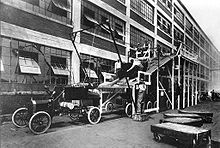
Model-T Assembly Line
At the end of the 19th Century, a laughably obscure technology began its unstoppable derailment of railroad passenger travel.  I refer, of course, to the automobile. From the very beginning, people loved the idea of being able to decide where and when to travel. Roads of the day weren't great, but people started to lobby for better roads. When Henry Ford's assembly line made the Model T affordable to almost every middle-class family, the automobile exploded onto the roadways.  For trips under a hundred miles, people would drive rather than take the train. They could leave on their own schedule and get to any town served by a road - even a bad road.  The family didn't have to have invest in a massive corporation to be able to drive. The large corporations like Ford Motor Company put the individual in charge of their own transportation.  It took decades, but gradually the railroads stopped running passenger trains and the country is now laced with interstate highways that carry the bulk of ground travel.  In the end, the individual would rather have control than give it to a large corporation. Small can be beautiful,

A second example is the main frame computer. When computing  came of age after World War II, it was the large companies like IBM that controlled the industry.  Once again, development was helped by government support - mostly from the Defense Department. Users were allowed limited access to these huge computing machines, mostly through leases to other corporations and universities.  The large capital required to build and operate these machines called for huge corporate investments and specialized technical people to operate the machines.

Then in the early 1980s, the personal computer became available from both Apple and IBM (and a host of smaller players). Computing was now available directly to the individual without an intermediary. People loved it. PCs were found in more and more homes and businesses. The individual became empowered and took control of computing virtually overnight. It didn't take the decades it took to move from the railroads to the automobile. Within a decade, PCs were ubiquitous. And those PCs when hooked to the emerging network called the internet gave people even more individual freedom to communicate and create thousands of new uses for the personal computer. Today, personal computers are in your pocket, in your smart phones, and tablets are becoming the new laptops. Given a choice, people will always opt for more control of their technology.

With these examples in mind, I started to muse about what the next big waves of personal control might be?  The starting point is to look for high capital intensity today. What demands a large corporation to provide the capital to make the technology possible?  I think it would be fair to eliminate those corporations that supply network services like power and oil companies. But even as I write this I think of Skype which has done a lot to eat into the phone companies' business. Maybe the two areas that might come to pass next are manufacturing and health care.

Right now, if you want a new widget, you have to look for someone who makes it and offers it for sale. But 3-D printing is changing the paradigm. Now, you can design or scan an object and send it directly to a 3-D printer that can pop a widget out in nothing flat. The technology is still early and you won't find a 3-D printer in your neighbor's house but give it a decade or two and see where we are. I predict that  manufacturing is going to undergo a sea change - and that sea change which will put more power into the hands of the individual.


The second area that comes to mind is health care. Right now, hospitals and clinics are capital intensive. Most people have to go to a physical facility to talk to a nurse or doctor. Medical records are closed for both privacy and competitive reasons. I think the forces of personal computing and the internet are going to change the way a lot of health care is practiced.  Small sensors built into your smart phone or tablet will measure your physical status and convey it to a doctor who will make electronic "house calls" to you via video links. For most minor situations, you will no longer have to go to the clinic or hospital to be seen.  Even for major procedures like surgery, you will be able to choose an expert who might live half-way around the world to do your procedure via robotic surgery.  Health care is ripe for change due to its taxing infrastructure and exploding costs.

People want control of their lives and technologies. New technologies that give them the sense of control at affordable costs will be rapidly embraced.  The world awaits the next waves of change. Small can be beautiful.

Sunday, November 13, 2011

The Art of the 20th Century Limited

Having just written in my previous blog post about the 20th Century Limited, the premier passenger train run by the New York Central Railroad, I thought I might share a couple of iconic poster images of this train made by the well-known graphic artist, Leslie Ragan. Ragan was born in Woodbine, Iowa in 1897 and trained at the Art Institute of Chicago. He taught there for awhile and later moved on to New York and then Europe. During the 30s and 40s, Ragan did quite a bit of commercial illustration for the NYC RR. But Ragan's poster images of the streamlined Hudson locomotive - with industrial design by Henry Dreyfuss - stand as icons of what we today call the Machine Age. These images seem to exude the power of the mighty locomotive at its pinnacle of success.

Poster from 1938
Poster from 1946
Railroad posters fell out of favor after WWII. The automobile took over the medium and  long-distance travel that use to be the domain of the railroads. The advent of the interstate highway system in the 50s was the final nail in the passenger train coffin.  But the images live on and give us a sense of what once was - or more accurately - what we like to think once was.

Saturday, November 12, 2011

High Speed Rail Redux

I frequently see articles in various news sources about the controversies of building high-speed rail in this country. The proponents argue that, rather than getting on an airplane, the lines will provide much easier and more pleasant ways to travel between distant cities. High-speed rail will rejuvenate outlying areas along the route that will see a new wave of investment in housing and business. Critics argue that high-speed rail will never pay for itself. People much prefer to drive or fly. If too many stops are planned along the route, the line will no longer be high-speed.  And because passenger rail is now run by Amtrak, a government-owned corporation, high-speed rail will turn into a taxpayer boondoggle.

It's worth remembering that long before the current debate, the U.S. had many "high-speed" passenger lines run by private railroad companies. These lines were profitable even as automobiles became the preferred mode of local transportation.

Perhaps one of the most famous of these early high-speed trains was the 20th Century Limited, operated by the New York Central Railroad between New York City and Chicago.  The service was inaugurated in 1902 and ran for 65 years, finally being discontinued in 1967.

In the early days of the 20th Century Limited, it took 20 hours to make the overnight run. By the 1930s, the time had been reduced to 16 hours. The train left New York City at 6:00PM Eastern time and arrived in Chicago at 9:00 AM Central time the next morning. The train consisted of Pullman sleeping cars, a dining car, a postal car, and a baggage-club car - usually nine or ten cars per train. Passengers entered and left the cars over specially-designed red carpets, giving rise to the expression "the Red Carpet treatment". Men were given carnation boutonniers and the women perfume when they boarded. Everything was meant to convey taste, efficiency, and good service.

NYC RR J3-a Hudson by Henry Dreyfuss
The trains became decidedly more beautiful in 1938 with the advent of the streamlined trains of industrial designer, Henry Dreyfuss. The powerful Hudson-class locomotives oozed an impression of power and speed, even when standing still. Compared to the brick-like design of today's Amtrak engines, the Dreyfuss-designed trains made people feel they were partaking in something special.

The 20th Century Limited, like the European Orient Express, became an iconic image for American culture and was used as a backdrop in many films including Hitchcock's North by Northwest. Hard to imagine a similar movie on the Acela.  The 20th Century Limited was only one of dozens of "named trains" that crisscrossed the country in the middle of the last century. The ghosts of some of those trains now reside in the few long-distance Amtrak trains that make their way (usually slowly due to outdated trackage and equipment) between distant cities .

I, for one, would like to see high-speed rail brought back into wide usage in this country. While some argue that it is a waste of resources, the future belongs to fast, efficient transportation with a low-carbon footprint. Most of the rest of the industrialized world gets it - the last century's transportation options will not be adequate for the coming century. A little classy design by a modern-day Dreyfuss would also be much appreciated.  Oh yes, and bring back the Red Carpet.

Tuesday, October 26, 2010

The Art of Technology

Technology always exists within the culture.  Technology also shapes the culture in ways both subtle and obvious.  But technology would have been one of the last subjects of interest to early 19th century American artists.  The Back Story of America was the opening of a virgin continent, the taming of the wilderness, and the westward expansion that was for some our Manifest Destiny.

The earliest landscape artists painted bucolic scenes of the Hudson River Valley - from which they drew their group identity, becoming known as the Hudson River School.  Technology in the landscape was hard to see even in the 1820s.  There might be a steamboat in the distance on the Hudson but most often painters such as Thomas Cole (1801 - 1848) painted their landscapes without machines.  But even Cole payed tribute to the settling of the land in his 1836 painting, The Oxbow (The Connecticut River near Northhampton).  Cole's painting is seen as one of the first clear visual statements of the difference between the settled land with well-tended farms (as seen on the right) and the yet unspoiled but ominous wilderness (on the left).

Thomas Cole, The Oxbow, 1836
Metropolitan Museum of Art, New York

Railroads came to America in 1829.  The railroad became the embodiment of technology change made visible, or to use Leo Marx's phrase, the railroad was "the machine in the garden."  Artists still didn't make technology a prominent feature in their paintings but it did start to have some presence, perhaps being represented by a distant steam locomotive seen in the far distance.  The landscape itself still dominated.  

As the 19th century progressed, the emerging place of technology became self-evident.  Artists began to be commissioned for paintings featuring technology as the main subject.  This was clearly the case with what has come to be seen today as the best example of 19th century technology art, "The Lackawanna Valley," by George Inness (1825 - 1894).

George Inness, The Lackawanna Valley, ca. 1855
National Gallery of Art, Washington, DC
This painting has an interesting history.  It was apparently commissioned by the directors of the Delaware, Lackawanna, and Western Railroad either for use in advertising or to decorate the walls of the company's offices. No one knows for sure. Inness was only about 30 years old when he painted it and was newly returned from an extended stay in Europe.  The scene depicted is of the Lackawanna's engine house (the round building in the center distance) in Scranton, PA. The picture is an idealized rendition of (what was in reality) a much flatter and uglier landscape as can seen in contemporary photographs of Scranton. But the picture places the train smack dab in the center and the engine house prominently in the distance.  Despite these placements, the landscape still speaks of tranquillity and the rural life.

Apparently, the railroad directors didn't much like the picture.  There is no mention of it in any surviving records and there are no engravings made from it for advertising.  When Inness had been in France, he had become enthralled with the Barbizon School of painting which was moving away from the older style of the Hudson River School. Inness was paid $75 to paint the work, money he desperately needed at this early stage in his career.  There isn't even agreement on the date of the painting or its original title.  It has become popularly known as The Lackawanna Valley but it was never named that by the artist.  It might have been painted in 1857, rather than 1855, because that was the year that the engine house was completed.  

Many decades latter, in 1891, George Inness was in a junk shop in Mexico City and he found his painting (which was quite large at 34 in by 50 in) piled in a corner.  The shop owner told Inness that he had acquired it in a load of old office furnishings.  Inness bought his old painting back for a few dollars, which is the only reason we have it at all.  The painting now hangs in the National Gallery in Washington, DC as one of the great masterpieces of 19th century American art. 

Technology both creates culture and is created by culture. From time-to-time, I hope to put some other artwork on the blog. It helps me, at least, to see the world as a whole.

Reference:

The Railroad in American Art, Representations of Technological Change, Edited by Susan Danly and Leo Marx, The MIT Press, 1988.


Wednesday, August 18, 2010

Heavy Machinery, An Occasional Series

Every now and then, I come across a photo I have taken that suggests a more artistic idea with a little help from Photoshop.  I took the photo at the left in Two Harbors, MN.  This is the Duluth, Missabe, and Iron Range Railroad locomotive No. 229.  The 2-8-8-4 , "Yellowstone" type engine was one of 18 built for the DM&IR by Baldwin Locomotive Works.  The engines were purchased to pull the very long and heavy iron ore trains from the Missable Range to the western ports of Lake Superior for shipment down lake.  They ran until around 1960 when they were replaced by diesels. Only three of the engines have been preserved, this one, a second at the Lake Superior Railroad Museum in Duluth, and the third in Proctor, MN.

The engine speaks of power.  I took a close-up of the running gear and valving which is the one I have converted into a more artistic image below.  These machines were never designed for beauty but I find there is some odd sort of aesthetic in the functional complexity of the design.  Every single part is there for a reason.  Nothing more, nothing less. I think an artist would relate to that definition. Hope you enjoy.