Showing posts with label computers. Show all posts

Friday, January 20, 2017

Technology and Democracy - 2016

A new president has been inaugurated. The 2016 presidential campaign showed us just how vulnerable our country is to the misuse of our now-ubiquitous internet and communications technologies. Consider some of the abuses we have seen: 

  • The Russian government hacked the Democratic National Committee servers.
  • They fed those documents to Wikileaks with the deliberate intent to undermine confidence in our electoral integrity and perhaps to help Donald Trump win.
  • Fake news stories circulated on Facebook and Twitter to misinform and incite higher levels of partisan anger.
  • Google search results were compromised by partisan groups to bring up negative stories first when searching for information. 
  • The media provided virtually nonstop coverage of Donald Trump and his campaign across both television and mobile platforms.
  • Twitter became Mr. Trump’s platform of choice to lead a cyber-bullying campaign against anyone who criticized him. And every Tweet became a news story.
  • Smartphone videos and photos provided instant “evidence” at campaign events and rallies supporting partisan views that were shared on social media platforms. 

We live in a world where the technology that was promoted to bring us together has instead driven us apart. Instead of connection we ended up with polarization. We live in our own social media worlds listening to those we agree with. We are beginning to doubt almost everything else we hear, see or read. We are living in a “post-fact” world.

The campaign we have just witnessed could not have happened even as recently as fifteen years ago. We simply did not have the connectivity and bandwidth that allowed this digital assault to be shared instantly. The iPhone is only ten years old. Same for Facebook, YouTube, and Twitter. The connecting of the cellular network, the internet, and smartphones was the link that permitted this political monster to be born. 

On May 24, 1844, the first message that was transmitted on the newly-invented telegraph was, “What hath God wrought?” We should be asking the same question now. We have created a superb, virtually real-time, global information network. It can be used for great good or it can do great harm. We have not lived with this technology long enough yet to know how to manage it or to manage ourselves when using it. The average time between checking our smartphones is now about six minutes. Ten times an hour we can get a jolt, a fix. When it comes to politics, it almost always zaps our nervous system. Like lab animals in some Skinner Box, we learn which buttons to push to get our hit.  It makes us a feel crazy and we pay the price through our inability to focus, sleep, or think clearly. 

In my view, smartphones are much more like television than they are like telephones. They are a screen that we seem powerless to ignore. We watch that small screen constantly, even while driving!  And all of these hundreds of millions of screens demand new content which Facebook, Twitter and hundreds of other social media sites are happy to provide. This can be problematic at any time but it becomes a real worry when it disrupts our political systems. Behind all this low-cost access and seemingly free content is money - eyeballs on advertising. While there is legitimate discussion regarding the corrupting influence of money in politics, no one talks much about the corrupting influence of the money being made off of political postings on social media platforms.


We have come to a juncture in our connected world. The questions we should be asking ourselves now are: how do we protect ourselves from the inherent vulnerabilities of this information network? How can we differentiate real news from fake news? How do we make our systems less vulnerable to being hacked? How do we reign in the urge to be isolate ourselves in our like-minded camps?  The challenges presented by our desire to be constantly connected will only grow. We can only hope to manage it better than we did in 2016.

Saturday, March 3, 2012

iPhone: Computer in My Pocket

Two weeks ago, I (finally) bought an iPhone 4S. I had been debating whether to buy one for a long time. For someone who writes a blog on technology, I felt almost as though I was some kind of anachronism. How could I not have a Smart Phone? Many of my friends have had one for years.  I was still on my plain-vanilla cellphone which, in addition to making calls could even send text messages using a little keyboard! Ooooh.

So why so long?  Well, I didn't want to be one of those people who whips their iPhone out walking down the street or while they are sitting in a darkened movie theater or while they are at the dinner table. I am all for connectivity but is it necessary to check your email or text messages every ten minutes?  The answer, I think, depends on your age. If you are a twenty-something, your life revolves around social networking. The expectation is that you are always online. Your friends want immediate responses. If you happen to be a little older, the fact that you can email someone when you get back to your home computer seems like connecting at light speed compared to growing up with snail mail. For the most part, my friends are not hanging out on line waiting for instant responses on where to meet up for tonight's social event.  Social networking with yourself isn't very much fun.

I have also learned that most of my email is, well... , boring. I have signed too many email political petitions and now my mailbox is filled mainly with the seemingly-urgent Rant-of-the-Day from one action group or another. I am suffering from Rant Fatigue and mostly hit the Delete button. Having removed the political email, I next winnow out the Groupons and Living Social coupons. Most days, I don't need a Brazilian or a facial so those go in the trash. What's left is an all too meager number of real emails. So, I didn't get an iPhone to check my emails and text messages.

Why did I get the iPhone? I wanted a mobile Information Appliance. I wanted to be able to look up locations on Google Maps. I wanted to find a good restaurant with Yelp. I wanted to know the answer to some question using Wikipedia. I wanted to check movie reviews on IMDB. I want to know if it's going to rain in the next 30 minutes. Could I have done without any of those functions? Sure. I have done without them so far. But the ability to have a computer in my pocket (for that is what a Smart Phone is) gives me an odd sense of freedom. I can navigate through my day a little better. I can find the answers to questions I will surely forget to look up by the time I get home (senior moments).  I feel...I admit it... hip.

I worried that I would become a slave to my new iPhone but, so far, I have surprised myself at how infrequently I check my emails (maybe for all the reasons I already mentioned).  My iPhone just nestles down in my pocket ready to give me answers when I ask. Oh, did I mention Siri?  This little artificial intelligence gnome is someone I want to get to know better.

Now, if you will excuse me, I need to check my iPhone. I want to know...

Thursday, December 29, 2011

Small Can Be Beautiful

I realize that the title of this post is something of a rip on E.F. Schumacher's book, Small is Beautiful, but small is not always beautiful. Sometimes small just leads to being crushed.  I started thinking about this when I was listening to an interview on the Diane Rehm Show on NPR. She was talking to  Stanford historian, Richard White, about his book, Railroaded: The Transcontinental and the Making of Modern America.

In his book, White lays out the mostly-sordid business history of the building of both the Transcontinental Railroad and other major expansions of the railroads in the late 19th Century. Railroads were the first large corporations in America. It was not possible to build something as capital intensive as a railroad without major investment. It was also not possible to operate such a large enterprise without layers of management. The Transcontinental Railroad was built mostly through political favors, bribes, and kickbacks. There was no business reason at the time of the Civil War that could justify building a rail line through mostly unpopulated areas. But the railroad got built because there was money to be made in railroad construction costs, land grants, and subsidies.

My purpose here is not to revisit the seamy sides of the railroad business. What got me thinking was how the railroads were once the dominant transportation system in the United States - at least for passenger travel. The over-used term of the time was how railroads "collapsed time and space", and it was true. Travelers depended on the railroads to get where they wanted to go. And in the late 19th Century, you could get almost everywhere on a railroad. Of course, you had to travel on the railroad's timetable and if the town you wanted to get to wasn't on a rail line, you were on your own.

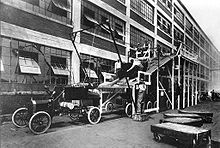
Model-T Assembly Line
At the end of the 19th Century, a laughably obscure technology began its unstoppable derailment of railroad passenger travel.  I refer, of course, to the automobile. From the very beginning, people loved the idea of being able to decide where and when to travel. Roads of the day weren't great, but people started to lobby for better roads. When Henry Ford's assembly line made the Model T affordable to almost every middle-class family, the automobile exploded onto the roadways.  For trips under a hundred miles, people would drive rather than take the train. They could leave on their own schedule and get to any town served by a road - even a bad road.  The family didn't have to have invest in a massive corporation to be able to drive. The large corporations like Ford Motor Company put the individual in charge of their own transportation.  It took decades, but gradually the railroads stopped running passenger trains and the country is now laced with interstate highways that carry the bulk of ground travel.  In the end, the individual would rather have control than give it to a large corporation. Small can be beautiful,

A second example is the main frame computer. When computing  came of age after World War II, it was the large companies like IBM that controlled the industry.  Once again, development was helped by government support - mostly from the Defense Department. Users were allowed limited access to these huge computing machines, mostly through leases to other corporations and universities.  The large capital required to build and operate these machines called for huge corporate investments and specialized technical people to operate the machines.

Then in the early 1980s, the personal computer became available from both Apple and IBM (and a host of smaller players). Computing was now available directly to the individual without an intermediary. People loved it. PCs were found in more and more homes and businesses. The individual became empowered and took control of computing virtually overnight. It didn't take the decades it took to move from the railroads to the automobile. Within a decade, PCs were ubiquitous. And those PCs when hooked to the emerging network called the internet gave people even more individual freedom to communicate and create thousands of new uses for the personal computer. Today, personal computers are in your pocket, in your smart phones, and tablets are becoming the new laptops. Given a choice, people will always opt for more control of their technology.

With these examples in mind, I started to muse about what the next big waves of personal control might be?  The starting point is to look for high capital intensity today. What demands a large corporation to provide the capital to make the technology possible?  I think it would be fair to eliminate those corporations that supply network services like power and oil companies. But even as I write this I think of Skype which has done a lot to eat into the phone companies' business. Maybe the two areas that might come to pass next are manufacturing and health care.

Right now, if you want a new widget, you have to look for someone who makes it and offers it for sale. But 3-D printing is changing the paradigm. Now, you can design or scan an object and send it directly to a 3-D printer that can pop a widget out in nothing flat. The technology is still early and you won't find a 3-D printer in your neighbor's house but give it a decade or two and see where we are. I predict that  manufacturing is going to undergo a sea change - and that sea change which will put more power into the hands of the individual.


The second area that comes to mind is health care. Right now, hospitals and clinics are capital intensive. Most people have to go to a physical facility to talk to a nurse or doctor. Medical records are closed for both privacy and competitive reasons. I think the forces of personal computing and the internet are going to change the way a lot of health care is practiced.  Small sensors built into your smart phone or tablet will measure your physical status and convey it to a doctor who will make electronic "house calls" to you via video links. For most minor situations, you will no longer have to go to the clinic or hospital to be seen.  Even for major procedures like surgery, you will be able to choose an expert who might live half-way around the world to do your procedure via robotic surgery.  Health care is ripe for change due to its taxing infrastructure and exploding costs.

People want control of their lives and technologies. New technologies that give them the sense of control at affordable costs will be rapidly embraced.  The world awaits the next waves of change. Small can be beautiful.

Saturday, October 8, 2011

In Defense of Steve Jobs

It seems that everyone with any sort of digital soapbox has felt the need to write about Steve Jobs.  I was particularly interested to read a couple of articles that tried to either make or dispel the idea that his impact on society equalled that of Thomas Edison or Henry Ford.

I think Walter Mossberg of the Wall Street Journal might have started the comparison in a very personal article he wrote about the thoughtful and personal side of Steve Jobs.  Rick Newman at US News and World Report picked up on the theme but threw mostly cold water on the comparison of Jobs to either Edison or Ford. Even the Christian Science Monitor got into the act with a followup article to Newman's.  At this particular moment in time, the loss of a leader in any field is felt acutely and the loss of someone with as many proven leadership skills as Steve Jobs is perhaps all the more strongly felt amongst the rest of us.

Of course, only history will be able to sort out the contributions of Mr. Jobs. But it seems safe to at least question some of the aspersions that Rick Newman made in his piece. Mr. Newman writes of Edison:

By the late 1800s, Thomas Edison developed an electric-lighting system that literally turned darkness to light and ushered in sweeping second- and third-order changes, from the improvement of working conditions in factories everywhere to safer homes no longer lit by candles.

Thomas Edison was a persistent, egocentric, dynamic leader of highly skilled technologists whom he employed to help create his vision for new products. (Sounds kind of like Steve Jobs to me.)  He never pursued anything without thinking about its likely commercial impact. He was a master of managing his image in the media. His work on the incandescent light was innovative not because he found a filament that could endure long durations of being heated, but because he envisioned that to make lighting successful he would have to build the whole system. This included the dynamos, the distribution wiring, the switching, and the end appliance - the electric light. That he pulled it off was a testament to his determination and persistence in the face of many, many hurdles.

Having said that, Edison didn't get it right when it came to extending his vision. He defended his direct current (DC) approach in the face of Tesla's clearly better alternative of alternating current (AC). AC power could be distributed without losses over much greater distances than could DC power. Edison even went so far as to mount a public relations campaign against AC power as being much more dangerous than DC. To prove his point, he was instrumental in the development of the electric chair for executing criminals. In the end, it took another generation of innovators beyond Edison and Tesla to make commercial lighting a reality for most people. Samuel Insull, who made commercial electricity a reality in Chicago, was the first of many of these innovators who built large electric distribution systems to bring power to the people.

Edison didn't get candles out of the home. Most people in the late 19th century were lighting there homes with either piped in gas or with kerosene. Factories were often lit by simply more windows or if night work was required, lighting was provided by arc lamps which predated Edison's invention of the lightbulb.

So who gets the credit?  Edison for the first embodiment of an electric lighting system or Tesla or Insull?  The answer is, of course, all of them, not just Edison alone.  If Edison hadn't developed his system, someone else would have done it within the next five to ten years. It was the focus of too many innovators who wanted to be first to show the new power of electricity.

Henry Ford is a different case but he also shares many similarities to Steve Jobs. Ford was neither a particularly talented machinist or even all that literate. What he did have in spades was the ability to envision a new type of automobile and the charisma and passion which attracted really good engineers to work with him to make it a reality. His first focus was not on a car for the masses but on racing cars (which were the earliest means of demonstrating automotive technology and reliability). He was a partial-founder of two automobile companies that failed to achieve his vision. It was only when he decided to be the founder of his own company - where he controlled the vision - that he began to succeed.

His first cars were not particularly different from scores of other startup auto companies. Everyone was selling to a customer who had the means to spend several thousand dollars on a car. Ford's genius was to see that if the cost of the car could be reduced dramatically, a mass market could emerge for the automobile for the first time. Ford not only hired great engineers, he hired a great business manager, James Cousins, to manage the finances of his company. Ford didn't invent the assembly line. That idea emerged from his engineers touring the disassembly lines of the Chicago meat packing plants. Ford provided the single-minded focus to pursue the dream of a mass market car when everyone else told him he was crazy. The result was the introduction of the Model T in 1908 (This was not his first model. There had already been Models A through S before the T came along).

Ford was a true innovator. He was the first to recognize the value of vertical integration in the automotive industry - owning everything from the iron mines to the steel mills to the final assembly plants in the giant River Rouge complex. Ford pioneered the five dollar day for his workers - not just to have them earn enough money to be able to afford a Model T but to get them to not quit (employee turnover on those first assembly lines was in the hundreds of percents).  Ford's vision proved to be correct and his company dominated the industry. But unlike Steve Jobs, Henry Ford did not die young. He lived long enough to have his initial vision become an impediment to Ford Motor Company's future. He would not give up on the Model T even when it was outdated and sales were plummeting. He micromanaged his son, Edsel's, period of running the company after Henry ostensibly retired. It would take Ford's grandson, Henry II, to put the company back on track.

So the traits that seem to recur in these three men of different eras and different industries are incredible vision, an awe-inspiring sense of determination, dictatorial decision-making, charisma, passion, and an ability to hire the best and the brightest and give them the environment to create. Each had the ability to see a future, not a future that others couldn't see, but a future which was holistic - one that went further than just one product to see what was needed to make it valuable to millions of people.

So in defense of Steve Jobs, I think he will, indeed, go down in history as being in the same league as Thomas Edison, Henry Ford, and a host of other visionaries who have helped to create the world we live in.  His legacy will be felt for generations in the digital devices that are the offspring of the iPods, iPhones, and iPads.  His legacy will be felt in the digital animation studios that come after Pixar.  His sense of what the market needed was truly remarkable. But even more remarkable was his willingness to bet the company on his vision - not once but over and over again.   Steve Jobs was the quintessential American Innovator.  Even though I never met the man, I will miss him.

(Disclaimer: I have been a longtime user of Apple products. I am typing this on my iMac desktop computer.)

Thursday, September 29, 2011

Technologies R'Us

The Conservation of Energy is one of the fundamental laws of our physical universe. Energy can be neither created nor destroyed. It can - and is - transformed continuously from one form to another.  Potential energy to kinetic energy. Heat to work. Work to motion. Energy moves constantly through our universe making the universe as we know it possible.

I sometimes think of technology in its broadest sense as a form of energy. While it gives the illusion of having been created through countless inventions, new technology always comes from a convergence of older technologies which make the new technology possible.  It is a flow, not an aggregation of static ideas. In the 18th Century, a new understanding of steam and other gases opened the door for the first steam engines to pump water from mine pits.  Coal powered not only the first steam engines but it also made possible the scientific fabrication of steel. Steel and the steam engine opened the door to manufacturing on an industrial scale.

In the 19th Century, iron and steel and the steam engine morphed into a revolutionary form of transportation - the railroad.  With the easy movement of goods and people, more trade evolved. The movement of goods and people became faster and cheaper. Costs dropped dramatically as manufacturing increased in scale. For the first time, almost everyone in the 19th Century owned at least something that was factory made.

Paralleling the advances in manufacturing and transportation came equal advances in communications, illumination, and motors - all based on a growing knowledge of electricity. The telegraph made communications across long distances virtually instantaneous. Eventually, transoceanic cables made the world a much smaller place.  As the century progressed, people wanted the electric lights, telephones, and electric street cars made possible through new technology. By 1900, the world was poised to explode on a wave of mass production facilitated by transportation, communication, and distribution networks.

The early parts of the the 20th Century were dominated by the emergence of the automobile.  The lure of being able to travel where you wanted when you wanted, free of the train and trolley schedules, was irresistible to anyone who could afford a car. New and better roads led to everything from suburban living to extended vacation travel across the country.  Mass consumption demanded a ready-made mass market which was created by raising consumer advertising to a virtual science.  Now, people commonly owned the products of technology - radios, refrigerators, washing machines, irons, and telephones. Not only did people buy these products but an ever-wider array of choices became available. There were products for people to buy not just for their function but as symbols of a rising status in the world.

The 20th Century unleashed people's feelings of autonomy. They could travel when they wanted, where they wanted. They could listen to any number of radio programs, choose the style of clothing that suited them best, and furnish their homes with a seemingly-endless array of consumer goods.  After World War II, new technologies and mass consumption kicked into yet a higher gear. Radio gave way to television. Live broadcasting was supplemented with video tapes and DVDs. A panoply of cable channels supplemented the major television networks. Music was unfettered from the home and car radio and became a more personal and portable form of entertainment through the Walkman and later the iPod. Electronics opened the floodgates to affordable information technologies starting with the personal computer which morphed into the internet and then to the wireless world of smart phones in an endless variety of models and capabilities.

We stand at the doorway of the 21st Century which will surely be the age of ubiquitous and constant information. Everything will communicate in some way with everything else. Information will wrap the planet in a garment of bits so thick that we will no longer remember what it was like to have to write a physical letter, or find a pay-phone, or do our taxes by hand and mail them at the post office (which may also disappear).

The advances of the last three centuries have been mind-boggling.  We have gone from a mostly agrarian world to a predominantly urban and connected culture.  But each advance has carried its own costs - its own Conservation of Good and Bad.  As people moved to the mill towns of the 18th century, they lost their independence and became dependent on the mill owners for a (usually poor) wage. The air became fouled with smoke and pollution. The density of housing with poor sanitation brought epidemics of disease. Eventually, of course, the worst of these ills of the mill towns started to be addressed - by new and better technology. Technologies moved on but so did the side effects.

In the 19th Century, more and more people gave up the farm for the factory, for what clearly seemed to be a better way of life. The route to prosperity was through the middle class with its better wages and better education for the children. More people worked for larger companies which, with the advent of the railroads, gave rise to the modern corporation. People were no longer just owners or laborers but occupied intermediate rungs on the corporate ladder.  Time became regulated by the clock to dictate everything from the hours of work to the schedules of the trains. The world became more networked with the sharing of stock prices by ticker tape and the creation of world time zones to unify travel and communication. Cities grew ever larger and more congested.

The 20th Century gave people a sense of autonomy while at the same time making them evermore interconnected and interdependent.  There were more choices of products but fewer choices on how to earn a living without being part of the interconnected web of commerce.  The population continued to grow and with it came more cars and traffic jams, more need for electricity and more air pollution. The world was both much richer and much more complex than ever before.

Now we face the Knowledge Age with only the slightest grasp of how pervasive and powerful it will become in our lives. We gain a sense of exponential connectivity while at the same time we face the specter of losing our privacy almost completely.  We will live in a world where our actions and intentions become the stuff of marketing research and directed advertising. Our children will never know what it was like to live in the Prewired World - and likely they would not choose to live there if they could.

We live in a world where we are becoming increasingly inseparable from the technology that we create and that surrounds us. This is not necessarily a bad thing but it should give us at least some pause for thought.  Can we control our technology or has it moved beyond our control into a stage of evolution that is almost biological in form?  Technologies now define us, define how we work and how we play.  We use communications technology ubiquitously. We social networker on Facebook, Google, and Twitter.  We are hooked to our iPhone even while we watch a movie in a theater. We drive and talk on our cell phones and think nothing of it.  Technologies make our everyday life possible. Do we know how many functions in our automobiles are now controlled by computers?  Digital electronics run our refrigerators and even our furnaces.  We have crossed the threshold and there is no going back.  But this is not a new phenomenon. The same was true a century ago - just to a lesser degree. We live in a world that is evermore shaped by our own hands and minds but that same technology is now shaping us.  We may no longer be masters of our own destiny.  Ready or not, Technologies R'Us.

Thursday, February 17, 2011

Thinking Machines: For Better and For Worse

Our machines get ever more intelligent, or at least capable of doing more and more complex tasks. Whether this should be considered intelligence is a separate question.  Last night, I saw two programs that brought this clearly into focus.


The first was the IBM Watson Challenge on Jeopardy. If you haven't been tracking this story, IBM has created a new computing system for its latest corporate Grand Challenge: a machine smart enough to understand Natural Language Processing (NLP).  In past Grand Challenges, IBM created a chess-playing computer it named Big Blue which was able to beat Grand Chessmaster, Garry Kasparov, and another computer dubbed Blue Gene (Big Blue + Genome) which was used to sequence DNA. For the current challenge, the IBM team named their computer Watson after IBM founder Tom Watson whose standing directive to his employees was "Think".  IBM's R&D lab wanted to take on a tough challenge and they felt that hardly anything could be tougher for a computer than being able to compete successfully on the television quiz-show, Jeopardy.  Who isn't familiar with the opening line, "This is Jeopardy!" with host, Alex Trebek (Disclosure Alert: we once sat in the studio audience of a filming of the show in LA. Our daughter chatted up Alex during the commercial break).

Watson was positioned at the center podium and competed against the two all-time high scoring contestants, Ken Jennings and Brad Rutter. Poor Ken and Brad. Watson's winnings over the three days of the tournament were $77,147 compared to Jennings' $24,000 and Rutter's $21,600.  Watching the show, I was impressed with how adept Watson was at answering questions filled with the usual twists on topics and language that are part of the Jeopardy game. But it was also clear that Watson got some things wildly wrong. His answer to a question about U.S. Cities was Toronto.  That seems like something that would have been easily ruled out in the programming of his logic circuits.  Nonetheless, Watson is an impressive advance in NLP and IBM now hopes to perfect the technology for many other fields including medical diagnostics.

The second program that I saw last night was Nova's "The Crash of Flight 447", which described in harrowing detail the final minutes of the Air France flight that disappeared over the Atlantic on the night of May 31, 2009.


Watch the full episode. See more NOVA.

Nova assembled its own team of investigators to look into what might have caused one of the most modern aircraft in the skies, the Airbus A330, to  tumble out of the sky. The official investigation is still ongoing and the Black Box and flight recorder have yet to be found in 15,000 feet of water in the mid-Atlantic. My short summary to the longer description given during the program is that the computer flying the plane was instrumental in the crash.

How could that be? The longer sequence of events was that Flight 447 encountered a very turbulent thunderstorm in the mid-Atlantic that caused all three of its airspeed sensors (called pitot tubes) to ice up and fail.  The flight computer was in control of the aircraft and airspeed is a key parameter for the computer to perform its tasks. The lack of airspeed data caused the flight computer to start to go into a sequence of failure modes, starting with disengaging the autopilot and throttling back the engines.  The pilots were instantly thrust into an extremely challenging situation with multiple cascading computer warnings coming at them as they manually tried to control the plane in heavy turbulence.  Without accurate airspeed information, they were flying in an even more dangerous situation.  Modern jets have very narrow windows of acceptable airspeed at cruising altitude.  Changes in airspeed of as little as 10 knots either up or down can cause the plane's wings to stall (lose lift).  When an aircraft stalls, the plane not only begins to rapidly descend, it also can go into a roll that can make recovery even more difficult.

The Nova team did a good job of demonstrating how pilots are supposed to avoid this problem.  The Nova investigators recreated the conditions that the pilots of Flight 447 encountered that night in a flight simulator. The two pilots who "flew" the rerun did not know in advance what they were going to be facing in the simulator.  The rerun began with the thunderstorm suddenly showing up on their radar and progressed to the loss of airspeed data and the flight computer issuing failure warnings. The standard procedure for pilots in such a situation is to increase engine power to 85 percent and adjust the rear elevators to 5 percent up-attitude.  This always put the aircraft at a safe speed to avoid a stall.  The pilots in the simulator did just what they were supposed to do and all went smoothly as they recovered control of the plane. But apparently, the pilots on Flight 447 were too busy or too distracted to follow this standard procedure.  The result was the loss of over 200 people's lives in a terrible aircraft tragedy.

Some of the pilots interviewed on the Nova program commented on how today's generation of pilots have come to depend on the flight computer to fly the plane.  They have too little experience with how to pull an out-of-control plane back to safety if the flight computer fails.  Having seen the pilots in the flight simulator follow the standard procedure of thrust and attitude adjustment, I wonder why the flight computer wasn't programmed to do the same thing when the loss of airspeed data started a sequence of failures?  Why depend on the pilots for this first safety measure?  Why doesn't the computer just do it and then alert the pilots to what had been implemented as part of the safety program to maintain control?  The program made clear that the flight computers are currently programmed to prevent pilots from maneuvering the plane in some way that would cause loss of control.  Why not in the loss of airspeed data situation?

Clearly, we are still in the infancy of computer intelligence whether it be computers like Watson which understand the difficulties of how we communicate in our natural language or the more prescriptive computers that fly airplanes, manage nuclear power plants, or even control the inner workings of our automobiles.  Much more is needed and certainly will be built into the computers in the future to enhance what we like to call intelligence. Computers are being built to mimic what humans can do under the best of circumstances.  Surpassing what humans can do is what Ray Kurzweil, the computer and music guru, calls The Singularity.  He thinks it is coming in the next decade or so.  I am not so sure.  But I am sure that it will happen in the first half of this century.  Then, like the computer, HAL in 2001: A Space Odyssey, we will be in a strange new world where the computer might say as it did, "I can't allow you to do that, Dave".  In the meantime, computers can be fun to watch or, under rare circumstances, they can create monumental tragedies.

[You can watch the entire Nova episode on the PBS website here.]

Monday, October 11, 2010

Grand Challenges: Keys to Future Training

How do you know when a new technology is becoming mainstream?  Conversely, what trends can you afford to ignore?  Where are the signals that suggest permanence - or at least a long run?  I wouldn't put my money on media hype.  The New-New can very quickly be about as appetizing as yesterday's oatmeal.

One sure indicator of a technology that is here to say is the emergence of training programs.    When employers are looking for skilled people, it is safe bet that the early risks of new technologies have passed.

If you look back at technology history, you can see the pattern.  In the late 1400s, the craft of printing exploded.  Printing was taught as a legitimate craft complete with guilds and master craftsmen.  In the 19th century, engineering emerged as a recognized discipline that was capable of far more than what had been the domain of the earlier military engineers.  Huge public works like the Erie Canal were built in the early 1800s by self-taught surveyors.  By the latter half of the century engineering, lead by civil engineering, was a mainstay at many larger colleges.  Specialty schools were founded which focused solely on science and engineering (e.g., MIT, CalTech, RPI, etc.).  In the last thirty years the emergence of the discipline of computer science has attracted students who wanted to work on the cutting edge of technology.

So what are the new training programs that are emerging that foretell the next wave of mainstream technology?  A quick scan of leading technology universities hints at some directions but one organization that cuts across many of the leading institutions is the National Academy of Engineering.  The leadership of the NAE has pulled together a list of what it calls Grand Challenges that represent some of the major issues facing our global society.  Here's the list:


  1. Make solar energy economical
  2. Provide energy from fusion
  3. develop carbon sequestration methods
  4. Manage the nitrogen cycle
  5. Provide access to clean water
  6. Restore and improve urban infrastructure
  7. Advance health informatics
  8. Engineer better medicines
  9. Reverse-engineer the brain
  10. Prevent nuclear terror
  11. Secure cyberspace
  12. Enhance virtual reality
  13. Advance personalized learning
  14. Engineer the tools for scientific discovery


When I looked over the list, it didn't seem to me that all these challenges were defined from the same altitude.  Some are very broad (e.g., prevent nuclear terror), while others are down in the trenches (enhance virtual reality).  But some broad themes emerge and these would be good bets for training for the future.  I would categorize the themes as energy, the environment, better health care, security, and retooling learning.

Energy and the environment are no brainers.  If we don't start to take these seriously, we will be in a world of hurt. The trick is to move mega-issues like these down into actionable projects which demand trained people.  There is, however, the little matter of who will write the paychecks?  The most sustainable solution is for private enterprise to emerge as a leader but at this stage it will take a public-private partnership to prime the pump.

Better health care is not new but two forces are coming into play to change the game.  The first is the diminishing viability of the old health care model.  This encompasses everything from HMOs to the pharmaceutical drug discovery model (which, as they say, is busted).  The cost increases in the current model are just not sustainable.  But help may be on the way in the form of sophisticated heath informatics to outline better and more cost-effective treatment protocols.  Bioinformatics is at the core of genomic medicine.  Computational power will have even higher leverage in health care in the future.

Another theme in the Grand Challenges is retooling learning.  Again, forces are in direct collision.  The current public education system in this country is failing miserably.  Government initiatives that demand uniform testing may be of some help but the bigger problem is that society, and particularly the family, are being redefined in the Age of Globalization.  On the positive side, virtually every college in the country now has so-called distance learning.  If you don't care about college credit, they even give away courses for free on the web.  The Gates Foundation is focusing billions on improving public education as they research new tools and techniques.  In the end, however, education takes individual concentration and effort.  No amount of technology replaces the desire to learn.

If I were going to college today, choosing a path from the Grand Challenges list would be a good place to start.  In the end, however, it is good to remember that every training and college program is willed into being by a demand for people with particular skills - skills where the demand outstrips the supply. We need to do all we can to make sure the demand is there.  The supply will follow naturally.

Monday, August 23, 2010

When Google and Apple Are as Passe as Ford


Virtually every list of the most innovative companies in the world list Google and Apple in the top two or three slots.  Both companies are there for a reason - their products and services are cutting edge and customers can't get enough of them.   Look at the lines out the door at the Apple Store when the iPad and the iPhone4 were introduced. Look at the ever-increasing reach of Google.  From search engines, it has branched out into operating systems for cellphones (Android), web browsers (Google Chrome), and online office suites (Google Docs), not to mention Gmail, Google Books, Google Maps, Google Earth, Google News, YouTube... you get the idea.

But that edge in the cutting edge moves.  What was the cutting edge one hundred years ago now brings a yawn.  While Google and Apple bask in the warm glow of innovation accolades today, in a hundred years they will most likely be history.  I was reminded of this as I was reading Douglass Brinkley's book, "Wheels for the World: Henry Ford, His Company, and a Century of Progress."  Brinkley writes of the heady days of early Model T production when Ford couldn't build their cars fast enough:

The astounding pace of change at Ford Motor Company in 1914 made it the most glamorous, most widely discussed company in America, if not the world. It was not merely that Ford was trying so many things in so many arenas, nor even that it was succeeding with most of them.  What attracted the admiration and envy of outsiders was the brimming confidence Ford Motor exuded. The public's fascination with Henry Ford's maverick role lay in part in his overt image as an iconoclastic, oddly nineteenth-century presence in the twentieth century's most up-to-date business. It seemed that through modern industry Ford had reopened the American frontier.  His company was more than a profit-making enterprise; it was a pioneer's domain, where old assumptions about business were cast off in favor of new notions.  As on any frontier, money did not make for heroes, and Ford Motor had started with very little money.  The company did not rely on established connections, either, remaining as stubbornly independent as it had on the day it was founded. Ford Motor proved that creating a fresh new world out of the industrial domain rested on only two crucial qualities: competence and confidence. (p. 180)

If you changed Ford Motor to Google or Apple in the above quote, you would have a pretty good description of what makes these companies great today. Henry Ford reminds me most of all of Steve Jobs.  Ford was a megalomaniac with his vision of the car for the masses.  He alienated almost everyone around him including those who helped him form the company.  He began to believe that he alone was the arbiter of automobile innovation.

Maybe it takes that kind of drive and vision to have the absolutely phenomenal results that innovative companies create.  Within ten years of Ford Motor Company's founding in 1903, Henry Ford was second in personal wealth to only John D. Rockefeller.  Ford sold more cars in 1914 than the next ten producers combined!  The Model T changed the face of America as surely as Apple and Google are changing it again today.

[Photo and logos from Wikipedia]

Sunday, August 22, 2010

The History of the Internet

I came across an interesting graphic via first the Resource Shelf website which sent me to the Online MBA.  Both sites are worth a look.  Here's the graphic:


Via: MBA Online

You can date your entry into online technology by where you intersect this timeline.  Few of us had access to ARPANET.  In fact, most of us couldn't even connect to the internet until well after the launch of the World Wide Web in 1992.  It took the first web browser, Mosaic, in 1993 to let people begin to explore.  I started using the World Wide Web with that first browser.  I can remember clearly how blown away I was with what I could find even then.

What struck me about the graphic was how "early" some things happened.  Pizza Hut gets the nod for jumping on the the e-commerce bandwagon as early as 1994.  But even more striking was how many technologies that we now simply take for granted have come about so recently:  Google in 1999, Wikipedia in 2001, and YouTube in 2005.  I use these services every day and never think of them as new.  Still, I often think to myself how incredible it is that I can find virtually anything from my networked computer.

As I write this, I am sitting on my screen porch connected over WiFi to my home network.  I have checked my e-mail, Facebook, Twitter, and RSS reader accounts.  I have looked at a product offering from Woot.  I looked up a very informative article on hummingbirds on Wikipedia (a hummingbird is at the feeder next to the screen porch).  I listened to hummingbird calls via the Cornell Birds website's mp3 files. I checked the weather forecast and the news headlines.  And I haven't left my laptop and my cup of coffee.  All this in only 17 years since the first web browser was launched. If you are younger than 20, you have no recollection of life before the web.  How quickly we take it all for granted.

What isn't on the chart, is the record of the Creative Destruction that has come with this new tsunami of technology.  All of this has come with a cost.  Not so much in the obvious impacts like the decline of daily newspapers (although that is pretty bad, especially if you are a journalist). The greater impact has been in the less visible world of corporate and government information systems which have shed layer upon layer of people whose jobs have been replaced with software systems.  Managing the transitions in technology is tough.  Maybe "surviving the transitions" would be a better description.  Still, I would not want to go back even if I could.

Now, if you will excuse me, I need to check FaceBook and a Tweet has just popped up.

Friday, August 13, 2010

Enabling a Revolution, Enabling Wealth

I saw a column by Rich Karlgaard this morning in Forbes entitled "How the Cheap Revolution Confuses Policymakers".  Karlgaard's title is a little misleading.  His article mostly focuses on how Moore's Law has driven down the cost of all things silicon and made the resulting products cheap.  (Moore’s Law refers to the fact that the number of transistor elements on a chip have doubled roughly every two years.) Making products cheap and affordable has made some people very, very rich.  Karlgaard tries to pull biotechnology advances into Moore's Law. But it is a bit of a stretch to say that biotechnology has made medicine cheap. 

Nonetheless, I subscribe to at least part of his thesis.  Some new technology platforms change everything.  They change how we live, how we work, who is rich, and who is poor.  Some technology platforms are so powerful that they can elevate nations to world leadership and relegate others to a has-been status.  Not all new technologies do this, of course  What sort of technology platforms can have such powerful effects?

The key is to be found in technologies with the broadest power to reach deeply into our world and change areas that would have never even occurred to the original developers. Here are a few examples that pop to mind:

The Printing Press - Gutenberg developed movable type so that he could print indulgences and bibles and make a few bucks. The printing press allowed for mass communication that changed the course of history.  Do you think Johannes could have foreseen the power and reach of his invention?  The Enlightment would never have happened, or happened much more slowly, without the printing press. 

Iron and Steel Processing - The Medieval world was one built of wood and stone. The discoveries (mostly) in England of how to smelt iron and later steel cheaply and in high volume had a dramatic impact that reached into every part of the lives of people in the 18th and 19th Centuries.  Without the ability to produce iron and steel cheaply, there would have been no steam engines, no railroads, no modern bridges, ships, or skyscrapers.  Those who controlled the steel mills became fabulously wealthy.  Those who worked in the mills had lives of misery.

The Automobile - This is an assemblage of inventions and materials (including the internal combustion engine, cheap fuel, steel, and rubber) that gave everyday people the ability to travel where they wanted, when they wanted at very low cost.  Whole industries were created to build and service automobiles and trucks. The highway system changed the face of the country just as suburbs changed the nature of our towns and cities.  Who was rich?  Auto and oil magnates, steel executives, and rubber company CEOs. 

The point I am trying to make is that some inventions have the ability to have very broad utility. They have uncounted ways of being exploited for products and services and hence for profits.  If there is a way to exploit one of these technologies, some entrepreneur will find it.

I would agree with Karlgaard on how pervasive the Silicon technology has been.  Look at who became wealthy.  The list includes chip company founders, personal computer execs, internet execs, venture capitalists, and social networking company founders. Less obviously but just as importantly, the wealth of bankers and financiers is tied directly to the enablement of silicon technology. Without computing, the world of instantaneous and complex finance would be impossible. 

What will be the next powerful technology platform?  If I knew, I would have my money there and I wouldn't be broadcasting my answer.  But I don't know.  I would hazard an educated guess, however.  It will be a new material.  I don't know if that will be a nano-material or a DNA-based, self-assembling material, but it will be some sort of material that opens doors that can't even be conceived of today.  My other prediction is that this next new material technology is a long way off and will take even longer to exploit.  Fundamental technologies are like that.  

Karlgaard writes of the Cheap Revolution but all powerful technologies have made things cheap.  But not all technologies have the capability to create such a profound impact.  That's why when we experience one, it is dubbed a "revolution".  We are still riding the Information Revolution.  Who knows what the next will be called?

[All pictures from Wikipedia]


Sunday, January 10, 2010

The IBM 1401 Computer


Update: I reformatted the video to show the full 16:9 video screen.

My brother works for IBM.  He sent me a link to a video that IBM made to celebrate the building of the IBM 1401 computer.  The picture at left is the control panel for the computer. The 1401 was an all-transistor, medium-sized computer that was one of IBM's most successful products.  Over 20,000 of the systems were manufactured between 1959 and 1971.  The computer could be configured with up to 32K of memory, although most were sold with only 8K or 16K on board.  IBM leased the machines rather than sold them, which was typical of their business model.  According to the company, by 1961, one in four computers in the United States was an IBM 1401.

I really enjoyed the video.  It focuses on the people and their evident pride in what they had accomplished so many years ago.  It reminded me once again of Warren Bennis' work on Great Groups which I blogged about a year ago when I was writing about Oppenheimer and the Manhattan Project.  One of the essential features of a Great Group is that it cannot last.  It is a moment in time in which people come together to accomplish something extraordinary.  That seems to have been the case with this IBM team.  The pride these people continue to feel is palpable.  Maybe, if we are lucky, we will also be part of a Great Group.  The memories last a lifetime.