Showing posts with label history. Show all posts

Tuesday, October 9, 2012

Machines and Nightmares

I recently finished reading a riveting memoir by Agnès Humbert entitled, Résistance, A Woman's Journal of Struggle and Defiance in Occupied France.  This book is a diary of Humbert's experiences from the time the Nazis invaded France in 1940 to the end of World War II. Humbert was an intelligent  woman who was employed at one of the museums in Paris at the time of the invasion. At the age of 43, she decided to work with some trusted friends to produce an underground newspaper of the same name as the book, Résistance.  The little group of a dozen friends lasted about a year until it was betrayed by an unknown informer. The Nazis executed the men involved by firing squad and Humbert and several other women were convicted to five years of slave labor working in Nazi factories in Germany.

What does any of this have to do with technology? Humbert was assigned to work under the most horrifying conditions at a rayon factory in Krefeld, Germany.  I will skip over the descriptions of the malnourishment, abuse, filth, and inhumane treatment at the hands of the Nazis to relate something she wrote while working at the factory. While pondering the inhumanity and total unpredictability of her situation at the hands of her captures, she remarked in August, 1942:

"I wonder - a worthy subject for meditation - what Descartes would have made of industrial machinery. What a subject for a philosopher! Not just the relationship between man and machine, and all the upheavals, material, moral and social that come in its wake, but simply the thoughts that sometimes come into your head when you are working at a machine. There's no tricking a machine; it's just not possible. A part out of alignment? Production immediately slows down. A loose screw? The whole machine seizes up. I like and admire the incorruptible integrity of the machine. With work done by hand there is always a little leeway, a margin of error, and any time lost can be made up with a little effort or improvisation; machinery, on the other hand, admits absolutely no possibility of inaccuracy or prevarication, is immune to all excuses, lies or flattery, Enduring, unswerving and fiercely tenacious, machines can teach men a marvelous lesson in integrity. The builders of the future, of our future, should take inspiration from man's handiwork, the Blessed Machine!"

I had to think about this for a bit because the machine she was describing was the spinning machine which extruded the viscous rayon pre-polymer through a very fine platinum minaret into an acid bath to form the thread. She had to work on this machine without any protection for her skin or eyes. The pre-polymer is extremely caustic to the skin. The acid is not only caustic but leads to blindness. The slave laborers were offered no protective clothing or gloves and had to work ten to twelve hour shifts even while Allied bombing raids were going on. She was a mass of sores and unable to even see for days at a time. How could she sing the praises of machinery? Because she desperately needed to experience something that had integrity.

Humboldt's countrymen in her opinion had totally lost their integrity in rolling over without fighting back against the Nazis. What kept her alive through her incarceration was a feeling of integrity - she would never bend or yield to her captors. She never cracked under interrogation by the Gestapo when they wanted information on her colleagues. She never once begged for mercy. She was one tough lady.

Humboldt survived the war. She was liberated by the U.S. Army while being held captive in April 1945. She stayed for a few months after her liberation and worked tirelessly, but fairly, to identify the true Nazis in the area that were trying to fade into the woodwork. She returned to France and lived for almost another twenty years, dying in 1963.

It still amazes me as I reread her words on machines that she could have been so lucid about such a subject in the middle of such horror.  Having never worked with machines, I would have thought she would have hated them. Yet, she found something positive in them even under the worst of circumstances. I stand in awe. I would love to have met her.

You can get the book on Amazon. There is also a Kindle edition.


Friday, May 25, 2012

Our Futurama

The lines formed as soon as the gates opened. It was the premier attraction. People were willing to wait for hours in the hot summer sun to see it. Many saw it multiple times during their visits. When they finally got into the building and entered one of the moving cars, the magic began.

Exhibit Building. Note the lines.
I might be talking about the iconic ride, Spaceship Earth, the geodesic-like sphere at Epcot in Disney World.  It is the the ride that most captivates people in our modern-day version of a permanent "world's fair".  But I am writing about General Motor's Futurama exhibit at the 1939 New York World's Fair. Futurama was the single most popular attraction at the fair by a large margin. People would wait for hours in the long snaking lines that wound up a curved ramp to finally enter the building through a deep-red slit in a towering wall. Huge letters, "G" and "M", defined the edges of the opening. Once inside, visitors would seat themselves in one of moving modules called "carry-go-rounds" that formed an endless loop slowly moving past the perimeter of the exhibit. Music and narration would emanate from a speaker in the back of each module, exquisitely timed to what the passengers were viewing.

Futurama was industrial and stage designer Norman Bel Geddes vision of what the United States would look like in the future of 1960. His vision was conveyed in a massive, 36,000 square-foot model of a city and countryside of that distant time 21 years in the future. The model contained over half a million individually-fabricated structures, a million trees, and fifty thousand vehicles.  Viewers were, in essence, flying over the landscape at a low altitude and witnessing what they might look forward to in the years ahead.
Model city. The tall buildings are actually about four feet in height.

The central theme of Futurama was that a network of better roads and superhighways would provide for a transformation of the nation. The current dirty and congested cities and clogged local highways would be replaced by cities that were clean and accessible by multilane, limited-access highways.  People would be able to live in green communities outside of the city and drive to work on modern roadways with higher speeds, better safety, and a minimum of congestion.

The Last Intersection 
The last scene in this futuristic vision of 1960 was of a city intersection with multilevel roads and modernistic buildings. When the visitor left the carry-go-round and walked through the exit doors, they found themselves in a full-sized version of the same intersection they had seen in the model. The illusion must have been startling. Perhaps most startling of all was that the vision, in fact, came true. The superhighways that Norman Bel Geddes portrayed became our interstate highways and toll roads. The green spaces where people lived away from the cities became our suburbs. We might not have quite gotten there by 1960 but most of us finally did.  And has it been the utopian vision described in Futurama?  We would, of course, say no. But we are not the same people who looked at it from afar and saw it in sharp contrast to their own world of 1939.

We don't have world's fairs in this country any more. The last one was held in 1984 in New Orleans and it declared bankruptcy halfway through its six-month run. Maybe because of television and computer imagery we can no longer related to the seemingly-quaint idea of a physical model of the future.  Dioramas to portray the world to come are expensive to build and go out of date quickly. Even Spaceship Earth at Epcot requires constant updating on what its vision of the future of communications looks like.  But let's just imagine for a moment that we could hire someone like a Norman Bel Geddes of 2012 to build a Futurama of 2035. What would it look like?  Would we see a better world ahead, as Futurama did, or would we see something much more worrisome?

I think we have become more cynical about the promise of technology.  At least we no longer believe in the illusion that it can solve all our problems. More often that not, we see technology as creating as many problems as it removes.  The internet and its attendant privacy issues are just the latest example of the duality of every new technology.  It might be easy to fall into envying the untroubled vision of technology portrayed in the 1939 World's Fair but these people were not naive, either. They saw their world being torn apart by the beginnings of World War II. They didn't know yet about atomic bombs but they saw - correctly - a horrific conflict ahead. Yet most people interviewed at the fair were optimistic about the longer-term future of the country. The American Way promised a brighter future for themselves and their children.  We might be tempted to disagree with them in our own times.

They say that hope dies last. I don't think we are anywhere near the end of hope but I do think we are facing some tremendous challenges in the coming decades and we have only just begun to see them looming ahead of us.  I would suggest that we build a new Futurama that would be a marker to help us get a better fix on the future.  I, for one, would even volunteer to help pay for it. And I would certainly stand in line for a few hours to see it.

Note: General Motors produced a film about Futurama, entitled "New Horizons". You can watch it on YouTube below. It runs about 23 minutes but is worth the time.


Tuesday, February 14, 2012

Connections

What does Llewellyn Park, New Jersey have to do with Bix Beiderbecke, the jazz trumpeter?   They are connected, if only through my web meandering yesterday. Maybe everything is connected at some level but I thought I might share with you the path of my meanderings as an example of what you can learn along the way.

I was looking at a book that is a chronology of automobile events. In the chapter on pre-automobile events, I found this entry:

1856
Alexander Jackson Davis designs Llewellyn Park, New Jersey, the first suburban subdivision in the United States. Planned in the romantic style with curving, non-gridiron streets.
That got me curious about both Llewellyn Park and Alexander Jackson Davis, which sent me off to Wikipedia. Today, Llewellyn Park is home to perhaps a few hundred extremely wealthy individuals. From the beginning, the community was planned to provide beautiful mountainside vistas to the residents. Estates varied in size from a couple of acres to ten acres, all nestled within the woods and highly-planned landscaping for a suburban Eden. The development was the brainchild of Llewellyn Solomon Haskell, a prominent New York City businessman who asked the architect, Alexander Jackson Pope to design his new suburban community. When it was built, Llewellyn Park was as close to downtown Manhattan as was Central Park. Thomas Edison built his palatial estate, Glenmont, in Llewellyn Park.
Glenmont, Edison's Estate

U.S Customs House, New York City
Not to belabor Llewellyn, I started to look at what else Alexander Jackson Davis had designed. Davis was one of the preeminent architects of the first half of the 19th century. He was famous for both his Greek Revival designs (like the New York Custom's House) and his Italianate homes.  One of those homes was the Blandwood Mansion in Greensboro, North Carolina - within an hour of my home. The Blandwood Mansion was the home of Governor John Motley Morehead. The home was originally constructed in 1795 but Morehead had the house redesigned by Davis in 1844 in the Italianate style. Davis had never been to Italy but the pictures he saw inspired him to design many grand homes in the style. Blandwood was the furthest south of all of Davis's designs.

Blandwood Mansion
Governor Morehead's family lived in the mansion until around 1900. in 1907, Blandwood was sold to Col. William H. Osborne to be the location of the North Carolina franchise of the Keeley Institute.  The Keeley Institute was based in Dwight, Illinois.


The Keeley Institute was probably the first U.S. institution to treat alcohol and drug addiction as a disease, rather than a moral failing. The founders of the Institute were Leslie E. Keeley, a doctor in Dwight, John R. Oughton, a local druggist, and a Fargo, N.D. merchant named Curtis Judd. The treatment they devised was an injectable concoction that they termed "bi-chlorides of gold".

The first Keeley Institute was opened in Dwight, Ill in 1879 with the slogan, "Drunkenness is a disease and I can cure it." The treatment which consisted of four injections a day plus other remedies plus rest became known as the "Keeley Cure". The Cure turned out to be a huge moneymaker for Dr. Keeley and his compatriots. They built a complex of buildings consisting of offices, laboratories, and a hotel to house their patients. By sheer coincidence, I had come across  a Detroit Photographic Company image of the Keeley office building a while back in Dwight - a magnificent Richardsonian structure with an enormous portal - taken sometime before 1902 when the building complex burned in a fire.

Keeley Institute Office circa 1902
The buildings were rebuilt and the facade of the office building was reused - albeit in a heavily modified design. The Keeley Institute itself stayed in operation until 1965. The treatments were controversial as to their effectiveness but at least they treated alcoholism as a disease. The Institute was sort of the Betty Ford Center of its day. Many thousands of people passed through its portals including many celebrities.

Bix Beiderbecke
And finally, this brings us to Bix Beiderbecke, the young jazz trumpeter of the 1920s who played in Paul Whitman's Orchestra. Beiderbecke was never healthy but seemingly he was bent on self destruction through drug and alcohol abuse. In 1929, when he was only in his mid-20s, he went to Dwight to the Keeley Institute to dry out. He was there a month and seemed in good shape when he left. But the Depression left him without much work in his native Midwest and he returned to New York City with all of its temptations. He died of his alcohol addiction in 1931 at the age of 28 .

And so that is how Llewellyn Park is connected to Bix Beiderbecke. It is a connection built on links between seemingly-unrelated subjects. Yet, the world is connected through just such random links. I love the internet but I sometimes hate it when I get off on one of these tangents. Nonetheless, I learned a lot for just one day.  May you be so blessed (or cursed).

Thursday, December 29, 2011

Small Can Be Beautiful

I realize that the title of this post is something of a rip on E.F. Schumacher's book, Small is Beautiful, but small is not always beautiful. Sometimes small just leads to being crushed.  I started thinking about this when I was listening to an interview on the Diane Rehm Show on NPR. She was talking to  Stanford historian, Richard White, about his book, Railroaded: The Transcontinental and the Making of Modern America.

In his book, White lays out the mostly-sordid business history of the building of both the Transcontinental Railroad and other major expansions of the railroads in the late 19th Century. Railroads were the first large corporations in America. It was not possible to build something as capital intensive as a railroad without major investment. It was also not possible to operate such a large enterprise without layers of management. The Transcontinental Railroad was built mostly through political favors, bribes, and kickbacks. There was no business reason at the time of the Civil War that could justify building a rail line through mostly unpopulated areas. But the railroad got built because there was money to be made in railroad construction costs, land grants, and subsidies.

My purpose here is not to revisit the seamy sides of the railroad business. What got me thinking was how the railroads were once the dominant transportation system in the United States - at least for passenger travel. The over-used term of the time was how railroads "collapsed time and space", and it was true. Travelers depended on the railroads to get where they wanted to go. And in the late 19th Century, you could get almost everywhere on a railroad. Of course, you had to travel on the railroad's timetable and if the town you wanted to get to wasn't on a rail line, you were on your own.

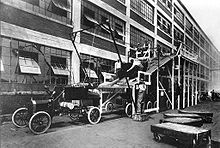
Model-T Assembly Line
At the end of the 19th Century, a laughably obscure technology began its unstoppable derailment of railroad passenger travel.  I refer, of course, to the automobile. From the very beginning, people loved the idea of being able to decide where and when to travel. Roads of the day weren't great, but people started to lobby for better roads. When Henry Ford's assembly line made the Model T affordable to almost every middle-class family, the automobile exploded onto the roadways.  For trips under a hundred miles, people would drive rather than take the train. They could leave on their own schedule and get to any town served by a road - even a bad road.  The family didn't have to have invest in a massive corporation to be able to drive. The large corporations like Ford Motor Company put the individual in charge of their own transportation.  It took decades, but gradually the railroads stopped running passenger trains and the country is now laced with interstate highways that carry the bulk of ground travel.  In the end, the individual would rather have control than give it to a large corporation. Small can be beautiful,

A second example is the main frame computer. When computing  came of age after World War II, it was the large companies like IBM that controlled the industry.  Once again, development was helped by government support - mostly from the Defense Department. Users were allowed limited access to these huge computing machines, mostly through leases to other corporations and universities.  The large capital required to build and operate these machines called for huge corporate investments and specialized technical people to operate the machines.

Then in the early 1980s, the personal computer became available from both Apple and IBM (and a host of smaller players). Computing was now available directly to the individual without an intermediary. People loved it. PCs were found in more and more homes and businesses. The individual became empowered and took control of computing virtually overnight. It didn't take the decades it took to move from the railroads to the automobile. Within a decade, PCs were ubiquitous. And those PCs when hooked to the emerging network called the internet gave people even more individual freedom to communicate and create thousands of new uses for the personal computer. Today, personal computers are in your pocket, in your smart phones, and tablets are becoming the new laptops. Given a choice, people will always opt for more control of their technology.

With these examples in mind, I started to muse about what the next big waves of personal control might be?  The starting point is to look for high capital intensity today. What demands a large corporation to provide the capital to make the technology possible?  I think it would be fair to eliminate those corporations that supply network services like power and oil companies. But even as I write this I think of Skype which has done a lot to eat into the phone companies' business. Maybe the two areas that might come to pass next are manufacturing and health care.

Right now, if you want a new widget, you have to look for someone who makes it and offers it for sale. But 3-D printing is changing the paradigm. Now, you can design or scan an object and send it directly to a 3-D printer that can pop a widget out in nothing flat. The technology is still early and you won't find a 3-D printer in your neighbor's house but give it a decade or two and see where we are. I predict that  manufacturing is going to undergo a sea change - and that sea change which will put more power into the hands of the individual.


The second area that comes to mind is health care. Right now, hospitals and clinics are capital intensive. Most people have to go to a physical facility to talk to a nurse or doctor. Medical records are closed for both privacy and competitive reasons. I think the forces of personal computing and the internet are going to change the way a lot of health care is practiced.  Small sensors built into your smart phone or tablet will measure your physical status and convey it to a doctor who will make electronic "house calls" to you via video links. For most minor situations, you will no longer have to go to the clinic or hospital to be seen.  Even for major procedures like surgery, you will be able to choose an expert who might live half-way around the world to do your procedure via robotic surgery.  Health care is ripe for change due to its taxing infrastructure and exploding costs.

People want control of their lives and technologies. New technologies that give them the sense of control at affordable costs will be rapidly embraced.  The world awaits the next waves of change. Small can be beautiful.

Wednesday, March 9, 2011

The Triangle Shirtwaist Fire


Three stories of ten-floor building at the corner of Greene Street and Washington Place were burned yesterday, and while the fire was going on 141 young men and women -- at least 125 of them mere girls -- were burned to death or killed by jumping to the pavement below.
The building was fireproof. It shows now hardly any signs of the disaster that overtook it. The walls are as good as ever; so are the floors; nothing is the worse for the fire except the furniture and 141 of the 600 men and girls that were employed in its upper three stories.
Most of the victims were suffocated or burned to death within the building, but some who fought their way to the windows and leaped met death as surely, but perhaps more quickly, on the pavements below.    New York Times, March 26, 1911.

I had missed the recent American Experience film on the Triangle Shirtwaist Fire but I was able to view it on the PBS Video website.  I highly recommend spending an hour watching it.  This program seems to be all the more pertinent to me as I continue to read about the daily struggles of unionized government workers in many states - starting with Wisconsin. They are, of course,  not fighting for safer working conditions but they are trying to hold onto long-fought-for collective bargaining rights.  The bitter irony of the workers at the Triangle Shirtwaist Company is that even though they had led a strike by New York City garment workers in 1909 for union representation, they never achieved it for themselves.  The owners, Isaac Harris and Max Blanck, would simply not permit any "meddling" in their control of the business.  Harris and Blanck were later tried and acquitted of manslaughter charges connected to the fire.  They went on to collect a lucrative insurance settlement and continued in the garment business. They were fined repeatedly for operating their factories under unsafe working conditions.

Asch Building in New York where fire occurred
on second to top floor still stands today.
Photo from Wikipedia.

Society benefits greatly from technology.  More often than not, that technology is made available through companies which compete fiercely against each other in the marketplace. The argument that nothing should fetter the owners of a business with regulatory burdens that might make them less competitive simply cannot be supported in the face of the tragic consequences that can so easily befall their employees.  Reasonable regulations and collective bargaining are not evils. They are part of the cost of doing business in a complex society. It is always a balance.  What should be regulated and what should be left to the market?  What voice should workers have compared to owners or managers?  While there is no lasting answer to these questions, it seems that we are once again tilting towards excessive power - and excessive rewards - on the side of owners and managers.

Wednesday, January 5, 2011

Of Photos and History

I love old photographs.  They show the technologies of the past in ways that words often fail to convey. My last post described the Shorpy website which features a variety of images, mostly beautifully cleaned up images, from the Library of Congress Archives.  I wanted to highlight two other websites I came across recently that are mashups of Google Maps and historical photos.


The first website is historypin.  This recent entry out of the UK provides a unique way to combine old historical views (worldwide) of street scenes with the more recent Street Views available in Google Maps.  The historical images can be switched on and off to allow you to see them superimposed on the way the street looks like today.  The site encourages users to upload their own images although in the current beta release version uploads are limited to five per user. There is also a place to annotate the photos under what the site calls Stories. The site has a little over 29,000 photos "pinned" at this point and is definitely worth a look.  There is a map view that lets you enter an address to see if there are any photos in locations that interest you.  Your best bet at this point is to look at the larger cities.


The second website, similar in concept, is SepiaTown.  This site also encourages you to upload your own images and shows the historical image in a side-by-side comparison with the current Google Street View of that location.  The website allows viewers to leave comments or share the photos through various social networking sites.  SepiaTown is also a relatively new entry and I haven't seen much in the way of posted comments but the photos are interesting and seem distinct from those on historypin.

All of these site are getting at a new way of social networking historical images. If they can get enough users, the power of the network will allow all of us to benefit with the accumulated knowledge that is in our collective heads.  I hope they live long and prosper.  But I think these sites are just the beginning experiments in how to plumb the depths of our knowledge about the more recent past. The pictures are interesting but they lack so many other ways in which they could be made even better.  For example, how about building links to Wikipedia articles or automating a simple Google search of keywords.  Which brings up another point: none of these sites allow tagging the images which would help to build out a set of images.  Other connections could include the vast libraries of online images in Flickr, Picasa, or any number of other photo sharing websites.  Online databases of historical newspaper articles could supplement the images in some cases. Just some thoughts.

If you know of any other websites like these or have any other suggestions on how sites like these could be improved, I would appreciate hearing about them.  Drop me a comment!

Sunday, October 3, 2010

Technology's Impact on the Land

We just returned from a week's trip to the Maine coast. This morning, we drove down the Hudson River Valley from Fishkill, New York, past the Manhattan skyline, and down the New Jersey Turnpike (it's always best to do this on a Sunday morning).

Coincidentally, I have been reading T.J. Stiles' recent biography of Cornelius Vanderbilt, "The First Tycoon."  Vanderbilt made his first fortune in steamboats and his second in railroads.  Vanderbilt first operated ferries that plied the waters between his home on Staten Island and the docks of Manhattan.  To say he led a colorful life would be an understatement.

When young Vanderbilt lived in the same environs that we drove through today, New York City had a rapidly-growing population of 40,000 people.  Staten Island was a farming community that sent produce to market across the river to New York City.  Getting from Manhattan to Philadelphia was an arduous journey that required a steam ferry, a long stagecoach ride across New Jersey, and a second steamboat trip down the Delaware. It took 12 hours... on a good day.


As I looked at the acres of freeways, the towering skeletons of ship gantries on the shores of Staten Island, the smokestacks of chemical plants and oil refineries, and the miles of dilapidated housing, I couldn't help wondering if the rise of technology has been worth it?  Have we lost our way somewhere and raced right past the Point of No Return as we built our cities and industries?

What would Vanderbilt have thought if he could see his old haunts today?  I'm not sure. Maybe he would have been fine with it.  He was first and foremost a ruthless businessman.  Vanderbilt had no problem spoiling the natural beauty and resources of his own day to make a buck.   But I wonder if the sheer scale of the change would set even Commodore Vanderbilt back a bit?  Would he see this as some scene out of a future run amok, even for someone as rapacious as he was himself?

Cornelius Vanderbilt
T.J. Stiles relates a very interesting moment in Vanderbilt's life. When Vanderbilt was middle-aged, he became desperately ill with what was thought was either pneumonia or pleurisy.  His doctor told him point blank that he should get his affairs in order because he wouldn't survive.  Vanderbilt called his family together and spoke to them from what he thought was his death bed.  One of his family later recalled his words:  "Don't be too anxious to make money, there is enough for all of you."  When the chips were down, Vanderbilt could see that the pursuit of wealth was not the most important thing even in his life.

Miraculously, Vanderbilt recovered from his pneumonia. Deathbed insights don't always stick.  He went on to become an even more hardened and calloused tycoon who took the greatest pleasure in crushing all who stood in his path.    Vanderbilt's world, the world centered on New York City, was changing forever.  It keeps on changing, of course.  Maybe the changes that come in the future will actually be more positive because there is nothing left to build on unless the old and the ugly is torn down first.  I hope that the result is not only functional and profitable, but also something that doesn't deaden the soul to look upon.

Vanderbilt lived in the days when most Americans believed in unlimited natural resources.  Thomas Jefferson thought it would take centuries to exploit all the riches of the continent. Instead, it took just over one.  We seem to learn most lessons, even the lesson of blighting the land, the hard way.  I would like to think we are at least gaining a little wisdom as we continue to mature as a nation.

Monday, August 2, 2010

The Antikythera Mechanism in Lego Blocks

I have written several times over the past couple of years about the Antikythera Mechanism, a complex astral computer built two thousand years ago.  The Antikythera Mechanism has fascinated and perplexed scientists since being discovered in a shipwreck off the tiny Greek island of Antikythera a century ago (and hence the name).  The Mechanism simply shouldn't exist given the modern assumptions on what the Greeks knew at the time about gearing and machines. Yet, there it is - a perfect mechanism.

Now a clever Lego engineer, Andrew Carol, has built a replica of the workings of the Antikythera Mechanism in Lego blocks.  You can see Carol's description of his work and even a short video here.

As if one of machine wasn't challenge enough, Mr. Carol also built a Lego version of the Babbage Difference Engine.  If you are so inclined, you can read the technical details of how each of these Lego machines was built.  Personally, I don't need to make one of these machines to admire Mr. Carol's creativity and skill. And where would this world be without Legos?  Who knows what might have been invented earlier if those ubiquitous little blocks had been around?

Monday, April 12, 2010

Back in My Library

I'm finally home after our week-long trip north from wintering in Florida.  Spring is arriving early all over the country, even here in Minnesota.  Now that I am back, I hope to pick up the blog again on a more regular schedule.

One of the nice things about being back is that I have access once again to my books.  My wife can tell you that I can't seem to travel without an inordinate number of books but even those are only a small portion of my library on the history of technology.  As I look at the titles that I can see next to me by the computer, I feel like I am with learned old friends.  The titles and art work beckon with a promise of interesting stories of entrepreneurs and inventors who tried to changed the world.  And some even succeeded.

I can never see a shelf of books without thinking about the authors who labored over the research and the manuscripts.  Each one of them wanted to write something that would be well received by their readers.  They wanted to see their names on the covers, offering at least a little immortality.  They probably even made a little money along the way. I am thankful that they made the effort.

Lots of my books are older editions.  Some date back fifty years or more, but that makes them no less appealing to me.  Sometimes these older books are even more interesting for the different perspective they provide.  The worn dust jackets and linen covers reveal a book that has been "around the block" a few times and has survived the recycle bin or landfill. (The image is a stock photo.  My books aren't yet that old!)

When I think about reading some of these old histories on a Kindle or iPad, it just doesn't feel like it would be right somehow.  If, as Marshall McLuhan said, "the medium is the message", then  I need an old medium for my history of technology books.  The musty pages have a certain aroma that connotes time.

It is always fun to travel but it is good to be home.

Friday, March 19, 2010

Why I Love the History of Technology

[Update 3/21/2010:  The quote I paraphrased is from Elizabeth Barrett Browning, not Shakespeare.  Good thing I wasn't an English major.]


How do I love the History of Technology?  Let me count the ways... 

Okay, so that is a very bad paraphrase of Shakespeare.  Sometimes I ask myself, "why are you so interested in this stuff?"  Maybe you are asking that same question?  To answer my own question, here, in no particular order, are ten things that popped into my head about why I love the History of Technology:


  1. Creativity and Innovation:  New technology brings something into the world that wasn't there before.  It taps into that urge that we all feel to create.
  2. Beauty:  Yes, technology can be beautiful, whether it is the sweeping curves of a suspension bridge of the elegance of a functional design.  We create technology that has an aesthetic to it.  Well-designed technology possesses deep beauty.
  3. Interesting People:  Technology always comes from people and new technology comes from people who are passionate, quirky, resourceful, and determined.  They can be inventors, innovators, and entrepreneurs.  Their desire to create makes for fascinating personalities.
  4. Exciting Stories: The birth of a new technology is always filled with drama.  To read about what people had to overcome to see their ideas through is always interesting. Sometimes the story is about personal sacrifice.  Sometimes the story is high adventure.  They are all interesting.
  5. Society and Culture:  Technology shapes our culture at its most fundamental level.  We become different people because of new technologies.  But technology also has a darker side, creating real dilemmas for society to grapple with.  Look at the issues we now face in our digital world.
  6. Legacy:  All of the people who have persevered to bring their ideas into the world have left us a legacy.  Their work stands as a testament to their having been here and having made a difference. The old saw for some kind of immortality says, "plant a tree, write a book, have a child."  I think you could add, "birth a new technology".
  7. Science:  Science and technology are intimately linked although it has not always been so.  Technology used to precede new science and then the science would provide the understanding on how to advance a technology.  Technology provides the tools of science. But, while often written in one phrase, science and technology are not identical twins. They are fraternal twins: linked but different.
  8. Enterprise:  Technology is not the same thing as invention.  There have been many inventions that have never made any difference in our lives.  To make a difference technology needs to come into the world and the path is by way of enterprise.  The story of business is intimately linked with any history of technology - and the struggle to create the business is often just as dramatic as the struggle to create the technology.
  9. Learning:  The History of Technology demands that I learn new things all the time.    It also provides great lessons about life.  While our world is very different than even thirty years ago, the characteristics innovators need and the challenges they face are the same. The past has much to teach us and I, for one, am the better for knowing.
  10. Perspective:  The History of Technology allows me to see a story against a larger background.  Often, the clarity of hindsight makes it much easier to see the relationships, the nuances, what worked and what didn't...and why. As an added bonus, we get to know how it all came out!


I am sure that I could come up with more reasons but this seems like a pretty good list for now.  As I look the list over, it seems like many of these reasons apply to almost anything you might find deeply interesting.  So maybe I haven't gotten to the nub of it just yet.  For whatever reason, it just resonates with me.  What does that for you?

Monday, March 15, 2010

Beach's Pneumatic Transit Company

In my last blog, I wrote about Rufus Porter, frustrated airship pioneer and founder of the magazine, Scientific American.  Porter founded the magazine in 1845 but by 1846 he had already sold it to Orson Desaix Munn and Alfred Ely Beach.  Munn and Beach continued to publish the Scientific American for the rest of their lives.  The magazine stayed in their families for generations.  Like Porter, Beach was also an inventor and a frustrated developer of new technology.  [Alfred Beach pictured from Wikipedia]

Scientific American's publishing offices were in New York City.  Traffic in the city was becoming unbearable in the years immediately following the Civil War.  The melee of horse-drawn carriages and trolleys mixed with pedestrian traffic made it difficult to get anywhere, especially at the morning and evening rush hours (sound familiar?).  Beach was a strong proponent of a subway system for the city.  He saw little future in talk of a steam-engine powered subway which would have all the attendant smoke and soot to contend with.  But he was very enamored with an idea that had begun in London to use pneumatic-powered tubes to move everything from mail to people.  Small tubes were being installed in stores and banks to move papers and money from one part of the building to another.  Intermediate tubes (about three feet in diameter) were being explored as a way to move packages and small freight.  Entrepreneurs in London had even proposed a pneumatic tube large enough to transport a subway car.

Beach picked up on this idea and tried to rally local officials to his cause.  Unfortunately, in the late 1860's , New York City was essentially owned by Boss William Tweed and his Tammany Hall ring.  Tweed received kickbacks from the horse-drawn trolley companies and a subway threatened that revenue stream.  Beach thought he could work around Tammany Hall by asking for a charter from the state to build two parallel intermediate-sized tubes to move letters and packages.  As this was no threat to Tweed, it was allowed to go through.  But Beech had other plans than what he was willing to put forth in his request to the state government.  

Unbeknownst to Tweed and his cronies, Beach planned from the beginning to build a demonstration subway using the pneumatic principle.  If challenged, he planned to tell people that he found it cheaper for his package test purposes to build one eight-foot diameter tunnel than two four-foot diameter tunnels.  Beach wanted as little visibility as possible for his project until it was complete.  He thought that if he could win over the public with the demonstration of a working prototype subway, he could overcome the political resistance from Tammany Hall.  He underestimated Tweed and the Machine.

Beach wanted to build his subway beneath Broadway, the main New York thoroughfare.  Beach rented the basement of the Devlin's Clothing Store building as a site to secretly begin excavating his subway.  The digging was done round the clock but the dirt was hauled out of the basement only at night.  It was placed in sacks and carried away in wagons with muffled wheels.  Beach's 21-year old son, Fred, was foreman for the digs.  Beach even invented and built a special tunneling shield to aid in the excavation.  The eight-foot diameter cast iron shield was moved forward by hydraulic jacks which could even be steered to allow the tunnel to turn corners.

After 56 days, the tunnel had been dug all the way under Broadway.  It was 312 feet long and ran from Warren Street to Murray Street.  Beach's single subway car ran on rails and was almost circular in cross-section to closely fit the circular walls of the tunnel.  It was plushly appointed and lit by on-board gas lamps.  Power came from a huge stationary fan system coupled to a steam engine.  The twin blades of the fan generated enough air velocity to briskly push the subway car through the entire length of the tunnel.  Reversing a valve on the fan system brought the car back again.  Beach even built an extravagant 120 foot-long lobby as a demonstration underground subway station. The station was ornamented with expensive furnishings, frescoes, an underground fountain, and even a grand piano.  The whole demonstration had cost Beach $350,000 out of his own pocket.


The subway was opened for public demonstrations on Feb 28, 1870 and it caused an immediate sensation.  People loved it - even if it didn't go anywhere.  Trying to capitalize on that enthusiasm, Beach applied for a charter from the state to build a longer subway system.  The resolution passed both houses but was vetoed by the governor - a Tammany Hall lackey.  But Beach didn't give up.  He was counting on public opinion and a change in his political fortunes to carry the day.  In 1872, it looked like he was going to get his break.  Tammany Hall had been exposed by the New York Times for its corruption and Boss Tweed was under indictment.  The Governor had been swept out of office in November of 1872 as a Tammany crony and the new Governor was much more favorable to Beach's ideas.  His charter granted, Beach formed The Beach Pneumatic Transit Company.

But when Beach tried to raise capital for the project, he ran into an entirely new opponent.  John Jacob Astor III owned much of the real estate along Broadway and he didn't like the idea of a subway tunnel that might cause structural problems under any of his property.  He stonewalled the project and got his friends to do the same.  Beach was by this time exhausted and out of funds.  He closed up his subway station and tunnel and abandoned the project.

Subways did not come to New York City until 1900.  In 1912, a work crew digging a new tunnel broke through into an old tunnel they hadn't known was there.  In it they found a perfectly intact subway car and a glorious underground station complete with water fountain.  Beach's subway was once again back in the limelight.  His pneumatic tunnel was mostly dug out for new construction but his efforts were recognized by a plaque that was placed in a local station.

Twice, publishers of the Scientific American had grand ideas and twice they had been thwarted from seeing their dreams realized.  Both ideas were ahead of their times.  Innovation demands viable technology, tenacity, and more than a little bit of good luck.  

Sunday, March 7, 2010

American Renaissance Men

Lately, I have come across a number of items that fit the pattern of American Renaissance Men of the 19th Century.  When we think of the Renaissance Man, the usual image is of a 16th Century Italian like Leonardo da Vinci (1452 - 1519). My dictionary defines a Renaissance Man as "a person with many talents and interests, especially in the humanities."  Notice that the definition does not limit the concept to one particular age.

So what made me think of this?  A few things.  I have been watching a Teaching Company course on the Masterworks of American Art (a great course, by the way).   I have also been keenly aware of many of the inventors who have helped to define our technological past.  I could not help but see that so many of them went beyond the boundaries of just one area of excellence.  Here are a few Renaissance Men to think about:


Samuel F.B. Morse (1791 - 1872):  Painter, but best-known as the inventor of the electric telegraph and his eponymous code. Morse painted portraits and historical subjects before turning to inventing.  He is said to have been motivated to invent the telegraph when he received a message too late for him to return home to be at his wife's side when she died.  This is an example of his portrait painting: Mrs. Daniel de Sassure Bacot (1830).

Monday, February 15, 2010

The Invisible Web

Eric Schmidt, the CEO of Google, wrote an op-ed piece on February 9th for the Washington Post where he put forth a number of ideas for getting innovation flowing again in the United States.  One of his ideas is for more H-1B visas so that foreign technical people who have been educated in the United States can stay here to work after finishing college.  Another is to extend R&D tax credits, and another is for leaders to develop a higher tolerance for failure.  Schmidt believes that we need to be willing to undertake riskier projects. If we never fail, we aren't taking enough risks. His final paragraph reads:

We have everything else we need to climb out of the current morass. Right now, somewhere in the United States, someone is working at a kitchen table, in a dorm room or a garage, developing an idea that could not only create a new industry but could also just possibly change the world. If we provide the right environment, she'll do the rest.

I agree with much of what Schmidt says, but is a lack of innovation the Big Problem?  If we just roll up our sleeves and become more innovative, will everything be all right again?  Don't get me wrong.  I am totally in favor of innovation, the more the better.  But is a lack of innovation the Big Problem that drives unemployment and the other ills we are experiencing today?  If we had ten or a hundred more Googles, would we be okay?  My short answer is "No".

So what is the Big Problem?  One thing I am certain about is that the issue of innovation and job creation is very complicated and no single (or simple) fix is likely to change the outcome by itself.  It shares this characteristic with other big problems like the healthcare crisis, climate change, energy dependency, jobs, the banking mess, to name a few.  As a nation, we prospered in the past because we had: 1) loads of natural resources, 2) the ability to attract immigrants and encourage their creativity, 3) a rising standard of living that allowed people to buy products made in our own factories (which were cheaper than imports) and because 4) international transportation costs were high and locally made products were better products anyway.

We have reached a point in our history where the old drivers of growth and prosperity just don't have the same impact that they use to have.  For the most part, I don't think this is a situation that exists because we have become lazy or self-satisfied.  The problems are a direct result of our own success in creating products that the world has wanted to buy.  Those products and technologies helped other countries come up the learning curve and let them compete more effectively in an increasingly global market.  The rest of the world is very aware of the high standard of living that we enjoy (in better economic times) and, not surprisingly, would like to share in that same prosperity.  As Tom Friedman, the New York Times columnist, never tires of pointing out, the world is getting flatter by the day.

The problem for which we need a new solution is how to sustain a high standard of living while coping with an ever more complex and interconnected world.  Over two hundred years ago, the Scottish philosopher and economist, Adam Smith, postulated the idea of the Invisible Hand which says in effect, if each of us acts in our own self-interest, we will collectively be better off as if guided by an Invisible Hand.  It worked when the world was rapidly moving from a pre-industrialized society to becoming a highly industrialized society.  Maybe if Adam Smith were alive today he would help postulate another idea that would fit the post-industrial world into which most of the First World is rapidly evolving.

We need lots of new approaches.  And in that way maybe a lack of innovation is, in the end, actually the Big Problem after all.  But this is not innovation in the usual sense of how to foster hi-tech businesses or how to invest more in basic R&D.  It is the innovation of rethinking how we can sustain the life we want on an ever-smaller, more interconnected, and fragile planet.  This will require us to do more than act in our own self-interest.  It will take  coordination across scientific disciplines, governmental bodies, business networks, and a host of other actors.  Maybe Smith would have called it the Invisible Web.

We have such an Invisible Web. It's called the internet or the World Wide Web and it is how you are reading this blog.  It allows us to connect with each other in ways that Smith could never have dreamed possible.  But the Web is just the beginning.  While we can finally talk to each other more easily, we must match that ability with the ability to work together to solve problems.  We need the social and collaborative skills that come naturally to those who have been raised in a wired world.  I know that we must stay open to change, the very thing that is the most difficult for many of us to accommodate.  Change will come, regardless.  I would rather it was a change for the better. It can be if we learn how to live and work together.

Thursday, February 11, 2010

David McCullough: Knowing History and Knowing Who We Are

I first came to know the work of historian, David McCullogh, not through his writing, but through his narration of Ken Burns' PBS production, The Civil War.  McCullough's voice was melodious and had the sort of character that made him instantly believable.  Since that time, I have read many of his fine works of history including John Adams and 1776.  He is a gifted writer who makes history come alive.  He has even written on the history of technology with The Great Bridge, on the building of the Brooklyn Bridge, and The Path Between the Seas, the story of the Panama Canal.

In 2005, McCullough gave a speech entitled, Knowing History and Knowing Who We Are, for a conference sponsored by Hillsdale College.  I came across the speech in my files recently and I noted that the college gave permission to reprint it as long as it was accompanied by the following credit:

Reprinted by permission from IMPRIMIS, the national speech digest of Hillsdale College,www.hillsdale.edu.


I think the speech is terrific and I am going to copy it in full below.  I don't usually send out long blog posts but this will have to be an exception. If you don't want to read the whole thing on line, you might print this one out. It runs about six pages, but once you start reading, I think you will finish it.  I am in awe of his skills as a writer.


Sunday, January 17, 2010

North, South, East, West


In my recent reading, I came across another reminder of the role that technology played in the development of the United States.  At the time of the revolution, the U.S. was a set of thirteen colonies arrayed along the Atlantic coast.  Virtually all economic activity within the colonies was confined to this natural North-South orientation.  But with independence, the lands west of the Alleghenies became open for settlement.  The Louisiana Purchase of 1803 only expanded the available territory.  People had begun to move to the Kentucky territory along the Cumberland Road, laid out by Daniel Boone, even before the war, but peace brought a tremendous drive to move west.

Getting over the Alleghenies, even by the Cumberland Road, was not easy or for the faint of heart.  Almost all of the early settlers were attracted by the lure of cheap farm land.  For people that had next to nothing, farming offered not only a way to fill their bellies but a path to a more prosperous future.  The United States population expanded by a third between 1790 and 1800 (from 3.9 million to 5.3 million people).  Many of these pioneers headed for the lands to the west, especially in the Old Northwest Territory of Ohio, Indiana, Michigan, and Illinois.  More and more, farmers needed to find a way to get their produce to market and the only cost-effective route was by water.  The Ohio and Mississippi Rivers offered the only low-cost transportation option. Barges and keel-boats brought the products of the western farms downstream to New Orleans for shipment. The lack of any viable route to the east over the Alleghenies created a separate economy that was only marginally linked to the Atlantic seaboard.

So where did technology play a role in changing this linkage to New Orleans?  The leaders of the young nation (including Washington and Jefferson) recognized that a western United States without strong ties to the East was ripe for exploitation by a European power either by conquest or by political and economic alliances.  Washington even founded a commercial effort to link the West to the East using the Potomac River and a network of canals to form a water link.  That effort was a bust for both investment and technical reasons but the idea of a water route was successfully carried out with the building of the Erie Canal, opened in 1825.  With the Canal, the cost of shipping goods east to New York became even cheaper than sending produce to New Orleans.  The products of the farms started moving East.  More canals were built and then an extensive network of railroads, all to cheaply transport farm goods to both Eastern and European markets.  Transportation technology knit the Eastern and Western segments of the United States into a cohesive whole.

Technology also played a role in the North-South divisions.  As I wrote recently, the invention and massive replication of the cotton gin opened the way for the less fertile lands of the South (away from the coastal lowlands) to be put under cotton cultivation.  Such a massive expansion in cotton production could only be accomplished by increasing the number of slaves to work the land.  Hence, technology reinforced the institution of slavery and increased the divide between the interests of the North and the South.

When the Civil War came, the Old Northwest Territory went with the Union.  The economic self-interest of the East and West were tied together.  The South, with its limited resources to match those of the industrialized North, lost the war -- and a way of life.  Of course, the technologies that were nurtured in the North's manufacturing-based economy only strengthened the ties between East and West as the farmers looked to the factories of the East for their factory-made goods.

Technology is a powerful force in shaping the course of history.  I'm reminded of the old saw, "for want of a nail...the war was lost."  Maybe in the case of the United States it should be modified to "because of a canal ... the war was lost."

Wednesday, January 6, 2010

Miller and Whitney: Early Innovation

"An invention can be so valuable as to be worthless to the inventor."
- Eli Whitney


Every child knows (or maybe every kid used to know) that Eli Whitney (1765 - 1825) invented the cotton gin.  Like most stories of the Hero Inventor, this one is a much-distilled and over-simplified version of the truth.  Cotton gins had been around for a long time before Eli Whitney came along. These earlier gins squeezed cotton between rollers and the friction pulled the seed from the cotton fibers.  The roller gins did a good job on long-staple cotton but there were a couple of limitations.  First, long-staple cotton only grew in the rich soil found near the coast, and secondly, while the roller gins worked, they were slow and favored good fiber over production output.

Eli Whitney was a Yale-educated son of a Connecticut farmer.  He seems to have been quite mechanically inclined from a young age.  After Whitney graduated from Yale, the president of the college, Ezra Stiles, arranged for Whitney to take up a tutoring position in the South.  Stiles put him in touch with another young Yale man, Phineas Miller, who had graduated a few years earlier.  Stiles had previously arranged for Miller to be a tutor in the South at the plantation of the Revolutionary War General, Nathaniel Green.  The general had died around this same time and Miller became not only the tutor to Green's five children but also the plantation manager for Green's widow, Catherine Green.


Whitney traveled with Miller and Mrs. Green from New York City to Savannah and stayed with them for several months.  The story goes that once there, Whitney turned down the tutoring job because of a dispute over the pay and stayed on at the plantation to invent his cotton gin. The exact order of events was deliberately obscured by Whitney and his new business parter, Phineas Miller, in order to facilitate getting a patent and to get a head start on manufacturing machines.  The partnership that was formed was always known as Miller and Whitney (not the other way around).  Once again, we see the indispensable role of the entrepreneur (Miller in this case) in moving an invention towards the market.  Miller not only had more business savvy, he had the deep pockets of Catherine Green's money.  Miller had married her at about this same time.

Miller conceived of a business plan in which their company would manufacture the gins in Connecticut and build service locations throughout the South where farmers would bring raw cotton for ginning.  The ginning mills would also have cotton seed presses to capture this source of revenue as well.  The company would be paid for their services, not in cash (which was very scarce), but by keeping one third of the ginned cotton output.  It seemed like such a great idea but like most great ideas, there were problems.

First, while Whitney's cotton gin did a good job of stripping out the seeds, it left the cotton fibers entangled in little knots called neps which created problems for the subsequent spinning operations to make cotton thread.  Spinning companies in England complained bitterly about the poor quality of the fiber from Whitney's gins.  The second problem was that Whitney's gin was elegantly simple and hence easy to pirate and there was a strong incentive to do so because of the high output of the gin. Many Southerners made copies or improved on Whitney's gin, ignoring Whitney's patent of 1793.  Miller and Whitney fought back in over 60 lawsuits but the number of infringers and the bias of the Southern courts towards helping local plantation owners proved to be too costly to continue.  While they lost most of the cases, Miller and Whitney were eventually awarded some compensation by the legislatures of the states of North and South Carolina (Georgia never did recognize their claims).

Whitney's gin galvanized local mechanics to come up with their own ideas on how to improve his design.  In this way, it was a tremendous spur to Southern innovation. The most common approach was what was called the saw gin in which the individual wire teeth of Whitney's gin were replaced by teeth mounted on a circular saw blade.  Eventually, the designs were improved to the point where the problems with fiber neps were reduced to an acceptable level.  Cotton production exploded because the short staple, green-seed cotton could be grown in much poorer soil conditions in the upland South. With the expansion in cotton production came a massive increase in the number of slaves to work the land.


What became of Miller and Whitney?  Miller died in 1803 having poured most of his money (or rather Catherine Green's money) into the venture. He never recovered his investment.  Whitney, penniless from his cotton gin venture, turned his back on the South and in 1798 went into the business of manufacturing firearms for the U.S. government at a factory in New Haven, Connecticut.  He didn't do as well financially as he had hoped with his new business but he did cement a name for himself as having had a crucial role in the development of manufacturing using interchangeable parts.

Whitney would never have been remembered for the cotton gin had it not been for the motivation and resources of Phineas Miller.  I find this interesting because in most cases in our culture it is the entrepreneur who gets the credit for an inventor's ideas.  Perhaps Miller would have been the one remembered had the company of Miller and Whitney been financially successful.  When it failed and Miller died, Whitney lived on until 1825 to continue to remind people of his patent and his inventions.  Miller was to become only a minor footnote in Whitney's later retelling of the story.

It helps to be the one to write the history of a venture.  You can give yourself all the credit you think you deserve. But I, for one, think that Phineas Miller ought to be up there as the Hero Entrepreneur as much as Eli Whitney was the Hero Inventor.  Invention is a necessary but not sufficient requirement for innovation.  That takes money, business savvy, and often more than a little good fortune.