Showing posts with label design. Show all posts

Thursday, August 17, 2023

Seeing the Big Picture

 I know exactly where I was on the night of July 20, 1969. At 9:56 PM, Central Daylight Time, I was in front of our black-and-white television set along with the rest of my family. We were part of the 600+ million people around the world doing exactly the same thing at that same moment. 


Apollo 11 Moon Landing Live Broadcast 

Neil Armstrong went down the ladder of the Lunar Lander and stepped off the last step onto the lunar surface. Humanity had put a footprint on the moon. The sense of history-in-the-making was palpable to everyone watching. It was astonishing -- mind-boggling, really -- that we could be watching something happening in almost real-time from a distance of 238,000 miles on another celestial body!

I'm not certain, but our television was probably no more than 27 inches. I remember it was contained in a plastic box which probably weighed fifty pounds because of the heavy cathode-ray picture tube. Long before the internet or even cable television, television signals arrived via an antenna. The picture was often grainy. Color television had been introduced in the late 50s but it was still expensive and my parents didn't own a set. Color broadcasts were limited to selected programming, I remember that NBC introduced theirs with the colorful peacock logo. 

But color television made no difference that night because NASA had only installed a black-and-white video camera on the Lunar Lander. Color video would have taken too much weight and too much power. We were still thrilled to be watching. 

What made me think of all this was that I recently came across a photograph of NASA Mission Control at the Houston Space Center. On the large screen on the wall, you can make out the same black-and-white image of the first moon walk. Today, we think nothing of large video displays and it barely catches our attention.

Large Panel Display in Mission Control

But like everything else associated with the Space Program of that era, even the video displays were state-of-the-art. There were no color LED panels that now fill every niche of our lives. The conventional broadcast video technology of the day was created using the cathode-ray tube. But a display of the size in Mission Control would have required a cathode-ray tube with an enormous glass enclosure weighing tons and needing immense power. So how did NASA create such a display?

The answer was revealed to me when I posted the Mission Control photograph to a Facebook group dealing with old technology. People commented almost immediately about the video display. It was created with a technology called Eidophor. I had never heard of it. 

A little more researching on Wikipedia and YouTube enlightened me further on what this was all about. What you see in the photo of Mission Control is only the front portion of a much larger room. Behind the wall was another room at least as large and painted matte black. Technicians called it the Bat Cave.  The equipment needed to project these displays filled the room as you can see in the schematic below. 
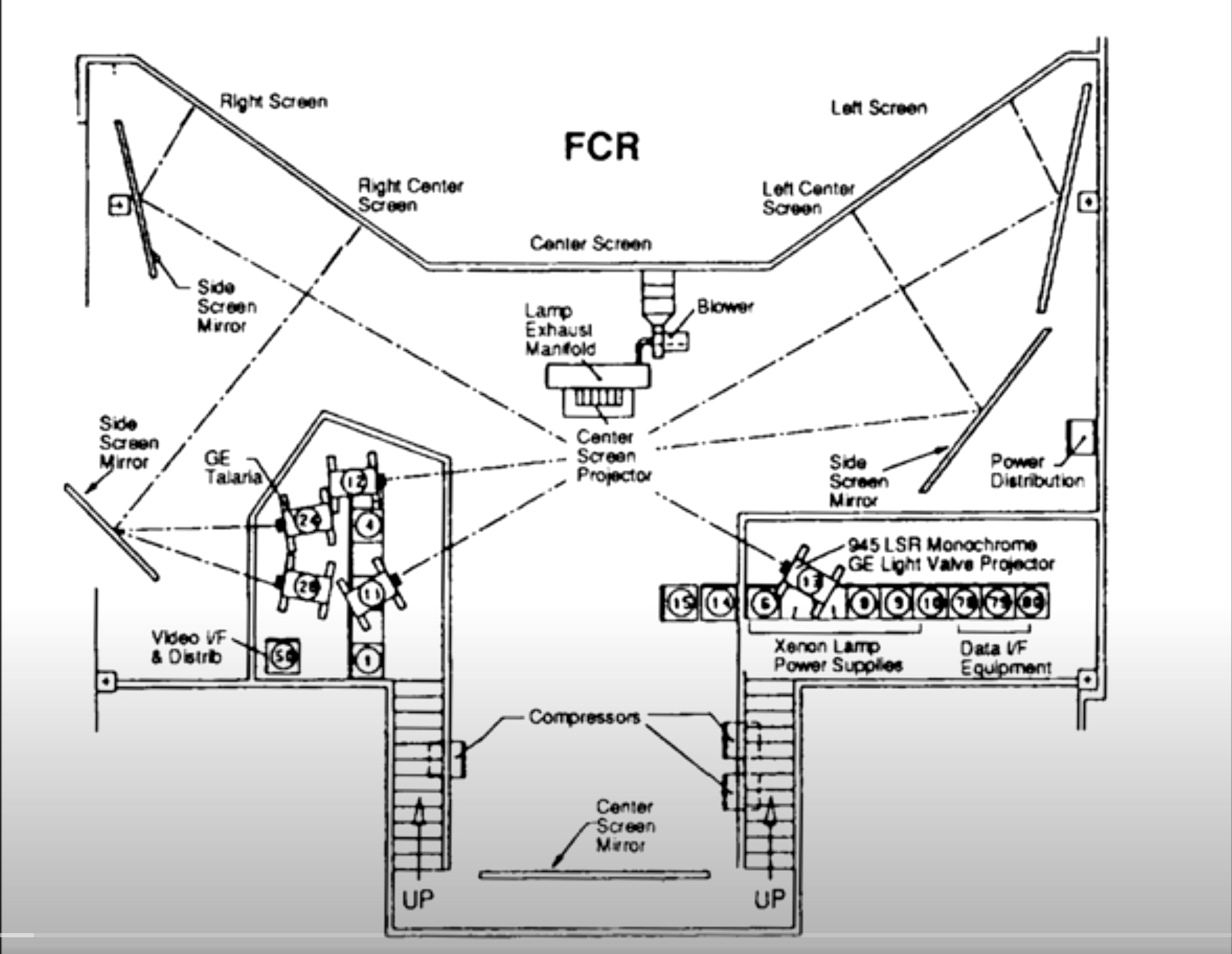
Layout of Bat Cave

The Eidophor projectors themselves were marvels of technology as can be seen in the drawing. Read Wikipedia if you want to know more. 


Schematic of Eidophor Projector


These projectors were around for a while beyond the Apollo missions and were used for sports events, rock concerts, and other large-screen applications. By then they had shrunk considerably from the NASA days but were still formidable hardware systems.

Refined Eidophor System


Today, flat-screen LED and OLED technology is so good that an 8K image can be displayed for a fraction of the cost and a fraction of the power. Cameras on spacecraft have also improved so much that we can now watch full-color, hi-def video in virtually real-time. 

On Feb. 18, 2021, the Mars Rover, Perseverance, made an extremely complex and completely autonomous landing as we all watched both the descent vehicle and the Rover as the maneuver was accomplished. We might even have been watching on our Smartphone while sitting at a local coffee shop enjoying a latte. 


We have come a long, long way in fifty years. Sadly, almost no one could tell you where they were on Feb. 18, 2021 when Perseverance landed. We take so much for granted.  Time for a refill of my coffee. 

"Making the simple complicated is commonplace; making the complicated simple, awesomely simple, that's creativity." 
- Charles Mingus

Sunday, November 16, 2014

The Persistence of Form

Like most everyone else, I was blown away by the European Space Agency's recent successful mission to land a vehicle on a comet. After a ten year, four billion mile journey, the tiny Philae spacecraft landed on a three-mile long piece of rock moving through space at forty-thousand miles per hour. Incredible is an understatement! There was well-deserved jubilation in ESA's control center.

ESA circa 2014
When I looked at the pictures of the ESA's mission control room, I was struck by how little had changed in fifty years since the images of NASA's Mission Control in the Apollo moon project became so familiar to us.

NASA circa 1970

The computational power behind the NASA control room was less than what you can find today in an ordinary laptop computer. Yet, the design of Mission Control has not changed much despite the incredible leap forward in technology. You see the same consoles with screens and buttons. The same rows of positions facing the large screens on the wall displaying statistics and parameters. You see the same low level of light giving the room a hushed, monastic presence. I remember the sci-fi movie, Minority Report, from 2002 that had Tom Cruise standing at a large glass panel where he moved and manipulated data with his special gloves.  Certainly, that theatrical image was intended to convey advanced technological control capability. And yet, here we are fifty years after Apollo and both the ESA and NASA rooms look virtually the same. Why?

Tom Cruise, Minority Report, 2002

The control rooms are a great example of the old adage, "form follows function." The rooms look the same because they provide the best way to fulfill the function. Nothing too deep about that. But what might change it? What would make this form no longer the best way to answer the functional need? Would everyone be wearing Google Glasses and hence no longer need to see a screen on the wall? Would the mission controllers be able to work from home in their bathrobes during the critical phases of the mission? I doubt it.

Think of business conference rooms. They have changed hardly a hair in over a century. Of course there has been the introduction of new technology. First it was the old overhead transparency projector which was replaced by a cable connection to allow a laptop to project an image on the screen. But the room, the long table with chairs on either side and the chairperson seated at the end, remains the same. It is the best way to allow everyone to have a "seat at the table", to fully participate in the meeting. Today we can have remote meeting via Skype but it never works quite as well as the conference room with everyone present. I wonder if those rooms will ever be replaced entirely?

Maybe it is because as people working towards a common objective, we need to be together. Our physical presence allows the non-verbal cues to be easily perceived. Silence can say as much as words. Actions can be decided upon quickly when necessary. More than that, we have a feeling of shared responsibility and shared reward that comes from being physically together to do the job.  We are, after all, tribal in our primal essence and we want to belong to the tribe. The conference room replaced the campfire circle.

So will mission control centers or conference rooms (or a thousand other forms in our lives) change? I suppose they will but our need for community will never go away. As we move into an increasingly virtual world, we will have to find a way for our online avatars to be able to not only speak but feel for us. I don't think it will happen soon.

[For a great tour of NASA's Johnson Space Flight Center Mission Control, read the blog by Lee Hutchinson on Ars Technica.]

Saturday, November 12, 2011

High Speed Rail Redux

I frequently see articles in various news sources about the controversies of building high-speed rail in this country. The proponents argue that, rather than getting on an airplane, the lines will provide much easier and more pleasant ways to travel between distant cities. High-speed rail will rejuvenate outlying areas along the route that will see a new wave of investment in housing and business. Critics argue that high-speed rail will never pay for itself. People much prefer to drive or fly. If too many stops are planned along the route, the line will no longer be high-speed.  And because passenger rail is now run by Amtrak, a government-owned corporation, high-speed rail will turn into a taxpayer boondoggle.

It's worth remembering that long before the current debate, the U.S. had many "high-speed" passenger lines run by private railroad companies. These lines were profitable even as automobiles became the preferred mode of local transportation.

Perhaps one of the most famous of these early high-speed trains was the 20th Century Limited, operated by the New York Central Railroad between New York City and Chicago.  The service was inaugurated in 1902 and ran for 65 years, finally being discontinued in 1967.

In the early days of the 20th Century Limited, it took 20 hours to make the overnight run. By the 1930s, the time had been reduced to 16 hours. The train left New York City at 6:00PM Eastern time and arrived in Chicago at 9:00 AM Central time the next morning. The train consisted of Pullman sleeping cars, a dining car, a postal car, and a baggage-club car - usually nine or ten cars per train. Passengers entered and left the cars over specially-designed red carpets, giving rise to the expression "the Red Carpet treatment". Men were given carnation boutonniers and the women perfume when they boarded. Everything was meant to convey taste, efficiency, and good service.

NYC RR J3-a Hudson by Henry Dreyfuss
The trains became decidedly more beautiful in 1938 with the advent of the streamlined trains of industrial designer, Henry Dreyfuss. The powerful Hudson-class locomotives oozed an impression of power and speed, even when standing still. Compared to the brick-like design of today's Amtrak engines, the Dreyfuss-designed trains made people feel they were partaking in something special.

The 20th Century Limited, like the European Orient Express, became an iconic image for American culture and was used as a backdrop in many films including Hitchcock's North by Northwest. Hard to imagine a similar movie on the Acela.  The 20th Century Limited was only one of dozens of "named trains" that crisscrossed the country in the middle of the last century. The ghosts of some of those trains now reside in the few long-distance Amtrak trains that make their way (usually slowly due to outdated trackage and equipment) between distant cities .

I, for one, would like to see high-speed rail brought back into wide usage in this country. While some argue that it is a waste of resources, the future belongs to fast, efficient transportation with a low-carbon footprint. Most of the rest of the industrialized world gets it - the last century's transportation options will not be adequate for the coming century. A little classy design by a modern-day Dreyfuss would also be much appreciated.  Oh yes, and bring back the Red Carpet.