Showing posts with label automobile. Show all posts

Sunday, July 1, 2012

In 1958, Disney Imagines the Future of the Highway

As long as I seem to be on an automotive futures theme, I want to draw your attention to part of a Disney television production from 1958, entitled Magic Highway USA. The show was part of the Wonderful World of Disney series, Most of this program explored the history of the highway in the United States. But the last ten minutes looked to the future.  You can watch the whole thing at the link about or just the last nine minutes here:


I love these old predictions of the future. Almost all of them have people flying around in their personal helicopters or living in some undersea colony. The buildings all look like they came out of the Jetsons. But just like in the Futurama exhibit that I wrote about a couple of entries ago, some of the predictions turn out to be remarkably accurate. Others turn out to be true but are embodied in some way other than that described. And of course, there are the "dead wrong" predictions. So how did the Magic Highway USA predictions turn out?  Here's a list of what was in our futures, circa 1958:

Dead Wrong Predictions:

- Multi-colored highway lanes to give motorists a color-coded path to their destination
- Radar screens to allow drivers to see in poor visibility
- Fog-eliminating devices to clear the roadway
- Atomic reactors to melt tunnels through mountains in a single pass
- Cantilevered highways hung from the side of mountains
- Automatic servicing of the car in the homeowner's garage
- Tandem vehicles that separate into parts for different destinations
- Special highways for new forms of vehicles (e.g., tubular highways)
- Individual parking spot for your car in your office at work
- Massive parking "cylinders" at shopping malls instead of parking lots
- Highway "elevators" to lift cars up sheer cliffs
- Gas turbine-powered automobiles
- Atomic-powered automobiles
- Jet engine-powered automobiles
- Cars that convert from highway vehicles to cabin cruisers


Nothing much surprising in this first list. This is the usual science fiction view of the future. What was more interesting to me was the number of predictions that turned out to be true, even if they were accomplished in a slightly different way. Have a look:

More-or-Less Correct Predictions:

- Larger, simpler highway signs that can be easily read at high speeds
- Roads specifically designed for better visibility
- Electronic navigation controls (at least there are now onboard navigation and traffic monitoring GPS systems)
- Rear view mirrors are television cameras (back-up cameras are becoming common)
- Helicopter rescue of traffic accident victims
- Integrated road building machinery that can lay down whole roadways at one pass
- Prefabricated bridges and overpasses
- Form-in-place concrete structures, such as bridges
- Wider, faster expressways that extend the areas from which people can commute to work
- A nation crisscrossed by a network of super highways
- Communities that are built around the design of the freeways for better access and commuting
- Preprogrammed route selectors (think GPS systems)
- Electronics that drive the car to its destination (not here yet but Google is working on a driverless car)
- Business conferences on video screens (... at least for a passenger)
- Family entertainment systems in the car (think DVD and game counsels)
- Ability to know your location on a synchronized electronic map (GPS again)
- Office buildings that combine multi-level parking and office facilities
- Moving sidewalks (at least in airports and convention centers)
- Solar powered automobiles (experimental cars are here. Production cars?  Hmmm).
- Air-conditioned routes across hot deserts (in-car AC is now virtually standard).
- Roads over subfreezing mountains (high-speed roads over subfreezing terrain are common in the northern parts of the country)
- Vehicle travel under the ocean (the Chunnel between the UK and France pops to mind)


Like most technology visions, this program also had its moments where it lapsed into the rhapsodic:

"These giant arteries will link together all the nations and help to create a better understanding among the peoples of the world. As in the past the highway will continue to play a vital role in the progress of civilization. It will be our magic carpet to new hopes, new dreams, and a better way of life for the future!"

Have you ever noticed how technology (whether embodied in better highways or in the internet) is always predicted to improve the relationships between peoples? There is some truth in these euphoric predictions but there is an equally true and opposite reality: technology creates frictions between the peoples of the world. Technology has never been a panacea. And predicting the future of technology remains one of our most difficult challenges.


Monday, May 28, 2012

The Horseless Age

In my last post, I wrote about Futurama, an exhibit sponsored by General Motors at the 1939 World's Fair. Futurama was Norman Bel Geddes vision of an America of 1960, fully connected by interstate highways. That vision became reality.

But visionaries have always been with us. I recently came across an editorial written in 1896 in the first publication that exclusively focused on the automobile. The magazine was called The Horseless Age and the publisher was a man named E.P. Ingersoll. He was a tireless reporter and promoter of all things automotive. In the fifth issue of Volume 1 of his journal, he penned an editorial with the very sedate title of "Effects on Land Values and the Distribution of Population."  But what he wrote was an insightful analysis of things to come.


The first thing that caught my eye when I read his piece was that it was the trolley and bicycle that began the movement of people to the suburbs - even before the advent of the automobile. When this editorial was written, there were essentially zero automobile companies in the U.S.  Any cars that were being purchased were imported from France and then only by the wealthy. It was this same trend to the suburbs that was illuminated in the Futurama exhibit forty-five years later. 

Ingersoll clearly understood the impact of transportation systems on land values. What Ingersoll didn't state was that it was the cost of transportation and not just its availability that drove land values. I think of the falling home prices today in the outer exurbs as people respond to high fuel costs by trying to move closer to the urban centers. The problem, of course, is that their homes are worth less than they owe on them, essentially trapping them in the exurbs.

Finally, I think Ingersoll deserves credit for not mincing words about congestion in the cities. He understood that the poorest people in the cities could never afford their own cars and hence would remain locked in the slums. Today, the poor are still locked in the slums of cities and run-down neighborhoods. They might have a car but if they do, it is usually very old and in very poor condition. Their upward mobility is close to zero.

Ingersoll's editorial isn't that long. I repeat it here verbatim:


"One of the most interesting phases of speculation called up by the motor movement relates to its probable effect on land values and distribution of population.


 In the aggregate the constant tendency of land values is to increase as population increases, and there is no reason to believe that this tendency, now very strong in this country, will be checked for some time to come. Every mechanical improvement introduced adds to land values, which may be considered as the capitalized value of civilization.


 But while the general tendency to increase will in all human probability remain unchanged, local changes are bound to result from the general introduction of motor vehicles as the have resulted from the introduction of other improvements in locomotion.


The trolley car has opened the suburban property, and by connecting rural towns has made populous streets where before were farmers' houses.


The bicycle has had a similar effect upon land values, pushing the line of possible residence near business centers further out, and hence making such outlying sites more desirable and more valuable.


The slight depreciation which these new agencies of locomotion have caused in the case of land devoted to industries injuriously affected by them is but a sign of the stimulating effect in other directions. The bicycle and the trolley depressed the prices of certain grades of horses and this has undoubtedly depressed the values of some lands devoted to raising such grade of horses, though this depression is apt to be quickly relieved by putting the land to more profitable uses.


Country hotel sites have in many sections been given additional value from the fact that they are frequented by bicycle riders seeking rest and refreshments on their outings.


The general adoption of the motor vehicle will intensify these tendencies. It will make suburbs easier of access, improve the trade of country hotels in many places, and still further depress the business of horse-raising. Much of the land now used for horse-raising and growing horse feed will in process of time find other uses more in harmony with the trend of progress.


The establishing of new factories will stimulate the growth of population locally, as has been observed in the case of the bicycle industry, but there is not the slightest hope that the motor vehicle will relieve the congestion of cities; for the congested districts are inhabited by the very poor, who cannot afford to buy a vehicle of any kind."


Note: The Horseless Age remains in publication today but its name was changed around World War I to Automotive Industries. You can read all the early volumes of the magazines on Google Books.

Thursday, December 29, 2011

Small Can Be Beautiful

I realize that the title of this post is something of a rip on E.F. Schumacher's book, Small is Beautiful, but small is not always beautiful. Sometimes small just leads to being crushed.  I started thinking about this when I was listening to an interview on the Diane Rehm Show on NPR. She was talking to  Stanford historian, Richard White, about his book, Railroaded: The Transcontinental and the Making of Modern America.

In his book, White lays out the mostly-sordid business history of the building of both the Transcontinental Railroad and other major expansions of the railroads in the late 19th Century. Railroads were the first large corporations in America. It was not possible to build something as capital intensive as a railroad without major investment. It was also not possible to operate such a large enterprise without layers of management. The Transcontinental Railroad was built mostly through political favors, bribes, and kickbacks. There was no business reason at the time of the Civil War that could justify building a rail line through mostly unpopulated areas. But the railroad got built because there was money to be made in railroad construction costs, land grants, and subsidies.

My purpose here is not to revisit the seamy sides of the railroad business. What got me thinking was how the railroads were once the dominant transportation system in the United States - at least for passenger travel. The over-used term of the time was how railroads "collapsed time and space", and it was true. Travelers depended on the railroads to get where they wanted to go. And in the late 19th Century, you could get almost everywhere on a railroad. Of course, you had to travel on the railroad's timetable and if the town you wanted to get to wasn't on a rail line, you were on your own.

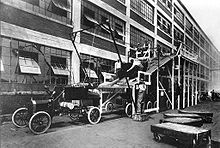
Model-T Assembly Line
At the end of the 19th Century, a laughably obscure technology began its unstoppable derailment of railroad passenger travel.  I refer, of course, to the automobile. From the very beginning, people loved the idea of being able to decide where and when to travel. Roads of the day weren't great, but people started to lobby for better roads. When Henry Ford's assembly line made the Model T affordable to almost every middle-class family, the automobile exploded onto the roadways.  For trips under a hundred miles, people would drive rather than take the train. They could leave on their own schedule and get to any town served by a road - even a bad road.  The family didn't have to have invest in a massive corporation to be able to drive. The large corporations like Ford Motor Company put the individual in charge of their own transportation.  It took decades, but gradually the railroads stopped running passenger trains and the country is now laced with interstate highways that carry the bulk of ground travel.  In the end, the individual would rather have control than give it to a large corporation. Small can be beautiful,

A second example is the main frame computer. When computing  came of age after World War II, it was the large companies like IBM that controlled the industry.  Once again, development was helped by government support - mostly from the Defense Department. Users were allowed limited access to these huge computing machines, mostly through leases to other corporations and universities.  The large capital required to build and operate these machines called for huge corporate investments and specialized technical people to operate the machines.

Then in the early 1980s, the personal computer became available from both Apple and IBM (and a host of smaller players). Computing was now available directly to the individual without an intermediary. People loved it. PCs were found in more and more homes and businesses. The individual became empowered and took control of computing virtually overnight. It didn't take the decades it took to move from the railroads to the automobile. Within a decade, PCs were ubiquitous. And those PCs when hooked to the emerging network called the internet gave people even more individual freedom to communicate and create thousands of new uses for the personal computer. Today, personal computers are in your pocket, in your smart phones, and tablets are becoming the new laptops. Given a choice, people will always opt for more control of their technology.

With these examples in mind, I started to muse about what the next big waves of personal control might be?  The starting point is to look for high capital intensity today. What demands a large corporation to provide the capital to make the technology possible?  I think it would be fair to eliminate those corporations that supply network services like power and oil companies. But even as I write this I think of Skype which has done a lot to eat into the phone companies' business. Maybe the two areas that might come to pass next are manufacturing and health care.

Right now, if you want a new widget, you have to look for someone who makes it and offers it for sale. But 3-D printing is changing the paradigm. Now, you can design or scan an object and send it directly to a 3-D printer that can pop a widget out in nothing flat. The technology is still early and you won't find a 3-D printer in your neighbor's house but give it a decade or two and see where we are. I predict that  manufacturing is going to undergo a sea change - and that sea change which will put more power into the hands of the individual.


The second area that comes to mind is health care. Right now, hospitals and clinics are capital intensive. Most people have to go to a physical facility to talk to a nurse or doctor. Medical records are closed for both privacy and competitive reasons. I think the forces of personal computing and the internet are going to change the way a lot of health care is practiced.  Small sensors built into your smart phone or tablet will measure your physical status and convey it to a doctor who will make electronic "house calls" to you via video links. For most minor situations, you will no longer have to go to the clinic or hospital to be seen.  Even for major procedures like surgery, you will be able to choose an expert who might live half-way around the world to do your procedure via robotic surgery.  Health care is ripe for change due to its taxing infrastructure and exploding costs.

People want control of their lives and technologies. New technologies that give them the sense of control at affordable costs will be rapidly embraced.  The world awaits the next waves of change. Small can be beautiful.

Saturday, October 8, 2011

In Defense of Steve Jobs

It seems that everyone with any sort of digital soapbox has felt the need to write about Steve Jobs.  I was particularly interested to read a couple of articles that tried to either make or dispel the idea that his impact on society equalled that of Thomas Edison or Henry Ford.

I think Walter Mossberg of the Wall Street Journal might have started the comparison in a very personal article he wrote about the thoughtful and personal side of Steve Jobs.  Rick Newman at US News and World Report picked up on the theme but threw mostly cold water on the comparison of Jobs to either Edison or Ford. Even the Christian Science Monitor got into the act with a followup article to Newman's.  At this particular moment in time, the loss of a leader in any field is felt acutely and the loss of someone with as many proven leadership skills as Steve Jobs is perhaps all the more strongly felt amongst the rest of us.

Of course, only history will be able to sort out the contributions of Mr. Jobs. But it seems safe to at least question some of the aspersions that Rick Newman made in his piece. Mr. Newman writes of Edison:

By the late 1800s, Thomas Edison developed an electric-lighting system that literally turned darkness to light and ushered in sweeping second- and third-order changes, from the improvement of working conditions in factories everywhere to safer homes no longer lit by candles.

Thomas Edison was a persistent, egocentric, dynamic leader of highly skilled technologists whom he employed to help create his vision for new products. (Sounds kind of like Steve Jobs to me.)  He never pursued anything without thinking about its likely commercial impact. He was a master of managing his image in the media. His work on the incandescent light was innovative not because he found a filament that could endure long durations of being heated, but because he envisioned that to make lighting successful he would have to build the whole system. This included the dynamos, the distribution wiring, the switching, and the end appliance - the electric light. That he pulled it off was a testament to his determination and persistence in the face of many, many hurdles.

Having said that, Edison didn't get it right when it came to extending his vision. He defended his direct current (DC) approach in the face of Tesla's clearly better alternative of alternating current (AC). AC power could be distributed without losses over much greater distances than could DC power. Edison even went so far as to mount a public relations campaign against AC power as being much more dangerous than DC. To prove his point, he was instrumental in the development of the electric chair for executing criminals. In the end, it took another generation of innovators beyond Edison and Tesla to make commercial lighting a reality for most people. Samuel Insull, who made commercial electricity a reality in Chicago, was the first of many of these innovators who built large electric distribution systems to bring power to the people.

Edison didn't get candles out of the home. Most people in the late 19th century were lighting there homes with either piped in gas or with kerosene. Factories were often lit by simply more windows or if night work was required, lighting was provided by arc lamps which predated Edison's invention of the lightbulb.

So who gets the credit?  Edison for the first embodiment of an electric lighting system or Tesla or Insull?  The answer is, of course, all of them, not just Edison alone.  If Edison hadn't developed his system, someone else would have done it within the next five to ten years. It was the focus of too many innovators who wanted to be first to show the new power of electricity.

Henry Ford is a different case but he also shares many similarities to Steve Jobs. Ford was neither a particularly talented machinist or even all that literate. What he did have in spades was the ability to envision a new type of automobile and the charisma and passion which attracted really good engineers to work with him to make it a reality. His first focus was not on a car for the masses but on racing cars (which were the earliest means of demonstrating automotive technology and reliability). He was a partial-founder of two automobile companies that failed to achieve his vision. It was only when he decided to be the founder of his own company - where he controlled the vision - that he began to succeed.

His first cars were not particularly different from scores of other startup auto companies. Everyone was selling to a customer who had the means to spend several thousand dollars on a car. Ford's genius was to see that if the cost of the car could be reduced dramatically, a mass market could emerge for the automobile for the first time. Ford not only hired great engineers, he hired a great business manager, James Cousins, to manage the finances of his company. Ford didn't invent the assembly line. That idea emerged from his engineers touring the disassembly lines of the Chicago meat packing plants. Ford provided the single-minded focus to pursue the dream of a mass market car when everyone else told him he was crazy. The result was the introduction of the Model T in 1908 (This was not his first model. There had already been Models A through S before the T came along).

Ford was a true innovator. He was the first to recognize the value of vertical integration in the automotive industry - owning everything from the iron mines to the steel mills to the final assembly plants in the giant River Rouge complex. Ford pioneered the five dollar day for his workers - not just to have them earn enough money to be able to afford a Model T but to get them to not quit (employee turnover on those first assembly lines was in the hundreds of percents).  Ford's vision proved to be correct and his company dominated the industry. But unlike Steve Jobs, Henry Ford did not die young. He lived long enough to have his initial vision become an impediment to Ford Motor Company's future. He would not give up on the Model T even when it was outdated and sales were plummeting. He micromanaged his son, Edsel's, period of running the company after Henry ostensibly retired. It would take Ford's grandson, Henry II, to put the company back on track.

So the traits that seem to recur in these three men of different eras and different industries are incredible vision, an awe-inspiring sense of determination, dictatorial decision-making, charisma, passion, and an ability to hire the best and the brightest and give them the environment to create. Each had the ability to see a future, not a future that others couldn't see, but a future which was holistic - one that went further than just one product to see what was needed to make it valuable to millions of people.

So in defense of Steve Jobs, I think he will, indeed, go down in history as being in the same league as Thomas Edison, Henry Ford, and a host of other visionaries who have helped to create the world we live in.  His legacy will be felt for generations in the digital devices that are the offspring of the iPods, iPhones, and iPads.  His legacy will be felt in the digital animation studios that come after Pixar.  His sense of what the market needed was truly remarkable. But even more remarkable was his willingness to bet the company on his vision - not once but over and over again.   Steve Jobs was the quintessential American Innovator.  Even though I never met the man, I will miss him.

(Disclaimer: I have been a longtime user of Apple products. I am typing this on my iMac desktop computer.)

Sunday, January 9, 2011

The Early Automobile Era: 1895 - 1910

Library of Congress Image
Detroit Publishing Company Collection

The story of America and the automobile has been going on for over a century.  We love our cars.  We love the sense of freedom they bring.  But it is much, much more complicated than that. Cars are modes of transportation, status symbols, a way to express who we want to be, and one of the mainstays of our economy. They have changed how and where we live, how we work, who we know, and even how some of us will die.

Let's play a little association game.  Don't try to be to self-conscious about this. Just remember the first thing that pops into your head when I say a word.  Ready?

Automobile

Now don't edit it.  What image came to mind - because it will most likely be an image.  Here's another:

Model-T

Did you think Henry Ford?  Old-fashioned?  How about these words:

General Motors

The quick image, now.  Bailout? Your father's Oldsmobile/Chevrolet/Buick? Crappy quality?

We could play this game forever and in fact, Americans a century ago could have played the same game. The automobile began to encroach on our collective and historic lives as far back as 1895 but the wheel really got rolling (bad pun intended) in the first few years of the 20th century. How some of that happened is the focus of a now out-of-print book entitled,  America Adopts the Automobile, 1895 - 1910, written by James J. Flink and published by the MIT Press in 1970.

 I came across this book in a used bookstore and I just had to buy it.  Something about those founding days of the automobile industry fascinate me.  Actually, the founding days of any industry fascinate me - but I digress.   The years covered in Flink's book were a period when we were thunderstruck by this glorious machine and willingly made the Faustian bargain to trade our very souls to become (in the term of the day) automobilists. Flink, who was not a historian of technology but a historian of American culture, wrote a number of books about the automobile but this was his first and it is a good one.

This is not the usual book of over-hyped color photos of "American Classics".  It is a thoughtful look at many aspects of how automobiles so rapidly became embedded in every aspect of our lives.  In his 300+ page book, Flink used as his primary sources most of the motoring periodicals of the day such as Horseless Age,  Motor Age, and The Motor Way.  He also referenced a number of books written shortly after this embryonic period when first hand knowledge of the beginnings of the automobile industry was still abundant.  There's plenty of data here and also some nice black-and-white car ads and car images that come out of the magazines of the day.

Why was the automobile so quickly adopted? Most people saw very quickly that an automobile was cheaper and a heck of lot easier to keep (not to mention less cranky) than a horse pulling a buggy.  For some occupations (such as the family doctor), the automobile allowed a more rapid and reliable way to get around town.  Contrary to our usual image of early automobiles broken down on the side of the road, they were in fact quite reliable even in their earliest designs.  What wasn't reliable was the tires on the car which gave endless reasons to the automobilist to curse until the tire technology finally began to catch up to the rest of the vehicle.  Those early trips were measured more in number of tires changed than in miles per gallon.

Flink covers topics such as how and when automobiles first began to be licensed.  At first, automobile registration was perennial.  Do it once and you were done.  Pretty quickly this proved to be impractical - not to mention the loss of tax revenue from annual renewals.  In the earliest days, automobilists had to license their car in every state in which they planned to drive.  Similar issues surrounded licensing of drivers.  Not surprisingly, this came about after a few hot-headed drivers managed to mow down some pedestrians and wreak havoc on the local horse-and-buggy traffic.

Licensing and regulatory issues were just some of the reasons that local automobile clubs formed quickly in the first decade of the century. Clubs formed to allow enthusiasts to share their passion for the car but also to band together to build garages and maintenance facilities.  In that first decade, townspeople didn't have garages and their automobile was more often a Sunday drive hobby.  They needed a place to park.  It was later that people began to recognize that their cars would get them to work more comfortably than they could get there on the streetcar.  If the owner was wealthy enough to own a stable behind the house, Ol' Dobbin was turned out and the shiny new Hupmobile or Packard took his place.

Flink spends some pages discussing why the gasoline-powered automobile quickly came to dominate the steam and electric cars of those early days. He also describes the chaos of the early manufacturing market with literally hundreds of companies jumping in to try to catch the wave.  How could so many people afford to start auto-making companies?  The early car manufacturers had an ideal set of business conditions.  People went crazy for cars and every car built was sold before it hit the end of the assembly line.  All purchases were strictly cash and people lined up to plunk down their money. The auto companies were essentially assemblers who bought almost everything from suppliers and demanded that the suppliers bear the cost of all the parts inventory.  Hence, very little capital was needed to get into the auto assembly business in this early stage.  That all changed, of course.  When Henry Ford introduced the Model-T in 1909, the jig was up for many of those still in the game.  More than that, most of the early car makers had focused on building higher priced (and more profitable) cars for the middle and upper-class markets. By 1909, these markets were already saturated and the game was then to build a reliable, low-cost car for the mass market.

The book doesn't go beyond the introduction of the Model-T.  The outcome of that era, though,  is still evident everywhere we look: suburbs, a vast network of highways, acres of parking lots, air pollution, and roadside carnage. But there is no going back.  Last week the venerable Ford Motor Company, which introduced the Model-T in 1909,  announced its first all-electric car.  GM already has the Chevy Volt and hybrids are becoming so common as to be non-events.  Our love of the automobile will go on but it will never be the same as those days in the first decade of the 20th century that Flink so ably describes. Maybe the same will be said for our own day with the excitement about the internet and the social networking of the world.  It looks great from here.  We shall see... or rather our great-grandchildren shall see.

Saturday, October 30, 2010

The Pontiac GTO

I came of age in the '60s.  George Lucas' 1973 paean to the rock-and-roll era, American Graffiti, (set in 1962 Modesto, California) was a near-perfect reflection of our 1960's obsession with cars and speed.

I read an article in the New York Times today that proclaimed the end for GM's Pontiac.  It made me sad - but I was not surprised.  Pontiac has been languishing for years in the backwaters of the troubled automaker.  Pontiac died a quiet death at age 84.  But like many obituaries of older folks whose family show a picture of the Dearly Departed from their younger years, I want to remember the Pontiac when it was young and vibrant.

Pontiac introduced their compact car line, dubbed the Tempest, in the Fall of 1960.  The first Tempest was intended to be a fuel sipping family hauler.  That first year, the car had an innovative drivetrain with the transmission from the Corvair mounted in the rear to flatten the hump in the middle of the front passenger compartment normally created by the transmission. By 1963, the car had grown from Compact to Intermediate class and like all cars of that era, higher-performance engines became an option.  The transmission moved back up front to take the beefed-up torque of these larger engines which had a 326 cubic-inch displacement. These small V8s were a hit with consumers and the restyled 1964 Tempest Lemans was offered with a factory option for the larger-bore-in-the-same-block, 389 cubic-inch V8.  This true Muscle Car was the brain-child of Pontiac's Chief Engineer, John DeLorean, and was dubbed the Pontiac GTO.

The 1964-65 GTO's remain at the pinnacle of desirable collector cars.  Restored to pristine condition, these hunks of mid-60s steel can easily bring over $100,000 at auction.  I would guess that most of the buyers are guys my age who always dreamed of owning one of these exotic machines from their long-ago youth.  In my high school years, I thought the GTO was second only to the Corvette as the coolest car on the road.  I never could have bought one, of course.  I could barely afford the tiny Honda CB160 motorcycle that was my only way of getting around.  But I was luckier than most.  I had the right high school friend.

1965 Pontiac GTO Couple

1965 Pontiac LeMans Convertible

The first year after graduating from high school, my best friend had managed to buy a 1965 deep burgundy GTO convertible by working out a loan with his very lenient father.  The '65 GTO had (and maybe still has) the best body style of any car in its class.  The over-under, forward-raked headlights and the clean grill looked as though it could just knife the air.  The bulge on the GTO's hood looked like a pair of flared nostrils.  The four-on-the-floor (with the white billiard-ball shift knob) was the lever to All Power.  The lines were clean and uncluttered - unlike so many cars of the day - and beautifully proportioned.

I got to drive this car... once.  Well, maybe twice.  But the time I remember was when I was driving it in the high school homecoming parade with one of the princesses sitting up on the convertible boot in the back seat.  My friend, the owner, couldn't drive because he was in another float in the same parade and had asked me to take the wheel.  I did my very best to look totally bored with the experience.  (Such a Guy Thing at age 18.) Never once did I let on that I wanted to do handsprings down the middle of the street because I felt SO COOL!  My Fifteen Minutes of Fame had arrived.  My biggest challenge was not inadvertently popping the very stiff clutch and send my homecoming princess flying off the trunk lid or stalling the car in the middle of the parade. I managed without mishap.

I didn't get my own car until a couple of years later.  It was not a Pontiac GTO.  It was a used VW Bug that struggled to get up to highway speed.  The GTO was definitely another kind of automobile and I will always remember it fondly.  It was iconic.  It defined the times.  Pontiac went on to get older, heavier, slower. (Sounds like what happened to us.)  Now, it is gone.  But when I see these classic GTOs at a car show, I still want to grin.   They were fun in a way that cars today can never be.  At least, not to me.

Saturday, September 18, 2010

Oliver Evans, America's First Great Inventor

People seem to naturally resist adopting a new technology even in the face of evidence that it will improve their lives. We stick with an old and inefficient technology when there is clearly a better way.  Given this natural human tendency, it is all the more remarkable that we have people who love to invent.  In fact, there have always been inventors.  In spite of the certain knowledge that getting people to change is a Herculean task, inventors not only persist, they seem to proliferate.

My list of positive attributes of an inventor would include creativity, persistence, and optimism.  Inventors have an extraordinary faith in their ideas and will endure years of neglect and abuse in an attempt to see that their ideas prosper. As a result of the rocky road that inventors must travel, they also tend to be defensive, prickly, and maybe even a little paranoid.  In short, inventors can be a real pain in the posterior.  When they are not enthusiastically pestering people to invest in their idea, they  are usually complaining about the stupidity of those who won't.

Oliver Evans was one of America's earliest inventors.  He is also is a great example of the inventor archetype. Evans was born a few miles west of Wilmington, Delaware in 1755. He was apprenticed as a wheelwright and wagon maker but he quickly gravitated towards ideas related to flour milling. In 1790, the first year of the newly-opened U.S. Patent Office, Evans received the third patent ever issued for his fully-automated flour mill.  His invention was a significant advance in the way flour mills had been constructed.  His new design not only saved a tremendous amount of the hard labor of lifting and carrying the intermediates of the flour milling process from place to place inside the mill, Evans' invention also improved the overall cleanliness of the finished flour.  Previously, millers in their work would walk across the ground flour that had been spread out on the floor to cool and dry, transferring dirt from their shoes into the flour.  Sometimes, the entire batch had to thrown out because it was too dirty.  Evans' automated mill spread the flour out evenly without the need for any manual operations and hence it remained clean.

Evans' Automated Mill

Despite all these advantages, millers at first saw no reason they should invest in his new-fangled milling equipment.  The old ways were tried-and-true, reliable, a real craft that demanded the miller's best efforts.  Milling couldn't simply be replaced with automated equipment - or so said the millers vested in the old ways of doing things.

Undaunted, Oliver Evans built his own automated flour mill and word started to get around that maybe this peculiar young man (inventors are often seen as a little odd) had something after all.  It wasn't Evans who convinced them to change.  It was a few of what today we would call "early adopters" who were willing to embrace Evans' new milling methods. Their success did more to convince their conservative brethren than all the evangelizing by the inventor.  Every inventor is made or broken by the early adopters.

When more millers did decide to try Evans revolutionary new method, they did what people have always done - they declared that the inventions were so obvious that they felt no moral obligation whatsoever to pay Evans his license fees for his patent.  They simply pirated the inventions.  Not everyone was so dishonest, of course.  George Washington paid Evans for a license to use his inventions in Washington's own mill on the Mt. Vernon estate.  A bit later, Thomas Jefferson did as well.

Evans' patent lapsed in 1804 after its 14-year patent life. Due to all the pirating of his invention, Evans never felt he was fairly compensated for his invention.  In a rare bit of legislative compassion, the U.S. House of Representatives in 1808 gave Evans a 14-year extension of his patent to allow him to again try to collect his patent license fees.  He didn't live to see the end of the patent extension. By the time of his death, he had become completely jaded on the legal protections offered by patents and railed against their usefulness as an incentive for inventors.  Evans wrote his own epitaph which perfectly expresses both the excitement and the frustration of the inventor.

This stone and sod, combined to hold
A wreck'd volcanic engine; old
Which steady wrought on, sixty years
then faulter'd and did need
repairs...
Here is the end of Oliver, he died
____day of _____
Where has the active spirit flown
Who formed opinions, of its own?
Did disregard the laughs of fools
The Claims of things, the pomp
of schools...
As he wished others do to him
Just so, he strove to do to them
in this straight course, his Bark
did steer
And never felt a pang of fear.

Evans' Powered Dredge
Painting in U.S. Capitol
Oliver Evans died on April 15, 1819 but in his many productive years, Evans would leave a legacy of inventions.  He conceived (and patented) America's first powered land vehicle in 1787.  He foresaw the day when railroads would travel at great speed, carrying passengers between cities, even traveling safely at night.  In 1804, he patented the high-pressure steam engine which would open the door to river navigation on the Ohio and Mississippi Rivers.  He built a steam-powered dredge he named the Oruktur Amphibolos (amphibious digger) for the City of Philadelphia. He was the first to invent a practical refrigerator based on cooling from the expansion of ether.  The breadth of his creativity was astounding.

Evans' High-Pressure
Steam Engine
Evans was a self-taught man whose book, The Young Mill-wright and Miller's Guide, on the design and construction of water-powered mills would remain in print through fifteen editions (up to the Civil War). He also published a well-received guide to the design of high-pressure steam engines.

It is intriguing to speculate if there is such a thing as a born inventor.  The more I read, the more I believe that invention is almost like a drug: it seizes receptive people with its creative power and fills their brains with something that is akin to an addicting drive.  Once experienced, the inventor seems to have little choice but to drive forward to either success or exhaustion.

Most of us (myself included) have never experienced the "inventor's high".  Probably the closest we come to it is when we think of a clever way to solve some problem at work or school.  But this is not invention.  These simple problem-solvers don't contain the power to change the world.  True invention can be a dangerous substance.  I would guess that some future inventors would opt out if they knew what the path before them held.  We're all the better that they can't see what's ahead.  They're the better for doing it.


Further Reading: The Genius of Oliver Evans, Joseph Gies, American Heritage Invention and Technology Magazine, Fall 1990.

Video of George Washington's Flour Mill which licensed Evans' technology.


Monday, September 6, 2010

The Century of Progress: Chicago, 1933


A couple of days ago, I was looking for something on my bookshelves when I got waylaid by a couple of books I had inherited from my Dad when he passed away a couple of years ago.  The first book was entitled, "The Official Pictures of A Century of Progress Exposition, Chicago 1933."  The book was the glossy souvenir book offered at the Exposition for those "take home" memories.  The second, a book of the same title, was a series of watercolor paintings of scenes from the Exposition.

My father visited the Exposition when he was eleven-years old - and he never forgot it.  The Century of Progress was a marvelous display of the latest in technology and architecture.  Just 40 years earlier, Chicago had hosted the World's Columbian Exposition, the so-called White City.  The 1933 Exposition was deliberately designed to be the opposite of the White City.  The architecture of the buildings was entirely modern rather than classical.  The buildings were painted in vibrant colors rather than a monochrome white, engendering the name "The Rainbow City".  The Exposition intended to look forward, not back. The motto of the fair, "Science Finds, Industry Applies, Man Conforms", was intended to be uplifting, even if today it carries more Orwellian connotations.

Despite the efforts to differentiate it, the 1933 Century of Progress had a lot in common with its earlier predecessor. Both expositions were held in the middle of a severe economic depression.  Both attempted to put on a brave face and look past the tough times.  Both were mostly compendiums of artifacts displaying what mankind had created. Both featured a major ride to awe the visitors (the Ferris Wheel in 1893 and the Sky Ride in 1933).  Both were built on the Lake Michigan shoreline and featured a Midway for amusement to complement the educational displays.  Most of all, both were proud proclamations by the City of Chicago showing that it was the leading industrial city in America.


Given that only 40 years had elapsed between the two expositions, many people could certainly have attended both.  But the differences between those two fairs were astounding. In 1893, automobiles were only in their earliest infancy.  By 1933, some of the largest pavilions were built by GM, Ford, and Chrysler.  In 1893, electricity had barely begun to be available in most homes and businesses.  By 1933, it was becoming ubiquitous.  The list goes on to include airplanes, radio, talking motion pictures, and the first experiments in television. There were clearly more technology changes in the 40 years between 1893 and 1933 than there were in the next 40 years from 1933 to 1973.

When I look at the photos of both of these past expositions, I lament how little of them remains.  Like the White City, the Rainbow City of 1933 - 1934 was quickly torn down after The Century of Progress Exposition was finished. Maybe that is as it should be.  Having visited Epcot at Disney World many times over the years, the excitement of the exhibitions begins to fade with repetition. I would guess that much of what was created for the 1933 Exposition was eventually destroyed.  That's a pity given the number of museum-quality displays and diorama that were built for the Exposition.

In 1933, the World's Fair was called The Century of Progress. In 2010, the World's Fair in Shanghai is called Expo 2010 - but it could easily be called The Century of Progress.  So far, every year marks a century of advancement. Given our current world problems, let's hope it stays that way.

Images:

First two are photos of my book jackets.
Second two from Wikipedia

Further Exploration:

Internet Archive film: Wings of a Century (1933). This is a 13 minute silent film but gives a good feeling for the Exposition.
University of Illinois at Chicago Photo Archive. About 1400 still shots taken at the Expostion.

Monday, August 23, 2010

When Google and Apple Are as Passe as Ford


Virtually every list of the most innovative companies in the world list Google and Apple in the top two or three slots.  Both companies are there for a reason - their products and services are cutting edge and customers can't get enough of them.   Look at the lines out the door at the Apple Store when the iPad and the iPhone4 were introduced. Look at the ever-increasing reach of Google.  From search engines, it has branched out into operating systems for cellphones (Android), web browsers (Google Chrome), and online office suites (Google Docs), not to mention Gmail, Google Books, Google Maps, Google Earth, Google News, YouTube... you get the idea.

But that edge in the cutting edge moves.  What was the cutting edge one hundred years ago now brings a yawn.  While Google and Apple bask in the warm glow of innovation accolades today, in a hundred years they will most likely be history.  I was reminded of this as I was reading Douglass Brinkley's book, "Wheels for the World: Henry Ford, His Company, and a Century of Progress."  Brinkley writes of the heady days of early Model T production when Ford couldn't build their cars fast enough:

The astounding pace of change at Ford Motor Company in 1914 made it the most glamorous, most widely discussed company in America, if not the world. It was not merely that Ford was trying so many things in so many arenas, nor even that it was succeeding with most of them.  What attracted the admiration and envy of outsiders was the brimming confidence Ford Motor exuded. The public's fascination with Henry Ford's maverick role lay in part in his overt image as an iconoclastic, oddly nineteenth-century presence in the twentieth century's most up-to-date business. It seemed that through modern industry Ford had reopened the American frontier.  His company was more than a profit-making enterprise; it was a pioneer's domain, where old assumptions about business were cast off in favor of new notions.  As on any frontier, money did not make for heroes, and Ford Motor had started with very little money.  The company did not rely on established connections, either, remaining as stubbornly independent as it had on the day it was founded. Ford Motor proved that creating a fresh new world out of the industrial domain rested on only two crucial qualities: competence and confidence. (p. 180)

If you changed Ford Motor to Google or Apple in the above quote, you would have a pretty good description of what makes these companies great today. Henry Ford reminds me most of all of Steve Jobs.  Ford was a megalomaniac with his vision of the car for the masses.  He alienated almost everyone around him including those who helped him form the company.  He began to believe that he alone was the arbiter of automobile innovation.

Maybe it takes that kind of drive and vision to have the absolutely phenomenal results that innovative companies create.  Within ten years of Ford Motor Company's founding in 1903, Henry Ford was second in personal wealth to only John D. Rockefeller.  Ford sold more cars in 1914 than the next ten producers combined!  The Model T changed the face of America as surely as Apple and Google are changing it again today.

[Photo and logos from Wikipedia]

Friday, August 13, 2010

Enabling a Revolution, Enabling Wealth

I saw a column by Rich Karlgaard this morning in Forbes entitled "How the Cheap Revolution Confuses Policymakers".  Karlgaard's title is a little misleading.  His article mostly focuses on how Moore's Law has driven down the cost of all things silicon and made the resulting products cheap.  (Moore’s Law refers to the fact that the number of transistor elements on a chip have doubled roughly every two years.) Making products cheap and affordable has made some people very, very rich.  Karlgaard tries to pull biotechnology advances into Moore's Law. But it is a bit of a stretch to say that biotechnology has made medicine cheap. 

Nonetheless, I subscribe to at least part of his thesis.  Some new technology platforms change everything.  They change how we live, how we work, who is rich, and who is poor.  Some technology platforms are so powerful that they can elevate nations to world leadership and relegate others to a has-been status.  Not all new technologies do this, of course  What sort of technology platforms can have such powerful effects?

The key is to be found in technologies with the broadest power to reach deeply into our world and change areas that would have never even occurred to the original developers. Here are a few examples that pop to mind:

The Printing Press - Gutenberg developed movable type so that he could print indulgences and bibles and make a few bucks. The printing press allowed for mass communication that changed the course of history.  Do you think Johannes could have foreseen the power and reach of his invention?  The Enlightment would never have happened, or happened much more slowly, without the printing press. 

Iron and Steel Processing - The Medieval world was one built of wood and stone. The discoveries (mostly) in England of how to smelt iron and later steel cheaply and in high volume had a dramatic impact that reached into every part of the lives of people in the 18th and 19th Centuries.  Without the ability to produce iron and steel cheaply, there would have been no steam engines, no railroads, no modern bridges, ships, or skyscrapers.  Those who controlled the steel mills became fabulously wealthy.  Those who worked in the mills had lives of misery.

The Automobile - This is an assemblage of inventions and materials (including the internal combustion engine, cheap fuel, steel, and rubber) that gave everyday people the ability to travel where they wanted, when they wanted at very low cost.  Whole industries were created to build and service automobiles and trucks. The highway system changed the face of the country just as suburbs changed the nature of our towns and cities.  Who was rich?  Auto and oil magnates, steel executives, and rubber company CEOs. 

The point I am trying to make is that some inventions have the ability to have very broad utility. They have uncounted ways of being exploited for products and services and hence for profits.  If there is a way to exploit one of these technologies, some entrepreneur will find it.

I would agree with Karlgaard on how pervasive the Silicon technology has been.  Look at who became wealthy.  The list includes chip company founders, personal computer execs, internet execs, venture capitalists, and social networking company founders. Less obviously but just as importantly, the wealth of bankers and financiers is tied directly to the enablement of silicon technology. Without computing, the world of instantaneous and complex finance would be impossible. 

What will be the next powerful technology platform?  If I knew, I would have my money there and I wouldn't be broadcasting my answer.  But I don't know.  I would hazard an educated guess, however.  It will be a new material.  I don't know if that will be a nano-material or a DNA-based, self-assembling material, but it will be some sort of material that opens doors that can't even be conceived of today.  My other prediction is that this next new material technology is a long way off and will take even longer to exploit.  Fundamental technologies are like that.  

Karlgaard writes of the Cheap Revolution but all powerful technologies have made things cheap.  But not all technologies have the capability to create such a profound impact.  That's why when we experience one, it is dubbed a "revolution".  We are still riding the Information Revolution.  Who knows what the next will be called?

[All pictures from Wikipedia]


Tuesday, July 20, 2010

Two Interesting Articles on the History of Technology

Just yesterday, I commented on how news stories on science seem to eclipse news stories on technology - at least technology outside of Silicon Valley Tech.  So much to my surprise, as I was reading the New York Times today, I find two articles directly focused on the history of technology.

The first actually was the lead in the Science Times section of the paper.  But despite the name of the section, the article by William J. Broad, entitled "Taking Lessons from What Went Wrong", is a great example of the kind of story I like to see.  The gist of the article is that at least one outcome of the Deepwater Horizon disaster will be failure analyses that will make future drilling much safer.  Broad looks at a number of events beyond the current Gulf oil spill to illustrate his point.  His examples include the collapse of the Tacoma Narrows Suspension Bridge in 1940, airplane crashes, the explosion of the Hindenburg, and even the sinking of the Titanic.

Broad quotes the well-known author and Duke University engineering professor, Henry Petroski as writing in his book, Success Through Failure,

Failures...always teach us more than than our successes about the design of things. And thus the failures often lead to redesigns - to new, improved things.

The second article was in a more unlikely part of the paper, The Arts section.  In an exhibition review by Edward Rothstein, entitled "The Anatomy of a City Traffic Jam", I learned the Museum of the City of New York currently has an exhibit on the role of the automobile in the life of 20th Century New York City.  Not surprisingly, that relationship has had both its good and bad elements over the years.  I learned quite a bit from Rothstein's review.  For instance, in 1900 there were only 8,000 autombiles in the United States but 2,500 of these were owned by people who lived in New York City (only the wealthy could afford them).  The nation's first course in automobile design was taught in New York City in the 1890s.  Many of the early safety signals, including the stop sign, were first used in New York City.

I particularly liked this quote from the article:

[I]t is impossible to separate the development of modern New York from the automobile's evolution. The city and the car were both expressions of the technological hopes of early modernism. They reflected a wide-ranging sense of possibility, in which speed, ease and power would seemingly become available to all.

Some great stuff here.  I would recommend both articles to your reading.

Saturday, April 24, 2010

Emptying the Freeways of LA

We've been out visiting our daughter in LA for the weekend.  LA's traffic problem is notorious but I still couldn't get over the sea of cars that were clogging the freeways, even when it wasn't rush-hour.  There are simply too many cars and not enough space.  Every one of these vehicles is consuming fossil fuel and emitting gases to the atmosphere.  The thing about LA is the sheer number of cars that are on the road. There has to be a better way.

I am doubtful that I will live long enough to see people voluntarily give up their automobiles.  But that doesn't mean that solutions to the fuel and emission problems aren't possible.  The new government-mandated fuel economy standards will help.  So will the expansion of hybrids and the introduction of plug-in hybrids.  But something more will still need to be done.

I was envisioning a transit system for cities like LA that would be the equivalent of light-rail for cars.  Small, all-electric commuting vehicles would be quickly driven onto commuter trains that would carry the cars 30 to 50 miles across a major metro area like LA.  The commuter vehicles would then be driven off and be used for local driving within, say, a 30 mile radius of the station.  If a rail-car system was specifically designed for this kind of commuter network, it might be possible to get a large number of cars off the freeways for longer commutes. In Switzerland, car-trains routinely take people through long tunnels under the Alps while the passengers remain in their cars. Why not across town?

While local governments might make some headway in encouraging people to carpool or take the bus, most people are highly resistant to giving up the freedom that comes from a personal vehicle.   Something like a car-train might just overcome some of the resistance.  Given that California is broke, this might also be an opportunity for a private company to create such a system.  Perhaps one of the auto companies might want to rethink its strategy and go beyond simply developing hybrids and expand into a different kind of transportation business.  The idea of private enterprise developing the networks is not so far-fetched.  Virtually all of the railroads that were built in the nineteenth century (with the exception of the transcontinental lines) were built by private investment.  And at one point, railroads carried 98 percent of all inter-city traffic, so the effect of private transportation networks was huge.  It's at least something to think about. It is certain we can't keep going the way we have in the last fifty years.  How about a little innovation (or maybe a lot of innovation)?

Tuesday, March 2, 2010

Linchpins of Technology

I was thinking about all the changes brought about  by digital technology and the internet.  It really is staggering to live through a technology change with this level of impact.  I was talking to a friend about it recently and he remarked on how there has never been a time of greater change.  This may be true but it got me to thinking about other technologies and the impact they had in their own day.  I would only give up my internet connection kicking and screaming.  I would sooner give back the television than the computer network.  So what are some of my candidates for "Linchpins of Technology"?  What technologies, if suddenly yanked out of our culture, would create the biggest craters?

I would nominate two technologies that are so embedded in our world that life as we know it would change overnight.  First, remove the internal combustion engine.  That would bring not only cars and trucks to a stop, it would also stop buses, diesel locomotives, ships, motorcycles, airplanes, emergency power generators, golf carts...the list goes on.  Not only couldn't we drive, we couldn't feed ourselves, move any goods in or out of our factories and stores, or even get sick people to the hospital fast enough to save their lives.

The internal combustion engine remade our world in less than three decades (1890 - 1920).  It did so at a more fundamental level than digital technology.  We could turn off the internet and we would struggle mightily for awhile, but we could go back to the world of 1995.  It wouldn't be pretty.  The number of digital systems that we depend on would rapidly become very, very apparent.  But most of us can remember how we did things before the digital era and we might make it work again.  Take away our transportation networks and we would simply fall apart.

Another technology whose loss would be even more devastating than the internal combustion engine is  the electric power distribution grid.  We experience what this would mean every time a storm knocks out the power to a wide area of the country, like it recently did in New England.  But for critical applications, we have our friend, the internal combustion engine, to power the backup generators at hospitals, airports, and other critical facilities.  No power:  no lights, no heat (furnace blower motors), no refrigeration or air conditioning, no computers, no television or radio...even the garage door won't open!

I can easily understand why governments are so worried about attacks on the power grid.  It would be paralyzing.  And unlike disabling hundreds of millions of internal combustion engines at once, knocking out the power grid (or at least critical pieces of it) is quite possible.  Come to think of it, it IS possible to knock out all the internal combustions engines at once.  It happened in the 1970's.  It was called the Arab Oil Embargo.  No oil, no gas, no fuel, no operating engines.

Both of these "linchpin technologies" share something in common.  They are both at their hearts,  systems.  The electricity grid allow energy to be used in places far removed from the sources that generate it.  The internal combustion engine is the key component of our transportation system. Both systems free us from the tyranny of geography.  Both are critical because they form a backbone upon which everything else is built.

The Industrial Revolution was powered by the steam engine, the first energy source that could be built anywhere without being dependent on the vagaries of the wind or falling water.  Mechanical power from steam engines came from gears, shafts, belts, and pulleys directly coupled to the engine.  Hence, the uses of that power had to be built in the same place as the steam engine.

The real industrial revolution came when the steam engine was coupled to an electric dynamo which could transform the power of the steam engine into mobile, distributable electricity.  Motors and lights on the far end converted the energy back to useful forms. It took some clever inventing to get from Edison's original DC system to the AC systems that made long-distance power transmission practical, but most of the kinks were worked out in only twenty years (1880 - 1900).

The internal combustion engine also brings portable, distributable power.  This, in turn, makes possible a transportation network with much greater flexibility than the railroad. Perhaps the real comparison to electricity is oil.  But oil was around for awhile before the internal combustion engine and it was only in harnessing the oil's energy that made petroleum products critical to the world.  Still, I vote for the engine more than the oil.  It was the seminal invention that made it all possible.  By the way, the invention of the internal combustion engine (like all inventions) has a long history.  The first to receive a patent was invented by the Englishman, Samuel Brown, in 1823.

Take away the internal combustion engine and we are back to the horse-and-buggy.  Take away the electricity grid and we would return to our own form of the Dark Ages.  I now believe that the more ubiquitous and invisible the technology, the more critical it is to our lives.  When the media goes on about the latest new "hi-tech" gadget, like Apple's iPad, I have a more balanced view for what real high technology is.  Very quickly (if we are not already there), digital systems will play at least as critical a role (if not an even more critical role) in our lives than the other two I have mentioned.  Systems and networks are the true Linchpins of Technology.

Do you have another view of this?  I am always interested in your thoughts.