Showing posts with label simulation. Show all posts

Friday, May 25, 2012

Our Futurama

The lines formed as soon as the gates opened. It was the premier attraction. People were willing to wait for hours in the hot summer sun to see it. Many saw it multiple times during their visits. When they finally got into the building and entered one of the moving cars, the magic began.

Exhibit Building. Note the lines.
I might be talking about the iconic ride, Spaceship Earth, the geodesic-like sphere at Epcot in Disney World.  It is the the ride that most captivates people in our modern-day version of a permanent "world's fair".  But I am writing about General Motor's Futurama exhibit at the 1939 New York World's Fair. Futurama was the single most popular attraction at the fair by a large margin. People would wait for hours in the long snaking lines that wound up a curved ramp to finally enter the building through a deep-red slit in a towering wall. Huge letters, "G" and "M", defined the edges of the opening. Once inside, visitors would seat themselves in one of moving modules called "carry-go-rounds" that formed an endless loop slowly moving past the perimeter of the exhibit. Music and narration would emanate from a speaker in the back of each module, exquisitely timed to what the passengers were viewing.

Futurama was industrial and stage designer Norman Bel Geddes vision of what the United States would look like in the future of 1960. His vision was conveyed in a massive, 36,000 square-foot model of a city and countryside of that distant time 21 years in the future. The model contained over half a million individually-fabricated structures, a million trees, and fifty thousand vehicles.  Viewers were, in essence, flying over the landscape at a low altitude and witnessing what they might look forward to in the years ahead.
Model city. The tall buildings are actually about four feet in height.

The central theme of Futurama was that a network of better roads and superhighways would provide for a transformation of the nation. The current dirty and congested cities and clogged local highways would be replaced by cities that were clean and accessible by multilane, limited-access highways.  People would be able to live in green communities outside of the city and drive to work on modern roadways with higher speeds, better safety, and a minimum of congestion.

The Last Intersection 
The last scene in this futuristic vision of 1960 was of a city intersection with multilevel roads and modernistic buildings. When the visitor left the carry-go-round and walked through the exit doors, they found themselves in a full-sized version of the same intersection they had seen in the model. The illusion must have been startling. Perhaps most startling of all was that the vision, in fact, came true. The superhighways that Norman Bel Geddes portrayed became our interstate highways and toll roads. The green spaces where people lived away from the cities became our suburbs. We might not have quite gotten there by 1960 but most of us finally did.  And has it been the utopian vision described in Futurama?  We would, of course, say no. But we are not the same people who looked at it from afar and saw it in sharp contrast to their own world of 1939.

We don't have world's fairs in this country any more. The last one was held in 1984 in New Orleans and it declared bankruptcy halfway through its six-month run. Maybe because of television and computer imagery we can no longer related to the seemingly-quaint idea of a physical model of the future.  Dioramas to portray the world to come are expensive to build and go out of date quickly. Even Spaceship Earth at Epcot requires constant updating on what its vision of the future of communications looks like.  But let's just imagine for a moment that we could hire someone like a Norman Bel Geddes of 2012 to build a Futurama of 2035. What would it look like?  Would we see a better world ahead, as Futurama did, or would we see something much more worrisome?

I think we have become more cynical about the promise of technology.  At least we no longer believe in the illusion that it can solve all our problems. More often that not, we see technology as creating as many problems as it removes.  The internet and its attendant privacy issues are just the latest example of the duality of every new technology.  It might be easy to fall into envying the untroubled vision of technology portrayed in the 1939 World's Fair but these people were not naive, either. They saw their world being torn apart by the beginnings of World War II. They didn't know yet about atomic bombs but they saw - correctly - a horrific conflict ahead. Yet most people interviewed at the fair were optimistic about the longer-term future of the country. The American Way promised a brighter future for themselves and their children.  We might be tempted to disagree with them in our own times.

They say that hope dies last. I don't think we are anywhere near the end of hope but I do think we are facing some tremendous challenges in the coming decades and we have only just begun to see them looming ahead of us.  I would suggest that we build a new Futurama that would be a marker to help us get a better fix on the future.  I, for one, would even volunteer to help pay for it. And I would certainly stand in line for a few hours to see it.

Note: General Motors produced a film about Futurama, entitled "New Horizons". You can watch it on YouTube below. It runs about 23 minutes but is worth the time.


Thursday, February 17, 2011

Thinking Machines: For Better and For Worse

Our machines get ever more intelligent, or at least capable of doing more and more complex tasks. Whether this should be considered intelligence is a separate question.  Last night, I saw two programs that brought this clearly into focus.


The first was the IBM Watson Challenge on Jeopardy. If you haven't been tracking this story, IBM has created a new computing system for its latest corporate Grand Challenge: a machine smart enough to understand Natural Language Processing (NLP).  In past Grand Challenges, IBM created a chess-playing computer it named Big Blue which was able to beat Grand Chessmaster, Garry Kasparov, and another computer dubbed Blue Gene (Big Blue + Genome) which was used to sequence DNA. For the current challenge, the IBM team named their computer Watson after IBM founder Tom Watson whose standing directive to his employees was "Think".  IBM's R&D lab wanted to take on a tough challenge and they felt that hardly anything could be tougher for a computer than being able to compete successfully on the television quiz-show, Jeopardy.  Who isn't familiar with the opening line, "This is Jeopardy!" with host, Alex Trebek (Disclosure Alert: we once sat in the studio audience of a filming of the show in LA. Our daughter chatted up Alex during the commercial break).

Watson was positioned at the center podium and competed against the two all-time high scoring contestants, Ken Jennings and Brad Rutter. Poor Ken and Brad. Watson's winnings over the three days of the tournament were $77,147 compared to Jennings' $24,000 and Rutter's $21,600.  Watching the show, I was impressed with how adept Watson was at answering questions filled with the usual twists on topics and language that are part of the Jeopardy game. But it was also clear that Watson got some things wildly wrong. His answer to a question about U.S. Cities was Toronto.  That seems like something that would have been easily ruled out in the programming of his logic circuits.  Nonetheless, Watson is an impressive advance in NLP and IBM now hopes to perfect the technology for many other fields including medical diagnostics.

The second program that I saw last night was Nova's "The Crash of Flight 447", which described in harrowing detail the final minutes of the Air France flight that disappeared over the Atlantic on the night of May 31, 2009.


Watch the full episode. See more NOVA.

Nova assembled its own team of investigators to look into what might have caused one of the most modern aircraft in the skies, the Airbus A330, to  tumble out of the sky. The official investigation is still ongoing and the Black Box and flight recorder have yet to be found in 15,000 feet of water in the mid-Atlantic. My short summary to the longer description given during the program is that the computer flying the plane was instrumental in the crash.

How could that be? The longer sequence of events was that Flight 447 encountered a very turbulent thunderstorm in the mid-Atlantic that caused all three of its airspeed sensors (called pitot tubes) to ice up and fail.  The flight computer was in control of the aircraft and airspeed is a key parameter for the computer to perform its tasks. The lack of airspeed data caused the flight computer to start to go into a sequence of failure modes, starting with disengaging the autopilot and throttling back the engines.  The pilots were instantly thrust into an extremely challenging situation with multiple cascading computer warnings coming at them as they manually tried to control the plane in heavy turbulence.  Without accurate airspeed information, they were flying in an even more dangerous situation.  Modern jets have very narrow windows of acceptable airspeed at cruising altitude.  Changes in airspeed of as little as 10 knots either up or down can cause the plane's wings to stall (lose lift).  When an aircraft stalls, the plane not only begins to rapidly descend, it also can go into a roll that can make recovery even more difficult.

The Nova team did a good job of demonstrating how pilots are supposed to avoid this problem.  The Nova investigators recreated the conditions that the pilots of Flight 447 encountered that night in a flight simulator. The two pilots who "flew" the rerun did not know in advance what they were going to be facing in the simulator.  The rerun began with the thunderstorm suddenly showing up on their radar and progressed to the loss of airspeed data and the flight computer issuing failure warnings. The standard procedure for pilots in such a situation is to increase engine power to 85 percent and adjust the rear elevators to 5 percent up-attitude.  This always put the aircraft at a safe speed to avoid a stall.  The pilots in the simulator did just what they were supposed to do and all went smoothly as they recovered control of the plane. But apparently, the pilots on Flight 447 were too busy or too distracted to follow this standard procedure.  The result was the loss of over 200 people's lives in a terrible aircraft tragedy.

Some of the pilots interviewed on the Nova program commented on how today's generation of pilots have come to depend on the flight computer to fly the plane.  They have too little experience with how to pull an out-of-control plane back to safety if the flight computer fails.  Having seen the pilots in the flight simulator follow the standard procedure of thrust and attitude adjustment, I wonder why the flight computer wasn't programmed to do the same thing when the loss of airspeed data started a sequence of failures?  Why depend on the pilots for this first safety measure?  Why doesn't the computer just do it and then alert the pilots to what had been implemented as part of the safety program to maintain control?  The program made clear that the flight computers are currently programmed to prevent pilots from maneuvering the plane in some way that would cause loss of control.  Why not in the loss of airspeed data situation?

Clearly, we are still in the infancy of computer intelligence whether it be computers like Watson which understand the difficulties of how we communicate in our natural language or the more prescriptive computers that fly airplanes, manage nuclear power plants, or even control the inner workings of our automobiles.  Much more is needed and certainly will be built into the computers in the future to enhance what we like to call intelligence. Computers are being built to mimic what humans can do under the best of circumstances.  Surpassing what humans can do is what Ray Kurzweil, the computer and music guru, calls The Singularity.  He thinks it is coming in the next decade or so.  I am not so sure.  But I am sure that it will happen in the first half of this century.  Then, like the computer, HAL in 2001: A Space Odyssey, we will be in a strange new world where the computer might say as it did, "I can't allow you to do that, Dave".  In the meantime, computers can be fun to watch or, under rare circumstances, they can create monumental tragedies.

[You can watch the entire Nova episode on the PBS website here.]

Friday, November 5, 2010

The Inexorable March Towards the Virtual

Second Life, The Sims, video games: the virtual world seems to be taking an ever-stronger hold in the high-tech world we live in.  Some people seem to feel even more comfortable in the virtual world, where they can craft new and different identities through their self-invented avatars.  But it's not hard to hear the murmured fears about how much time some people spend in these Neverlands rather than being grounded in reality.  The people that inhabit these binary universes are thought to be somehow just a bit whacky.

But these fears of the virtual are not new.  The move from the physical world to a more virtual world has been going on for a very long time.  I was reminded of this as I was reading T.J. Stiles National Book Award-winning biography, The First Tycoon, The Epic Life of Cornelius Vanderbilt.  In the first decades of the 19th century, the economy consisted of individual proprietors and limited partnerships.  As the first corporations began to be chartered to build canals and railroads, the concept of what constituted a business began to become untethered from the hard and comforting reality of the physical world.  The structure of the corporation not only created a new entity that had a legal life of its own (including legal immortality), the stock issued by the corporation began to move away from an accounting-based recognition of the value of the corporation's real property.  Stocks began to be issued for financial reasons and were now free to seek their value in the open market.  This uncoupling of what used to be considered "real" for something more intangible created great angst in the general public.  Shares that were issued for financial reasons were considered to be "watered stock", an expression that derives from the trick of old drovers who would would let their cattle over-drink just before being weighed to determine their market value.  What did stock represent if not the total capital assets of the corporation?  If it couldn't be taken apart and sold, many felt it wasn't real.  Things like an existing customer base, brand recognition, or know-how were considered to be intangibles and hence of no monetary value.  People like Cornelius Vanderbilt helped to move the country forward into a new era, a more virtual era, through his creation of the New York Central and Hudson River Railroad.

The march to the virtual continued during the Civil War when the lack of enough gold in the U.S. Treasury made it impossible to procure all that was needed to fight the war.  The Greenback was issued as legal currency and it set off a wave of negative reaction that went on for decades.  Why should a piece of printed paper be worth something?  It wasn't either gold or silver.  It was just... paper.  We moved another step towards a more virtual world.

When Samuel Morse invented the telegraph, communication took a giant step towards the virtual.  No longer would long-distance communication require either people or a written document moving from place to place to carry information.  Information could now move instantaneously, unfettered by the limitations imposed by geography.  The same sense of uncoupling followed the introduction of the telephone and the phonograph.  Edison was known as The Wizard of Menlo Park, not because of his lightbulb, but because his phonograph took the physical world of sound and somehow encapsulated it so that it could be reproduced at will.

So many of our technologies have a component of abstraction to them; photography, motion pictures, radio, and television all uncoupled the real from the virtual.  With the blooming of the Information Age, we have moved to virtual money through ATMs, cash cards, and PayPal.  We make friends through social networks such as Facebook and MySpace.  We chat through text messaging, tweets, instant messaging, and video calls.  We shop on the internet without giving it a second thought.  We fight our wars using pilots who fly Predator aircraft through virtual links halfway around the planet.  The boundaries blur rapidly.

As surely as there is an Arrow of Time that moves in only one direction, there is also an Arrow of the Virtual which moves ever more away from what we like to call the Real World.  The rate of change often exceeds our capacity to cope.  We feel disoriented and apprehensive as we are pried loose from the old objects of our security.  But what was uncomfortable to one generation is taken for granted in the next.  Our world of 2010 is only a way station on the journey to something that will seem even more disconnected from what we think of as real.  Maybe the comfort in all of this is to realize that it is not only natural, it is inevitable.  People will feel just as comfortable (and uncomfortable) with the world of 2110 as people felt in 1910.   Maybe the secret is to relax and try to enjoy it.

Saturday, October 16, 2010

The Panorama: IMAX of the 19th Century

No matter what direction they looked, the battle raged around them.  The agony of the dead and dying, the chaos of Pickett's Charge, the noise, smoke and confusion was everywhere visible.  The sense of being there was overwhelming, yet the scene they observed had happened 20 years earlier.  The time machine that transported them there was a cyclorama.

A couple of days ago, I came across a reference to Louis Le Prince who was the inventor who had been credited as being first to create a motion picture.  I put a link up on my Facebook TechAlmanac to his two-second, 1883 film entitled "Roundhay Garden Scene." I started reading a little more about Le Prince and learned that he had emigrated from France - first to England and then to New York - in the mid-1880s. One of his jobs was to manage the Monitor and Merrimac Panorama exhibition.  I had never heard of a cyclorama so I started doing a little investigating.  What I found was a fascinating history of a form of entertainment that mesmerized those in the late 19th century who saw such a display.

Panoramas (also interchangeably called Cycloramas) were gigantic paintings that were displayed inside specially-constructed round buildings so that the painting completely surrounded the viewer.  The painting could be 350 to 400 feet in circumference and 25 to 40 feet high.  The viewers would typically climb stairs to a high platform in the center of the building so that their viewpoint was that of being on a high hill.  Often, the panorama was also combined with real foreground elements such as trees, fences, or (if it was a military scene) cannons and other armaments.  The illusion of being in the painting was said to be overpowering.

The cyclorama was patented by and Englishman named Robert Barker in 1787.  Barker was the first to coin the term panorama from which the adjective "panoramic" entered the lexicon in 1813.  Barker's first panorama was a view of Edinburgh. He later displayed a second panorama of London as seen from the roof of Albion Mills and it was wildly successful.  Hundreds more such scenes followed by other artists and were displayed across England and Europe.

In the United States, the first panorama was painted by John Vanderlyn in 1818 and was entitled, "A View of the Palace and Garden of Versailles".  The painting was originally displayed in a special building in New York City called the Rotunda. The panorma has survived and is now housed in a round hall at the Metropolitan Museum of Art.  It is one of only three historical panoramas that can still be seen in this country.

Paul Phillippoteaux
The second and perhaps the most famous is "The Battle of Gettysburg" which was painted in 1883. The panorama captured the scene on July 3, 1863, the third and final day of the epic battle, at the time that Confederate General George Pickett commanded a charge of 12,500 troops against an entrenched Union positions.  The result was a bloodbath for the Confederates with over fifty percent rate casualties. The cyclorama painted was painted on commission from Chicago investors by French artist, Paul Dominique Phillippoteaux and a team of other artists. It was first displayed in Chicago on Oct. 22, 1883 to critical acclaim.  As painted, the original was 365 feet in circumference and 42 feet high. Three copies of the Gettysburg Battle were subsequently created by the artist and his team for display in other cities. The first copy, which opened a year later in Boston, found its way years later to the Gettyburg National Military Park in Pennsylvania. It has been displayed there since 1912. It was recently renovated and moved to a brand new exhibition building in the Park.
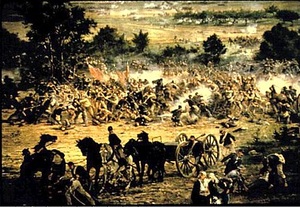
A Portion of the Gettysburg Cyclorama

The third existing historical cyclorama is titled "The Battle of Atlanta" and is on display in Atlanta, GA.  While this battle depicts the North's victory in Atlanta, it is still cherished as a reminder of the Confederacy's resistance to the decimation of Atlanta by General William Tecumseh Sherman.

There were many more of these huge paintings that were shown in traveling displays to hundreds of thousands of people.  Some titles included "The Battle of Shiloh", "The Battle of Second Manassas", and (the one that got me going in the first place) "The Battle of the Monitor and Merrimac". You might think that it would be hard to lose paintings this large.  After all, the combined paintings making up the cyclorama usually weighed about 10,000 pounds and, even rolled up, would have been 30 to 40 feet long.  Some were lost to fire, others were undoubtedly thrown out when the fashion for these paintings passed. Still others were cut up to make smaller paintings for framing.

One interesting footnote came to light almost in my backyard.  An artist named Joseph Wallace King of Winston-Salem, NC became obsessed with finding one of the missing Battle of Gettysburg cycloramas and stayed on the hunt for decades.  In the 1960s, he got word that one of them might be in a warehouse in Chicago.  When he went to the location, he was told that the old warehouse had burned down a few years before but he went in to the new one and found a fire-blackened back wall.  For whatever reason he thought there might be something behind the wall and talked the owner into letting him punch a hole through to check.  Behind the wall lay one of the stored copies of the Gettysburg cyclorama.  He bought the painting and brought it back to Winston-Salem and unrolled the paintings end to end in the Bowman Gray football stadium.  They even had to take the goal posts down to put all the pieces end to end. King died in 1996 while trying to get the paintings restored and redisplayed.  He bequeathed the cyclorama to Wake Forest University.  In 2007, three unidentified investors from Raleigh bought the painting from the University for a reported $10 million and are seeking other investors to restore and display it.

Cycloramas were the IMAX of their day.  They provided a spectacle and an immersive experience that took viewers to other places and other times.  In the days before motion pictures, they must have been truly extraordinary.  But like every technology, these massive paintings became a dated form of entertainment.  The painting that was found in the old Chicago warehouse was last displayed at the Chicago World's Fair in 1933 and was a Midway attraction, not even one of the major exhibits.

I wonder what the next century will bring in immersive experience.  With the rate of acceleration of virtual reality software it is likely that we will get to the point where we will be able to inhabit places indistinguishable from the real world.  We are almost there now. I can imagine a future virtual theater recreating an even more powerful rendition of the Battle of Gettysburg.  On the other hand, there have been so many battles since that epic conflict that it might be hard to chose which battle to recreate.

Further reading:

Saving the IMAX of its Day - American Heritage Magazine
The Velaslavasay Panorama
Official Website of the International Panorama Conference with lists of other panoramas by country.

Wednesday, August 11, 2010

Simulating the Industrial Revolution

The Industrial Revolution changed our world forever.  I was reminded of that yesterday when in the span of two hours I went from a museum exhibit on Antebellum cabinetmaking to an IMAX film on the Hubble Space Telescope.  Only 150 years separates a cabinet shop, in which every tool was hand-powered, from a Space Shuttle mission to repair an earth-orbiting  telescope.  Sometimes we lose track of just how far we have come and how fast we have gotten here.

But, not to worry.  If you want to relive some of that past, the gaming community makes it possible for us to go back and try our hand at building a facsimile of the business empires that drove the Industrial Revolution.  Three games which let us satisfy our closet fantasy of being a business mogol are SimCity, Railroad Tycoon, and Victoria II.

SimCity and Railroad Tycoon have been around for awhile but are still popular.  Originally introduced in 1989, SimCity continues to be the granddaddy of simulation games.  You can set the time frame of the city you want to build and then construct your city with industries, utilities, and services appropriate to those times.  SimCity continues to enjoy a strong following and has seen multiple updates over the years. 

Railroad Tycoon (the latest version being Railroad Tycoon 3) is another game that dates back to 1990.  In this simulation game, you get to build your railroad empire - complete with industries, old steam engines, and financial disasters.  Railroad Tycoon 2 introduced the concept of hiring Virtual General Managers - simulations of historical railroading figures.  Here is Wikipedia’s description:


It is interesting to notice that the variations introduced in the gameplay by each manager are somewhat based on the given managers' real-life personae, history and impact on exploitation and management methods. For example, hiring Eugene V. Debs as a General Manager will procure your exploitation with spectacular benefits that somehow fit well with Debs' personal involvement in the world of early 20th Century labor. As Debs' view of labor was socially oriented and aimed at the Common Good, so will hiring Debs as a Manager increase your railroad's popularity in the communities you serve. As Debs strove to procure a safest workplace for Train Crews during his early involvement as a Railway Union Representative, so will your railroad become safest and less prone to derailments and breakdowns. However, in order to make things harder on you, the game developers have decided that you can't hire Mr. Debs as manager until your railroad becomes very prosperous (it needs to be, since hiring Debs comes at a cost of $95,000 a year).

It looks like a new version of Railroad Tycoon is slated to come out this October.

The newest kid on the block is a game called Victoria II which is scheduled to be released this month.  Victoria II lets you pick a European country and guide it through the Industrial Revolution.  The games allow you to control natural resources, political parties, reform movements, colonization, and military conquest. What could be more satisfying than to build a thousand coal smoke-spewing factories and employ an army of itinerant and child laborers? Here's a small trailer for the game:


The Industrial Revolution was the result of a complex set of interactions between political, technological, and philosophical influences.  Academics are still pondering what really caused the Industrial Revolution to happen where it did, when it did.  While this game is no substitute for real scholarship, it can teach us a lot about a very dynamic time in our history.  The sense of being able to control at least some events in an omnipotent fashion is a very seductive way to learn.  Don’t get me wrong; I still favor good scholarship. I am jealous that of the three games, only SimCity is available to us Mac owners. I need to buy the PC simulator that runs on my Mac to play a simulation of the past world.  I am sure I would learn something.

[Pictures are all from Wikipedia]
[Victoria II Trailer from YouTube]

Additional Reading:

The Industrial Revolution, by Charles Beard, pub. 1919, on Google Books.