Showing posts with label innovation transportation. Show all posts

Tuesday, January 17, 2012

What's Needed for Successful Innovation?

In Sunday's New York Times, Susan Cain, who is an author and essayist, published a piece entitled, "The Rise of the New Groupthink". In this very well-written essay she more or less bursts the bubble of the current trend which prioritizes group activities over solo efforts. As she writes in her opening paragraph,


Solitude is out of fashion. Our companies, our schools and our culture are in thrall to an idea I call the New Groupthink., which holds that creativity and achievement come from an oddly gregarious place. Most of us now work in teams, in offices without walls, for managers who prize people skills above all. Lone geniuses are out. Collaboration is in. 
But there's a problem with this view. Research strongly suggests that people are more creative when they enjoy privacy and freedom from interruption. 

I couldn't agree with her more. In my 35 years of experience working in, and directing, R&D labs, I saw numerous examples of the best ideas coming from the solitary work of individuals. Team meetings had their place but not at the creative front end. This was the territory of the individual, not the team.

In thinking about what makes successful innovation tick, I see four things that are needed for successful (in this case, commercial) innovations:
  1. Very bright people who have the spark to think in new ways.
  2. Freedom for those individuals to explore their ideas without close supervision.
  3. Extreme persistence that provides the energy to surmount the inevitable naysayers.
  4. A very smart commercialization team that knows how to get the innovation to market.
When I was running R&D labs, I saw my job as identifying those people who had the really glorious new ideas and giving them space, time, and resources to flesh out their ideas. Often, my "management" meant wandering into their labs from time to time to have them show me what they were up to. Being willing to give them the support they needed quickly opened the door to their enthusiastically showing me their early ideas. The worst thing I could do would be to assign a team to them too early before the creative work was well along.

Our labs would often have fifty to a hundred technical people in them but not everyone had the creative spark. Many were more comfortable shepherding the creative ideas of others along the path to commercialization. It was never easy to pick out the really creative people during the hiring process.  Sometimes, those who seemed creative were just blowing smoke.  It often turned out that the quiet people were the really creative individuals. They were comfortable in the world of ideas more than they were in interacting with people.

Even so, getting a new innovation underway often took the combined efforts of both the innovator and supportive management. There was always a reason that the really creative ideas were deemed by upper management to be impractical or unattractive from a marketing perspective.  The innovator was often the best person to explain the technical nuances of his or her idea. My role in management was to wrap the idea in the acceptable attire of our business so that it wasn't seen as too outside the box to be acceptable. Often, ideas would percolate for years before suddenly becoming "obvious" to everyone that they should be commercialized.

At that point, getting a really good team of people together to go through the paces of manufacturing, marketing, perhaps regulatory approvals, and sales became the priority. Great teams could do wonders to get the idea out the door. But not all teams were great and many good ideas would languish for want of a strong commercialization team.

The inventors and innovators were often gratified to see their ideas go all the way through commercialization but that wasn't what motivated them. Their motivation came from the freedom to do it again -- to come up with another new idea.  They basked in the knowledge that they were appreciated for what they could create.  We all crave the approval of our peers. For them it came not through promotion to becoming a team leader but through the ability to have the space to explore their ideas.

In Ms. Cain's Times' essay, she quotes Steve Wozniak, the engineer who designed the Apple II computer:

Most inventors and engineers I've met are like me... they live in their heads. They're almost like artists. In fact, the very best of them are artists. And artists work best alone... I'm going to give you some advice that may be hard to take. That advice is: Work alone... Not on a committee. Not on a team. 

I couldn't agree more.

Thursday, December 29, 2011

Small Can Be Beautiful

I realize that the title of this post is something of a rip on E.F. Schumacher's book, Small is Beautiful, but small is not always beautiful. Sometimes small just leads to being crushed.  I started thinking about this when I was listening to an interview on the Diane Rehm Show on NPR. She was talking to  Stanford historian, Richard White, about his book, Railroaded: The Transcontinental and the Making of Modern America.

In his book, White lays out the mostly-sordid business history of the building of both the Transcontinental Railroad and other major expansions of the railroads in the late 19th Century. Railroads were the first large corporations in America. It was not possible to build something as capital intensive as a railroad without major investment. It was also not possible to operate such a large enterprise without layers of management. The Transcontinental Railroad was built mostly through political favors, bribes, and kickbacks. There was no business reason at the time of the Civil War that could justify building a rail line through mostly unpopulated areas. But the railroad got built because there was money to be made in railroad construction costs, land grants, and subsidies.

My purpose here is not to revisit the seamy sides of the railroad business. What got me thinking was how the railroads were once the dominant transportation system in the United States - at least for passenger travel. The over-used term of the time was how railroads "collapsed time and space", and it was true. Travelers depended on the railroads to get where they wanted to go. And in the late 19th Century, you could get almost everywhere on a railroad. Of course, you had to travel on the railroad's timetable and if the town you wanted to get to wasn't on a rail line, you were on your own.

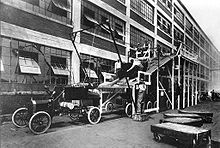
Model-T Assembly Line
At the end of the 19th Century, a laughably obscure technology began its unstoppable derailment of railroad passenger travel.  I refer, of course, to the automobile. From the very beginning, people loved the idea of being able to decide where and when to travel. Roads of the day weren't great, but people started to lobby for better roads. When Henry Ford's assembly line made the Model T affordable to almost every middle-class family, the automobile exploded onto the roadways.  For trips under a hundred miles, people would drive rather than take the train. They could leave on their own schedule and get to any town served by a road - even a bad road.  The family didn't have to have invest in a massive corporation to be able to drive. The large corporations like Ford Motor Company put the individual in charge of their own transportation.  It took decades, but gradually the railroads stopped running passenger trains and the country is now laced with interstate highways that carry the bulk of ground travel.  In the end, the individual would rather have control than give it to a large corporation. Small can be beautiful,

A second example is the main frame computer. When computing  came of age after World War II, it was the large companies like IBM that controlled the industry.  Once again, development was helped by government support - mostly from the Defense Department. Users were allowed limited access to these huge computing machines, mostly through leases to other corporations and universities.  The large capital required to build and operate these machines called for huge corporate investments and specialized technical people to operate the machines.

Then in the early 1980s, the personal computer became available from both Apple and IBM (and a host of smaller players). Computing was now available directly to the individual without an intermediary. People loved it. PCs were found in more and more homes and businesses. The individual became empowered and took control of computing virtually overnight. It didn't take the decades it took to move from the railroads to the automobile. Within a decade, PCs were ubiquitous. And those PCs when hooked to the emerging network called the internet gave people even more individual freedom to communicate and create thousands of new uses for the personal computer. Today, personal computers are in your pocket, in your smart phones, and tablets are becoming the new laptops. Given a choice, people will always opt for more control of their technology.

With these examples in mind, I started to muse about what the next big waves of personal control might be?  The starting point is to look for high capital intensity today. What demands a large corporation to provide the capital to make the technology possible?  I think it would be fair to eliminate those corporations that supply network services like power and oil companies. But even as I write this I think of Skype which has done a lot to eat into the phone companies' business. Maybe the two areas that might come to pass next are manufacturing and health care.

Right now, if you want a new widget, you have to look for someone who makes it and offers it for sale. But 3-D printing is changing the paradigm. Now, you can design or scan an object and send it directly to a 3-D printer that can pop a widget out in nothing flat. The technology is still early and you won't find a 3-D printer in your neighbor's house but give it a decade or two and see where we are. I predict that  manufacturing is going to undergo a sea change - and that sea change which will put more power into the hands of the individual.


The second area that comes to mind is health care. Right now, hospitals and clinics are capital intensive. Most people have to go to a physical facility to talk to a nurse or doctor. Medical records are closed for both privacy and competitive reasons. I think the forces of personal computing and the internet are going to change the way a lot of health care is practiced.  Small sensors built into your smart phone or tablet will measure your physical status and convey it to a doctor who will make electronic "house calls" to you via video links. For most minor situations, you will no longer have to go to the clinic or hospital to be seen.  Even for major procedures like surgery, you will be able to choose an expert who might live half-way around the world to do your procedure via robotic surgery.  Health care is ripe for change due to its taxing infrastructure and exploding costs.

People want control of their lives and technologies. New technologies that give them the sense of control at affordable costs will be rapidly embraced.  The world awaits the next waves of change. Small can be beautiful.

Tuesday, December 9, 2008

The Roots of the Industrial Revolution

I came across a very interesting television program that was produced for the BBC as part of the Millennium celebration. The series was entitled "The Day the World Took Off". It is a look at the roots of the Industrial Revolution in England and the events over a long history which enabled that revolution to happen. The episodes are available on YouTube and the first can be seen below:


You can watch the other episodes by looking at the links in the sidebar at the right on the YouTube page.

It is still a much debated question as to why the Industrial Revolution began where it did, when it did. Why the Midlands of England? Why the late 1700's and early 1800's? Why was the textile trade the first truly mass production industry? We like to think we understand the events of history and perhaps the historians really do. I am fascinated by the questions as well. But the answer(s) may be rooted in complexity, simultaneity, and even random chance. Still, the series is worth the time to at least ponder one set of ideas about this extraordinary point in time.

Monday, September 3, 2007

Sometimes Old is New


I recently visited San Francisco where I saw the usual gaggle of tourists lined up to ride the Cable Cars. Now don't get me wrong, I love the old cars myself. They represent a past that few cities have been able to preserve. But what really caught my attention were the Trolley Cars! The San Francisco Railway Museum has been actively engaged in building a Museum in Motion. They are making trolleys relevant again as a solid part of a public transportation system. The cars span many years and several vintages: old U.S. trolleys and so-called "PCC's". The cars have been refurbished and put back into active service. What a great idea!

A hundred years ago, every self-respecting city of even modest size had it's own trolley system. The trollies were born with the advent of efficient electric motors and generators in the late 1880's. Electricity was at least a decade or two ahead of the gasoline engines that powered automobiles. Trolleys and automobiles co-existed for the first half of the 20th century. With America's ever-increasing love affair with the car, however, the trolley lines were doomed. By the early 1950's most were gone. The lines were often taken over by unscrupulous businessmen who sold the assets for a quick profit. The tracks were ripped out, the cars scrapped, and the car barns torn down. Now, if you are lucky, you might still see a trolley car running on a mile or two of track as a tourist attraction (as I do in Minneapolis).

Folks here in the Twin Cities are now engaged in a (largely partisan) debate over whether we should extend the Light Rail line to more points than the single line we have today. I hope we do. San Francisco can help other cities to see how it can be done. San Francisco's trolleys are not just a tourist attraction. The newly refurbished cars are part of a working public transportation system that ties the past to the future. And the people love 'em. Sometimes Old really is New.