Showing posts with label engineering. Show all posts

Thursday, August 17, 2023

Seeing the Big Picture

 I know exactly where I was on the night of July 20, 1969. At 9:56 PM, Central Daylight Time, I was in front of our black-and-white television set along with the rest of my family. We were part of the 600+ million people around the world doing exactly the same thing at that same moment. 


Apollo 11 Moon Landing Live Broadcast 

Neil Armstrong went down the ladder of the Lunar Lander and stepped off the last step onto the lunar surface. Humanity had put a footprint on the moon. The sense of history-in-the-making was palpable to everyone watching. It was astonishing -- mind-boggling, really -- that we could be watching something happening in almost real-time from a distance of 238,000 miles on another celestial body!

I'm not certain, but our television was probably no more than 27 inches. I remember it was contained in a plastic box which probably weighed fifty pounds because of the heavy cathode-ray picture tube. Long before the internet or even cable television, television signals arrived via an antenna. The picture was often grainy. Color television had been introduced in the late 50s but it was still expensive and my parents didn't own a set. Color broadcasts were limited to selected programming, I remember that NBC introduced theirs with the colorful peacock logo. 

But color television made no difference that night because NASA had only installed a black-and-white video camera on the Lunar Lander. Color video would have taken too much weight and too much power. We were still thrilled to be watching. 

What made me think of all this was that I recently came across a photograph of NASA Mission Control at the Houston Space Center. On the large screen on the wall, you can make out the same black-and-white image of the first moon walk. Today, we think nothing of large video displays and it barely catches our attention.

Large Panel Display in Mission Control

But like everything else associated with the Space Program of that era, even the video displays were state-of-the-art. There were no color LED panels that now fill every niche of our lives. The conventional broadcast video technology of the day was created using the cathode-ray tube. But a display of the size in Mission Control would have required a cathode-ray tube with an enormous glass enclosure weighing tons and needing immense power. So how did NASA create such a display?

The answer was revealed to me when I posted the Mission Control photograph to a Facebook group dealing with old technology. People commented almost immediately about the video display. It was created with a technology called Eidophor. I had never heard of it. 

A little more researching on Wikipedia and YouTube enlightened me further on what this was all about. What you see in the photo of Mission Control is only the front portion of a much larger room. Behind the wall was another room at least as large and painted matte black. Technicians called it the Bat Cave.  The equipment needed to project these displays filled the room as you can see in the schematic below. 
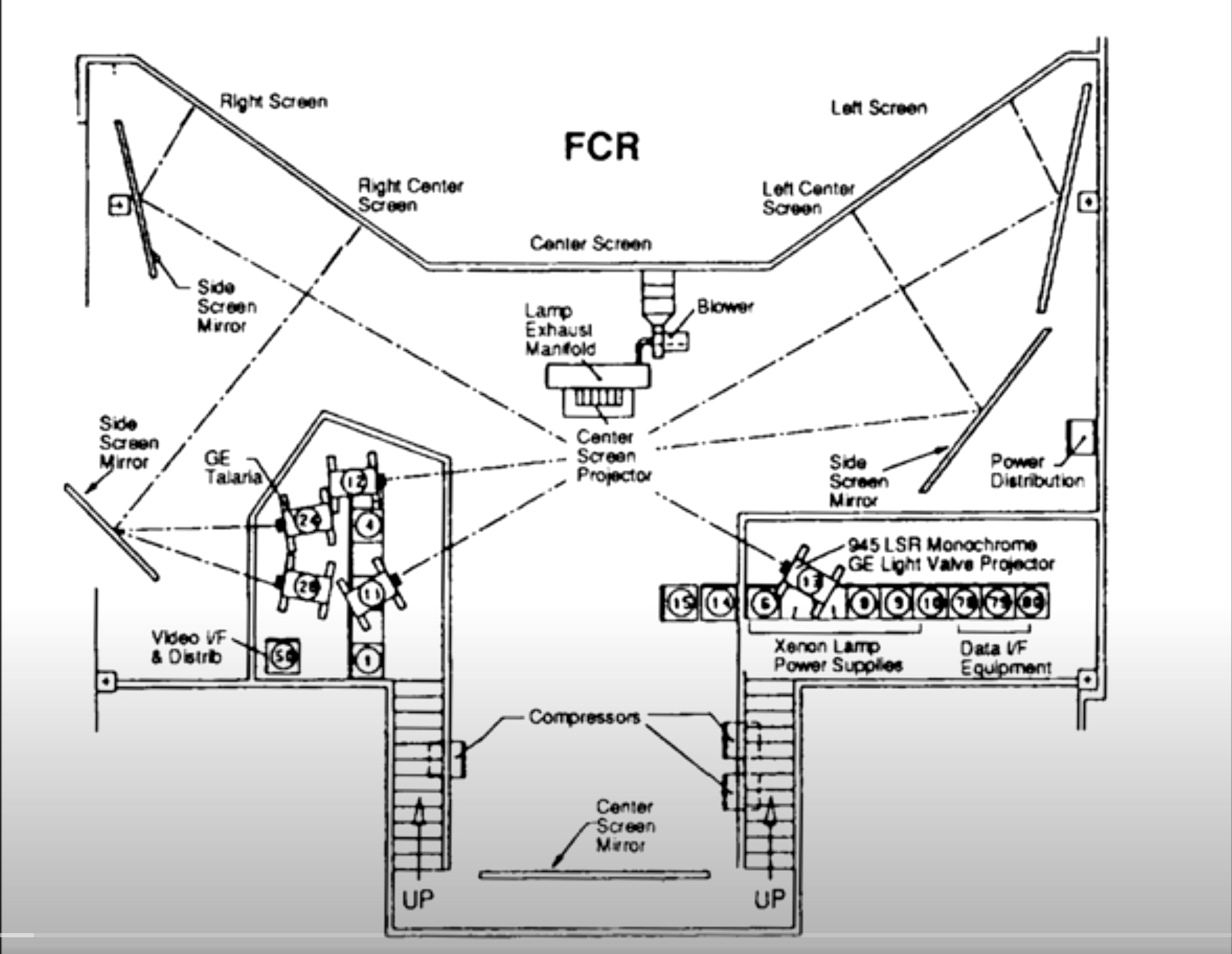
Layout of Bat Cave

The Eidophor projectors themselves were marvels of technology as can be seen in the drawing. Read Wikipedia if you want to know more. 


Schematic of Eidophor Projector


These projectors were around for a while beyond the Apollo missions and were used for sports events, rock concerts, and other large-screen applications. By then they had shrunk considerably from the NASA days but were still formidable hardware systems.

Refined Eidophor System


Today, flat-screen LED and OLED technology is so good that an 8K image can be displayed for a fraction of the cost and a fraction of the power. Cameras on spacecraft have also improved so much that we can now watch full-color, hi-def video in virtually real-time. 

On Feb. 18, 2021, the Mars Rover, Perseverance, made an extremely complex and completely autonomous landing as we all watched both the descent vehicle and the Rover as the maneuver was accomplished. We might even have been watching on our Smartphone while sitting at a local coffee shop enjoying a latte. 


We have come a long, long way in fifty years. Sadly, almost no one could tell you where they were on Feb. 18, 2021 when Perseverance landed. We take so much for granted.  Time for a refill of my coffee. 

"Making the simple complicated is commonplace; making the complicated simple, awesomely simple, that's creativity." 
- Charles Mingus

Tuesday, August 7, 2012

Curiosity: The Rover

"The top of the atmosphere down to the surface... it takes us seven minutes. It takes fourteen minutes or so for the signal from the spacecraft to make it to earth - that's how far Mars is away from us. So when we first get word that we've touched the top of the atmosphere, the vehicle has been alive or dead on the surface for at least seven minutes."

- Adam Steltzner, EDL Engineer


By now, we all know that the new Mars Rover, Curiosity, is safely on the surface of the Red Planet. But I think it is worth taking a minute to marvel at the complexity of simply getting something the size of a small car successfully onto the surface of Mars.

It begins with a launch vehicle to get the massive payload off the earth's surface and into a trajectory to intersect with a planet over 350 million miles away. It continues with getting the probe into orbit and then, most amazing of all, landing something this big as gently as you might have your car lowered to the service shop floor after an oil change. And the kicker in all this: it has to be done automatically with no intervention from earth. The distances involved are just too large to have any real-time control.

NASA and Cal-Tech's Jet Propulsion Laboratory is the nerve center for this adventure. They produced a wonderful simulation video of what was involved in getting Curiosity onto the surface.  You can watch it here:


Why spend a billion dollars to put a one-ton rover on the surface of Mars? The name says it all - Curiosity. When we stop being curious, we stop living. We stop being the best we can be as humans.  Curiosity is going to bring us many more surprises in the coming weeks and months.  The payback will be worth the money.

So here's to the engineers!  Let's take a moment to stop and think about what they just did.  Simply amazing!

Monday, October 11, 2010

Grand Challenges: Keys to Future Training

How do you know when a new technology is becoming mainstream?  Conversely, what trends can you afford to ignore?  Where are the signals that suggest permanence - or at least a long run?  I wouldn't put my money on media hype.  The New-New can very quickly be about as appetizing as yesterday's oatmeal.

One sure indicator of a technology that is here to say is the emergence of training programs.    When employers are looking for skilled people, it is safe bet that the early risks of new technologies have passed.

If you look back at technology history, you can see the pattern.  In the late 1400s, the craft of printing exploded.  Printing was taught as a legitimate craft complete with guilds and master craftsmen.  In the 19th century, engineering emerged as a recognized discipline that was capable of far more than what had been the domain of the earlier military engineers.  Huge public works like the Erie Canal were built in the early 1800s by self-taught surveyors.  By the latter half of the century engineering, lead by civil engineering, was a mainstay at many larger colleges.  Specialty schools were founded which focused solely on science and engineering (e.g., MIT, CalTech, RPI, etc.).  In the last thirty years the emergence of the discipline of computer science has attracted students who wanted to work on the cutting edge of technology.

So what are the new training programs that are emerging that foretell the next wave of mainstream technology?  A quick scan of leading technology universities hints at some directions but one organization that cuts across many of the leading institutions is the National Academy of Engineering.  The leadership of the NAE has pulled together a list of what it calls Grand Challenges that represent some of the major issues facing our global society.  Here's the list:


  1. Make solar energy economical
  2. Provide energy from fusion
  3. develop carbon sequestration methods
  4. Manage the nitrogen cycle
  5. Provide access to clean water
  6. Restore and improve urban infrastructure
  7. Advance health informatics
  8. Engineer better medicines
  9. Reverse-engineer the brain
  10. Prevent nuclear terror
  11. Secure cyberspace
  12. Enhance virtual reality
  13. Advance personalized learning
  14. Engineer the tools for scientific discovery


When I looked over the list, it didn't seem to me that all these challenges were defined from the same altitude.  Some are very broad (e.g., prevent nuclear terror), while others are down in the trenches (enhance virtual reality).  But some broad themes emerge and these would be good bets for training for the future.  I would categorize the themes as energy, the environment, better health care, security, and retooling learning.

Energy and the environment are no brainers.  If we don't start to take these seriously, we will be in a world of hurt. The trick is to move mega-issues like these down into actionable projects which demand trained people.  There is, however, the little matter of who will write the paychecks?  The most sustainable solution is for private enterprise to emerge as a leader but at this stage it will take a public-private partnership to prime the pump.

Better health care is not new but two forces are coming into play to change the game.  The first is the diminishing viability of the old health care model.  This encompasses everything from HMOs to the pharmaceutical drug discovery model (which, as they say, is busted).  The cost increases in the current model are just not sustainable.  But help may be on the way in the form of sophisticated heath informatics to outline better and more cost-effective treatment protocols.  Bioinformatics is at the core of genomic medicine.  Computational power will have even higher leverage in health care in the future.

Another theme in the Grand Challenges is retooling learning.  Again, forces are in direct collision.  The current public education system in this country is failing miserably.  Government initiatives that demand uniform testing may be of some help but the bigger problem is that society, and particularly the family, are being redefined in the Age of Globalization.  On the positive side, virtually every college in the country now has so-called distance learning.  If you don't care about college credit, they even give away courses for free on the web.  The Gates Foundation is focusing billions on improving public education as they research new tools and techniques.  In the end, however, education takes individual concentration and effort.  No amount of technology replaces the desire to learn.

If I were going to college today, choosing a path from the Grand Challenges list would be a good place to start.  In the end, however, it is good to remember that every training and college program is willed into being by a demand for people with particular skills - skills where the demand outstrips the supply. We need to do all we can to make sure the demand is there.  The supply will follow naturally.

Sunday, April 4, 2010

Stopping a 70-Foot Long Truck On a Dime

Driving on I-95 today, we passed many semi-trucks (and a few even passed us).  As we passed these 53-foot rigs (that's just the length of the trailer, not the whole tractor-trailer which is closer to 70 feet), I was thinking back on one of my earlier careers where I worked for a time developing anti-skid braking systems for big rigs like the ones we were passing.

In the early 1970's, the Federal Government passed a law that said that heavy trucks (e.g., tractor-trailers, cement carriers, and even school buses) had to be able to stop in a straight line within something like 350 feet from a speed of 60 mph.  While the regulation didn't specify how this was to be done, the only practical way was by using anti-skid (otherwise known as antilock) brakes.  Brake systems like this had long been employed on passenger aircraft and the systems were becoming more common on automobiles.  But antilock brakes were completely new to trucks.  The trucking companies hated the idea.  It would mean that they would have to invest in expensive, new (and as yet unproven) technology.  To save money in those days, lots of trucking companies would take trailers on the road with at least some of the wheels having brakes that were known to be defective.  With the mandate, not only would they have to buy the antilock systems, they would have to actually fix the brakes.  I thought about this often as I was next to a truck on the highway.  I still do.

Nonetheless, the braking requirement was already a law and we set about developing a system that would work on heavy trucks.  I will spare you the gory details except to say that we finally managed to get a system working.  The company that I worked for (Kelsey-Hayes) had a test track that had been an Army Aircorps runway during World War II.  Here I was, a 25-year old engineer, driving a truck that was configured to weigh as much as a fully loaded cement truck, going down a runway at 60 mph.  The truck had been fitted out with our antilock brakes and in the cab next to me were all of these recording instruments to measure various parameters of the braking system while we put it through its paces.

After getting up to speed and making sure everything seemed to be working.  I literally stomped on the brake pedal to see how fast I would stop this monster.  I don't think I can convey what it felt like to be riding in this rig that seemed to actually be hopping down the pavement like some bucking bronco as it shuddered to a halt.  The instruments were banging back and forth against the dash...and so was I.  But the truck stopped in the required distance.  I had to peel my fingers off the steering wheel and sit there for a few moments before I could even look at the test results.

A system like this is never developed in one test or even a hundred tests, but eventually we had a working system.  And what happened?  The trucking companies lobbied the government and had the law rescinded.  Antilock brakes were no longer required and without the legal mandate, there was no market. Our system died.  As far as I know, they are still not required on heavy trucks.

I have driven a lot more miles over the intervening years and I have seen quite a few accidents where trucks have either careened off the road or been involved with multi-vehicle crashes.  I often wonder what might have happened if these trucks had been equipped with antilock brakes?  I know it wouldn't have prevented all these accidents but I believe that it would have helped.  But when the choice for the trucking companies came down to cost or safety, cost won.

From what I read, the NHTSA has had a mandate in place for a number of years which requires a stopping distance from 60 MPH of 335 feet or less.  In 2012, the mandate is going to get even stricter.  Heavy trucks will have to be able to stop in 225 feet.  There is still no explicit requirement for how the technology to meet the requirements but at least the limits are getting tougher.  Who knows?  Maybe a new generation of young engineers will develop the antilock truck brakes that we had attempted to bring to the highway.  I hope so.

Thursday, March 25, 2010

Book Notes: The Brooklyn Bridge


The Great Bridge:  The Epic Story of the Building the Brooklyn Bridge, by David McCullough, Simon & Schuster, 1972, 636 pages.


A Picture History of The Brooklyn Bridge, by Mary J. Shapiro, Dover, 1983, 122 pages.


May 23, 1883 was the last day that people commuting between New York City and Brooklyn needed to take a ferry.  The next day, the Brooklyn Bridge was officially opened for business.  The opening celebrations that day included everyone and anyone who was a dignitary or connected to the building of the bridge.  The review committee was headed by President Chester A. Arthur and Governor of New York, Grover Cleveland.  The mayors, the aldermen, the trustees of the bridge company, all were in attendance.  Everyone was there except the Chief Engineer, Washington Roebling.  Roebling, in fact, had not set foot on the bridge once in the entire 14-year history of the construction of his bridge.  That fact is part of what makes the story of the building of the Brooklyn Bridge such an epic.  And no one writes a better historical narrative than David McCullough.

I read McCullough's book just this week.  I must confess, for someone who professes to enjoy all things historical about technology, I have had his book for years but it has gone unread.  Maybe it was my reprinting his speech on history here in this blog a few weeks ago.  Maybe it was the fact that I came across Mary Shapiro's wonderful photo documentary of the bridge in a used bookstore.  Whatever the reason, I sat down and started to read them both together.  I am so glad that I did.  McCullough writes beautifully about the characters and events that shaped the bridge.  He writes at great length about the engineering and the construction of the bridge itself.  But when it comes to visualizing something so complex, the old saw that "a picture is worth a thousand words" remains true.  The Great Bridge does have photos and illustrations in the middle of the book but there are so many more good photos and engravings in Shapiro's Picture History.  If you are interested in reading McCullough's book, I would seriously suggest getting a copy of Shapiro's book as a reference companion.

As the subtitle of McCullough's book suggests, the building of the Brooklyn Bridge really was a saga.  Construction of a bridge across the East River had been thought about for years - as far back as 1811 when Thomas Pope imagined his Rainbow Bridge that I wrote about a while ago.   It was on an East River ferry that became trapped in the ice in 1852 that John A. Roebling conceived of an idea for a great bridge spanning the river between New York and Brooklyn.  John Roebling was the pre-eminent bridge builder in America and with him that day was his young son, Washington Roebling.  Because of the Civil War and economic problems, construction of the Brooklyn Bridge would not start until 1869.

John Roebling was the engineer who designed the bridge, including its massive gothic towers and the multiple traffic lanes and pedestrian walkway.  But on June 28, 1869, before any work could be done on even the footings of the bridge towers,  John Roebling badly crushed his foot in an accident at the ferry dock.  He contracted tetanus and died a horrible death 24 days later.

From the beginning, John Roebling had intended that his son, Washington, would be the Chief Engineer on the bridge.  Washington Roebling (photo) was trained as an engineer at Rensselaer Polytechnic Institute in Troy, New York.  In 1861, Washington enlisted as a private in the Union Army.  Over the course of the Civil War he would become a hero at Gettysburg and finally resign his commission in 1865 at the rank of Colonel.  Shortly afterwards, he joined his father in Cincinnati to help him complete the suspension bridge over the Ohio River (the bridge still stands today).  Washington Roebling was no novice when he assumed full responsibility for constructing his father's design in 1869.

The building of the bridge was inevitably linked to politics and scandal in both New York City and Brooklyn.  Boss Tweed of Tammany Hall was an early backer of the bridge and it was only Tweed's downfall from other disclosures that removed that particular opportunity for pillaging the public coffers.  Politicians were always trying to use the bridge for their own political purposes.  Through it all, Washington Roebling refused to become embroiled in any of the controversies or to bend to any of the political pressures.

Washington Roebling himself would be crippled for years afterward from Caisson's Disease, otherwise known as the Bends, when he was down in the New York caisson, 70 feet under the East River, in December, 1872.  Roebling was in such pain that he requested a leave of absence and from that time forward performed all his duties as Chief Engineer by mail and written instructions.  His wife, Emily, acted as his corresponding secretary, caretaker, and confidant.  She became well-known to the assistant engineers of the bridge and later would often visit the construction site to convey instructions from her husband.  By unanimous choice, Emily Warren Roebling was the first person to walk across the decking of the bridge when it was completed in late 1882.  The Brooklyn Bridge was very much a family legacy: father, son, and daughter-in-law.  It is a story about honorable engineers and far less honorable politicians.  Mostly, it is a story of the triumph of will - personal and collective.

The Great Bridge was McCullough's second book following The Johnstown Flood (1968).  Several publishers offered him advances to write other disaster stories including one on the San Francisco earthquake of 1906.  But McCullough decided that he didn't want to become labeled as a writer of disaster stories and wanted instead to write a positive story - the building of the  Great Bridge.  Virtually every book after The Great Bridge has won McCullough awards, including two Pulitzers (Truman and John Adams).  If this book had come later in his series of books, it probably would have won a Pulitzer as well.  But the book did receive wide-spread critical acclaim at the time and now, 38 years later, it is still in print and still thought to be the single best history of the building of the Brooklyn Bridge.

McCullough began his book with a quote from Montgomery Schuyler, written for Harper's Weekly, May 24, 1883 (the day the bridge opened).  Shuyler was in some ways the first of the architectural critics in this country.  Schuyler wrote:

It so happens that the work which is
likely to be our most durable monument,
and to convey some knowledge of us to the
most remote posterity, is a work of bare utility;
not a shrine, not a fortress, not a palace, but a bridge.

Note:

If you are more the visual type, instead of reading the books I would recommend watching Ken Burns' 1981 documentary entitled The Brooklyn Bridge.  David McCullough is the narrator.  You can download the video from iTunes for a couple of bucks.

Saturday, February 27, 2010

Thomas Pope and the First Brooklyn Bridge

Thomas Pope was a carpenter, a landscape architect, a bridge designer, and a poet.  In 1811, he published the first book ever written in the United States on bridge building entitled, A Treatise on Bridge Architecture in Which the Superior Advantages of the Flying Pendent Lever Bridge Are Fully Proved.  You can find the entire book online at Google Books.

Pope's book gives a detailed history of many bridges around the world and throughout history.  His illustrations are certainly part of the fun of the book.  I have provided a few of them below.  You can see more in the online book.


The most interesting part of the whole book is Pope's proposal to build what can only be seen as a futuristic vision of a cantilever bridge to span the East River between New York and Brooklyn; the first design of a Brooklyn Bridge.


Pope proposed a wooden structure over 1800 feet long and with a free height at its center of over 260 feet!  Pope anticipated by fifty years that bridges that were cantilevered would be built as self-supporting structures from each shore until they connected in the center.  The fact that his bridge design was unbuildable because it was made of wood, a material not strong enough for the span, does not detract from many of his insights.  The clean simplicity of his cantilevered arc design would not be seen for almost 200 years.

Pope's book is filled with bridge history, data, and designs, but these are also accompanied by long stanzas of poetry.  The illustration above contains a few of the opening lines of a poem about his proposed bridge.  They read (and the verse continues):

Let the broad arc of the spacious HUDSON stride,
And span COLUMBIA'S rivers far more wide;
Convince the world AMERICA begins
To foster arts, the ancient work of kings.
Stupendous plan! Which none before e'er found,
That half an arc should stand upon the ground,
Without support while building, or a rest;
This caus'd the theorist's rage and sceptic's jest.
Like half a rainbow rising on one shore,
While its twin partner spans the semi o'er,
And makes a perfect whole, that need not part,
Till time has furnish'd us a nobler art.

[Caps in original]

Pope's bridge was never built.  But the idea of a bridge to span the East River would not die.  Finally, the Brooklyn Bridge, an icon of American architecture, was completed on May 24, 1883.  It remains one of the most beautiful bridges in the world.  But the dream started with Thomas Pope.  And some dreams just will not die.


Friday, February 5, 2010

The Book Wheel and the Origin of Technology Books

I love books.  I have piles of them sitting on my desk and in my family room in various stages of being read.  I came across the Book Wheel and thought how cool it would be to have one.  As real as it looks, the Book Wheel was never built.  It was a "paper invention" of the Italian military engineer, Agostino Ramelli (1531 - 1600).  The illustration was published in 1588 in a book entitled, The Various and Ingenious Machines of Agostino Ramelli.  
The book belongs to a genre called Theater of Machines.  These late Renaissance books were some of the first printed books with detailed technical illustrations.  The term Theater of Machines comes from the first book of this type published in 1571 or 1572 by Jacques Besson (1540 - 1573), a French mathematician and failed clergyman. His book was entitled Theatrum Instrumentorium et Machinarum (Theater of Instruments and Machines, hence the name of the genre).  The Smithsonian has a copy of both Besson's and Ramelli's book in their Dibner Library.  You can flip the pages of the books virtually using the hotlinks.

Besson started something big with his Theatrum Instrumentorium.   These Theater books were showpieces that were designed to impress the reader with the technical sophistication of the author.  Almost all of the illustrations are fanciful inventions that were never built - and might not even have worked.  But for the first time they provided clear illustrations of mechanisms, gears, and other mechanical devices that were later incorporated into truly useful machines.

Before the Renaissance, almost all technical work was done by craftsman who passed their knowledge down orally from master to apprentice. Most of these skilled craftsman were illiterate or at best, sub-literate.  Moreover, the skills they taught were often quite literally "trade secret", the means by which they protected their business.  There was no other practical means of legal protection of intellectual ideas.
Everyone knows that Leonardo da Vinci (1452 - 1519) kept extensive notebooks of his ideas for machines.  But Leonardo kept his notes secret.  He even wrote in a code (he taught himself to write in the mirror image of script) that was only intelligible when viewed in a mirror.  He did not disclose these works during his lifetime.  Another Renaissance Man, Fillippo Brunelleschi (1377 - 1446), who built the dome on the cathedral in Florence, deliberately left no records at all of how he achieved his engineering masterpiece.

The Theater of Machine books were very well received.  But books like these were rarely produced before the advent of moveable type printing in the mid-1400's.  They also needed the invention of linear perspective drawing (another Brunelleschi invention of around 1425) and the availability of copper engraving plates around 1500.  The copper engravings showed much more detail than previous woodcuts.

In the 1600's, there was a veritable explosion of technology books.  Many were plagiarisms of the Theater books and other texts but the result was the same:  technical knowledge began to diffuse to other countries and other craftsman to be incorporated into new machines.  Drawings became ever-more refined with details describing dimensions, tolerances, materials, and processes for fabrication.

In 1790, when patents finally emerged as a means of protecting inventions in America, the Patent Office required a drawing, a written description, and a working model.  The latter was because drawings still did not convey the essence of how mechanical details might work.  The model requirement was dropped in 1880, partly because drawings had improved but mostly because the Patent Office ran out of room to store the models.

What put me on to all of this was an entry in a book I am reading entitled, Engines of Change: The American Industrial Revolution 1790 - 1860, by Brooke Hindle and Steven Lubar (published by the Smithsonian in 1986). Hindle and Lubar described the Theater of Machines books which led me (via Google) to a wonderful blog named BiblioOdyssey which focuses on illustrations from books of all ages.  This blog is well worth a visit for the diversity of books and illustrations that are presented.

Now, if I just had my Book Wheel...

Monday, July 20, 2009

Even Apollo Required Mundane Fixes


I wrote in my last blog about the new images of the moon which show the Apollo landing sites and even the astronauts, footprints on the moon. The photos also show the scientific experiments that were placed there to monitor the geophysical makeup of the moon. These experiments were collectively called the Apollo Lunar Surface Experiment Package (or ALSEP). Each Apollo mission carried a set of experiments but the mix of experiments was different on every flight. [The image to the left was from Apollo 16 and you can see the Lunar Rover in the background next to the Lunar Lander.]

I began working for Bendix Aerospace Systems Division in Ann Arbor, Michigan in 1970, right after graduating from the University of Michigan. Bendix was the prime contractor for the ALSEP experiments. The Apollo 11 and 12 missions had already successfully landed on the moon by the time I joined Bendix. Shortly after I started, the Apollo 13 disaster occurred (April, 1970) and it set back subsequent missions by more than a year. I was involved in engineering efforts on all the subsequent Apollo science packages (14 through 17).

A little background about the experiments: ALSEP was designed to be a package of experiments that shared a common communication and power source. The Central Station housed all of the communications electronics and telemetry systems. It is the tall, gold structure in the photo below. The antenna for transmitting data is the pole-like object on top of the Central Station. The gold is actually metal-coated mylar-plastic film and it was used to control the thermal environment inside the Central Station. Keep in mind that the moon in the daytime is over 200 degrees F and it is -200 degrees F at night. That is a tough environment and controlling the temperature in the electronics in all of the experiments was a major challenge.


The little gray, finned object to the left and behind the Central Station is the Radio Thermal Generator or RTG. It is the power source for all of the experiments. Electricity is generated by converting the heat from a Plutonium-238 fuel cartridge inside the RTG. As an aside, one of the Apollo 12 astronauts said that he could feel the heat from the Plutonium cartridge all the way inside his space suit when he was loading the cartridge into the RTG. That's hot (in more ways than one)!

The silver disk-like object in the foreground is actually a lunar seismometer, part of something called the Passive Seismic Experiment or PSE (the program just loved acronyms). It was designed to measure "moonquakes". Actually, you are not looking at the seismometer but at the thermal shroud (think blanket) which covered the seismometer. The instrument was so sensitive that if it had been directly exposed to the lunar day and night, it would have "creaked" due to thermal expansion and contraction. Even with the thermal shroud, it still creaked a little and buggered up the data.

All of the experiments (and there are three more that are out of the picture) were connected to the Central Station by cables. You can just make these out in the photo as copper/gold-colored ribbons in the lunar soil. They really were ribbons, by the way, ribbons that were about three inches wide, each of which carried multiple wires.

By the time I got to Bendix, the system and the experiments had already been designed (the work started in 1966). Bendix was in the process of building the final instrument packages and testing them to make sure they were ready for their missions. As a young engineer, my job was to work on problems that came up from experiences on previous missions. One of those experiences happened on the Apollo 16 mission. Astronaut John Young was deploying some of the experiments when his boot became entangled in one of the flat-ribbon cables. With the bulk of his suit and the changed sensations of lunar gravity, he was completely unaware that he had snagged a cable. When he moved, he accidentally tore the cable out of the experiment (it was an experiment for measuring heat flow) and the experiment was wrecked. Several million dollars gone in an instant. You can see this happen in the movie below if you start watching around the 11:36 mark. (The whole movie tells the story of the Apollo 16 mission. It is worth watching.) [movie from Internet Archive]


I was at work the afternoon that the ALSEP deployment was being broadcast live from the moon. We were all in a conference room watching a television and we could see Young get tangled up in the cable and everyone in the room started yelling at the set as though Young could hear us. There was a palpable gasp that went up from the group when we saw the cable snap. We knew before Young did that it was not going to be repairable. It is just not possible to put a broken cable back together on the surface of the moon.

Not surprisingly, shortly after the mission, orders came down from NASA to look at ways to prevent this from happening again. Despite the best of planning, nobody had really thought about strengthening the cable connections. Each of us has tripped over an extension cord or laptop power cable sometime in our lives. Usually, a plug pops out of its receptacle but sometimes plugs can be damaged or broken. Same here. But there were no plugs to come undone (the cables were hardwired in place). The cable snapped. My job was to design a better cable strain relief that would withstand the impact of a skipping astronaut in full gear. We couldn't change the basic cables so we had to find a way to spread the load out. A combination of well-rounded mounting brackets and reinforcing fiber tapes seemed the best way to get the job done.

But how do you test something like this to know it will work? You can't go to the moon to do it. We rigged up a test system in the lab and enlisted our "test astronaut" to see he could break the cables in a deliberate accident. What you see in the first picture below is the ALSEP package of experiments (a non-flight model) in the form that it is stowed in the Lunar Lander and before it is unpacked. Attached to the front of the package is our redesigned test cable with a heavy lace to put around the test astronaut's leg. Yours Truly is standing with my back to the camera in the stripped shirt.


It didn't seem like a fair test to have the high friction between the bottom of the ALSEP package and the floor of the lab so we put the package on a greased plate to decrease the friction and more closely simulate the friction in the lunar dust.

The next photo shows the test in progress with the astronaut putting his full weight into the cable. Two assistants stood on either side of him to catch him if he fell. You can see the cable snap taut.


The last photo shows me examining the cable stress relief after the test. It worked; the cable was intact and fully functional. This wasn't the only testing but it was the most convincing. We retrofitted all of the cables on the Apollo 17 mission with the new strain reliefs. Of course, the astronauts were now extremely mindful of getting tangled in the cables and nothing untoward happened on that mission.


Complex missions like the Apollo Program were staffed by tens of thousands of engineers doing the same sort of unglamorous, day-to-day jobs like fixing cables. Nothing is perfectly designed the first time. Not every contingency can be planned for. (If you want to see the ultimate example of this, rent the movie Apollo 13). To tell the truth, many days were pretty mundane but I still feel proud of the fact that I was there and had a tiny part in the Apollo missions. We have so few things in life that command the kind of vision that the Apollo Program did. It brought out the best passions in so many people. As Georg Hegel, the German philosopher said, "We may affirm absolutely nothing great in the world that has been accomplished without passion." Apollo proved that to me. I wish there were a comparable challenge to stir the dreams of the next generation.

Postscript: The ALSEP packages went on sending back data until September 30, 1977 when for the reason of budget cuts, the experiments from all the flights were powered off to save costs on the earth-side monitoring station.

P.S.S. Today mark's the 40th anniversary of the first lunar landing on the Apollo 11 mission.

Saturday, July 18, 2009

Return to Apollo

NASA reported this week that for the first time the Apollo Lunar Modules have been able to be visualized from a new satellite named the Lunar Reconnaissance Orbiter (LRO) which arrived in lunar orbit on June 23, 2009. In the image below you can see the the Apollo 14 Lunar Module Base on the right and the scientific experiment package on the left with footprints traversing between the two sites. This is incredible detail for an orbiting imaging satellite.


The images (all the sites except Apollo 12 have been imaged so far), are particularly timely given the 40th anniversary of the first lunar landing coming on July 20th. I can remember being glued to my television set at home that summer day watching the commentary provided by Walter Cronkite. I was saddened to hear that Mr. Cronkite died yesterday at the age of 92. For me, he was the voice of the Apollo lunar missions. The New York Times has a number of video clips of Cronkite on their website including this video of the Apollo 11 Lunar Landing in which he is visibly moved by the landing. We all were.


I didn't know at the time I was watching the first landing that within a year after college graduation, I would be hired by Bendix Aerospace Systems Division which had the prime contract to design and manufacture the Apollo Lunar Surface Experment Package (or ALSEP in the jargon of the day). I worked on experiments that were flown on the later Apollo 14 through 17 missions. Those were exciting times when as a nation we could feel good about some of our accomplishments. The quagmire of Vietnam eventually brought the Apollo missions to a premature conclusion with the cancellation of Apollo flights 18, 19, and 20.

When I think now about how primitive our technology was in the late 1960's, I am all the more impressed with the accomplishments of the NASA team. Despite the subsequent successes on SpaceLab, the Space Shuttle, and the International Space Station, we have not yet surpassed that "one small step" which was taken on a day in July forty years ago.

Tuesday, April 15, 2008

The Art of Riveting


I was interested to read a recent article by William Broad in the Science section of the New York Times entitled "In Weak Rivets, A Possible Key to Titanic's Doom". The article summarized investigations by historians of science who have looked into the question of whether Harland and Wolff, builders of the Titantic and her two sister ships Olympic and Britannic, used sub-standard rivets on the Titanic (see my previous post about these ships). Deep submersibles investigating the Titanic's wreck site have seen that the plates in the forward part of the ship's plates sprung open from the impact with the iceberg. The bow and stern of the ship were put together with iron rivets while the center, higher-stressed, portion of the hull was riveted using stronger steel rivets. The evidence seems to suggest that poor quality material and poor riveting techniques lead to brittle rivets which fractured more easily when the ship hit the iceberg.

What caught my eye in the article was a description of the riveter's art:

In their research, the scientists, who are metallurgists, found that good riveting took great skill. The iron had to be heated to a precise cherry red color and beaten by the right combination of hammer blows. Mediocre work could hide problems.


This really speaks to my blog of a couple of days ago about defining what is technology? The Greeks would have easily called the art of riveting "techne". It was something that took a highly skilled and experienced worker to do correctly. Done right using good material, iron rivets were perfectly acceptable fasteners. But done poorly (the builder couldn't find enough qualified riveters for the massive project) and with inferior materials (the iron ordered was often of a lower grade), then the integrity of the rivets were very much in question.

The article went on to describe how iron gave way to steel in later riveted construction and hand riveters were upgraded with automatic riveting equipment to insure more consistent results. Certainly, these were steps in the right direction to insure the safety of structures. But somewhere along the way, another art died, the art of the hand riveter. We probably don't need many of them anymore but it is a great example of how so many other artisans have disappeared to progress. Stone masons, wood carvers, glass makers, steel workers, these occupations and more have become part of the "lost arts", part of the "lost techne". TItanic was lost for the lack of techne.

Sunday, February 24, 2008

The Roads More Traveled


I live in Florida during the winter. My house is about two miles from I-75. If I go south on the Interstate, I will reach the end of this highway in about 200 miles at Hialeah, FL. From Hialeah, it is 1785 miles to the terminus of the highway in Sault Ste. Marie, Michigan. I spent most of my childhood growing up in the "Soo". My dad still lives there.

We take the Interstate highways for granted. They connect us in a highway grid that lets us get to virtually any area of the country. According to Wikipedia, there are 46,837 miles of road in the Interstate Highway system. The need for the highway system emerged from experience during World War I when the army found that the railroads could not transport all the needed supplies to support the war effort. Truck convoys were added to supplement the railroads. I can just imagine what that must have looked like in 1917. In 1919, Lieutenant Colonel Dwight D. Eisenhower set off from Washington on a coast-to-coast truck convoy to San Francisco to explore highway readiness in the event of another war. His experience then, coupled with his later experiences with the autobahn in Germany during World War II convinced him of the need for a high-speed national highway network. At the urging of President Eisenhower, legislation was passed in 1956 to begin the network and it was completed in 1991. The cost was originally projected to be $25 billion. The 2006 estimate for the cost of the system is $425 billion.

I was prompted to write about the highway system while reading a book called, Are We Rome? by Cullen Murphy. Murphy draws many parallels between the United States and the Roman Empire. Murphy points out that this is not a new idea. The Roman Republic was, in fact, the model of the Founding Fathers. Murphy makes the comparison of the Roman road system to the Interstate highways. The Roman system at its peak consisted of about 53,000 miles of roads. The rationale for the two systems was the same: a way to rapidly move military supplies. The Roman mileposts were all tied to a Golden Milepost in the Forum in Rome. The Zero Milestone of the Interstate system lies in the Ellipse in Washington, just south of the White House. The old saw, "All roads lead to Rome." was based not only on a political reality but an engineering one as well. The same could certainly be said for Washington, DC today.

The Interstate highways make our lives immeasurably easier (disregarding the traffic jams around major cities). But they need to be maintained, not something we seem to be fond of doing. Just last summer, the I-35 Bridge over the Mississippi River collapsed in Minneapolis. The cause appears to be a combination of design flaws and poor maintenance. There is very little glory in a keeping a good highway system together...at least, until we see it fall apart. The glory is all in the new project, the new bridge, the new interchange. We would do well to take better care of what we already have.

We merely want to live in peace with all the world, to trade with them, to commune with them, to learn from their culture as they may learn from ours, so that the products of our toil may be used for our schools and our roads and our churches and not for guns and planes and tanks and ships of war.
Dwight D. Eisenhower
34th president of US 1953-1961 (1890 - 1969)

Monday, January 28, 2008

Changing a Tire


I came across a new collection of Library of Congress photos that are being posted on Flickr as Flickr: The Commons. The intent is to use Flickr to get wider dissemination of the photos and hopefully some additional identification and comments on those that are not well documented.

The collection contains some beautiful color photographs from the 1930's and 1940's. One that particularly caught my eye was an image of changing a "tire" on a steam locomotive drive wheel. Funny, I had never thought about the fact that steel tires could be changed in the same way rubber tires are changed. But as the photo demonstrates, changing a tire in the locomotive shop can be a hot job. The steel tire has to be heated to a red-hot temperature to allow the steel to expand and slip off of the inner wheel. Reversing the process, the hot tire is put back on the wheel and allowed to cool and contract to keep it anchored in place.

In both the steel tire and the rubber tire, the principle is the same: pressure keeps the tire anchored to the wheel. In the case of the steel tire, the pressure is in the form of high stresses within the tire compressing it to the wheel. For the rubber tire, it is air pressure forcing the edge of the tire against the rim of the wheel.

If you have an interest, it is worth the time to browse this collection of color photos. There are some amazing shots that cover both towns and industries and, in the later years, the war production efforts. Who knows? You might even see places or people that you know.

Wednesday, January 9, 2008

The Origin of the Computer: Counting Noses


I was interested to learn that it was the U.S. Census that provided the compelling need for the development of the calculating machine, the predecessor of the computer. Herman Hollerith was a young engineer who went to work for the U.S. Census Bureau in 1880. He witnessed firsthand the long and tedious hand tabulation methods used on the 1880 Census data. It took the Census Bureau eight years to finish the tabulations! Hollerith saw the need but nothing came of it immediately.

Hollerith left the Census Bureau for a teaching position at MIT in 1882. He began looking at ways to encode information in punch marks on a continuous paper tape. The needle penetrating through the holes would complete an electric circuit and trigger an electric counter. But the paper tape had too many problems to be practical. On a train ride, Hollerith observed the conductor punching his train ticket. As Harold Ellis relates in They Made America:

The train ticket that Hollerith handed the conductor was also a form of identity card, called a punch photograph, which matched the presenter of the ticket with the purchaser. "The conductor punched out a description of the individual as 'light hair, dark eyes, large nose, etc.' said Hollerith, who then commented on his adaptation of this system to the census: "So you see, I only made a punch photograph of each person."


On January 8, 1889, he was issued U.S. Patent 395,782 , claim 2 of which reads:

The herein-described method of compiling statistics, which consists in recording separate statistical items pertaining to the individual by holes or combinations of holes punched in sheets of electrically non-conducting material, and bearing a specific relation to each other and to a standard, and then counting or tallying such statistical items separately or in combination by means of mechanical counters operated by electro-magnets the circuits through which are controlled by the perforated sheets, substantially as and for the purpose set forth.


Hollerith's invention intrigued the Census Bureau but it did not take it by storm. The Bureau arranged a trial between three competing systems on a limited set of data. Hollerith's machine trounced the other two contenders. The Census Bureau ordered multiple machines, machines that Hollerith had no factory to produce. He contracted his electric tabulators to Western Electric and his punch card machines to Pratt and Whitney. Where it had taken eight years to complete the 1880 Census, it took only one year to complete the tabulations for 1890, even though the population had grown by twenty-five percent.

You might have thought people would have been thrilled. Hollerith's tabulations showed that the United States in 1890 had 62,622,250 people. Some people felt that the numbers were much too low to represent the grand growth they saw everywhere around them. The New York Herald even ran a headline stating:

SLIPSHOD WORK HAS SPOILED THE CENSUS
MISMANAGEMENT THE RULE
Speed Everything, Accuracy Nothing!


Hollerith's calculations stood the test and the he was vindicated. Hollerith's invention found immediate acclaim and for the next 15 years it was used to tabulate census data not only in the U.S. but also in many other countries. But success was not to last. Hollerith charged exorbitant fees to census bureaus to lease his machines. The U.S. Census Bureau balked after the 1900 Census and invented a machine of their own. The competition soon surpassed his devices and his company languished.

In 1912, Hollerith sold the company to the Computer Tabulating Recording Company. This company was created from a variety of lackluster companies in the general field. It continued to languish until Thomas Watson, Sr. took over as the head of sales and marketing. Hollerith was still chief design consultant for the company, but he hated Watson. They hardly ever spoke. Hollerith finally left the company entirely in 1921. The company was renamed the International Business Machine Company (IBM) and the rest, as they say, is history.

Saturday, December 15, 2007

Eiffel's Towers


When you stand under the web of steel that arches high over your head, you have to tilt back so far that you almost lose your balance. The scale is nothing if not monumental. It stands 1,047 feet tall. It took 50 engineers and designers 5300 blueprints to specify the structure known as the Eiffel Tower.

Today is the birthday of Gustave Eiffel who was born December 15, 1832 in Dijon, France. Who isn't familiar with the iconic Eiffel Tower? It has over-shadowed Paris since it was built in 1889. I can remember the first time I visited the tower. It was amazing! It never looked that large in pictures. I felt somehow humbled by its presence.

Gustave Eiffel didn't set out to become a structural engineer. While he did attend a technical college in Paris (École Centrale des Arts et Manufactures), he graduated not as an engineer but with a degree in chemistry. Life often rudely derails the best plans and young Gustave could not find a job as a chemist and took an entry level job managing part of a railroad bridge building project. He was good enough at his work that his supervisor gave him more and more responsibility building other bridges. Eiffel eventually set up a project management consulting company for structural engineering projects. The Eiffel Tower was an example of his work as contractor working in collaboration with Maurice Koechlin and Emile Nouguier, structural engineers, and Stephen Sauvestre, architect. The tower has long-since surpassed its original intended life of 20 years. The Tower now hosts over six and a half million visitors a year.

But this was not the first tower with which Eiffel was involved. When Frédéric Auguste Bartholdi sculpted the Statue of Liberty as a gift from France to the United States for the U.S. Centennial celebration, a scaffold of steel was needed to support the plates of Lady Liberty. Eiffel was contracted to design and build the pylon. The unique structure allows the 200,000 pounds of copper plates to move independently in order to reduce stresses on the overall Statue. So Eiffel has both his famous Tower in Paris and a less visible but equally technically impressive structure standing in New York Harbor.

Ironically, I have been to Paris to stand beneath (and ascend) the Eiffel Tower but I have never been to the Statue of Liberty in my own country. But regardless of my failing to make the journey, my hat is off to Gustave Eiffel. Few get a chance to create something that persists in the collective consciousness so strongly as the gracefully rising web of steel of his grand Parisian Tower. And while you can't see it as easily, his work supports that equally iconic statue that personifies America.

[Images from Wikipedia]

Sunday, December 2, 2007

CP-1


Sixty five years ago today (December 2, 1942), the world moved into a new and more dangerous era. CP-1 is the code designation for Chicago Pile-1, the first nuclear fission pile built in an abandoned squash court at the University if Chicago. Enrico Fermi and his colleagues who built the pile were part of the Manhattan Project. The goal was to develop an atomic bomb before the Germans did.

The experimental reactor was built under the abandoned west stands of Stagg Field stadium. The pile contained 771,000 pounds of graphite, 80,590 pounds of uranium ore, and 12,400 pounds of uranium metal. It was a crude affair about the size of a two-car garage. The pile was constructed quickly (but carefully) and was held together with a lumber frame to keep the massive weight of the sphere of bricks in place.

The physicists had been testing the pile all morning of December 2nd. Richard Rhodes in The Making of the Atomic Bomb describes the scene in the afternoon of that day:

At two in the afternoon they prepared to continue the experiment...Forty-two people now occupied the squash court, most of them crowded onto the balcony. Fermi ordered all but one of the cadmium control rods again unlocked and removed. He asked Weil to set the last rod at one of the earlier morning settings and compared pile intensity to the earlier reading. When measurements checked he directed Weil to remove the rod to the last setting before lunch, about seven feet out...'This time, he told Weil, 'take the control rod out twelve inches.' Weil withdrew the cadmium rod...'This is going to do it,' Fermi told Compton. The director of the plutonium project had found a place for himself at Fermi's side. 'Now it will become self-sustaining. The trace [on the recorder] will climb and continue to climb; it will not level off.'...Again and again the scale of the recorder had to be changed to accommodate the neutron intensity which was increasing more and more rapidly. Suddenly Fermi raised his hand. 'The pile has gone critical,' he announced. No one present had any doubt of it. Fermi allowed himself a grin. Its neutron intensity was then doubling every two minutes. Left uncontrolled for an hour and a half, that rate of increase would have carried it to a million kilowatts. Long before so extreme a runaway it would have killed anyone left in the room and melted down.

'Then everyone began to wonder why he didn't shut the pile off,' Anderson [a physicist present] continues. "But Fermi was completely calm. he waited another minute, then another, and then when it seemed that the anxiety was too much to bear, he ordered, 'ZIP in!' It was 3:53 PM. Fermi had run the pile for 4.5 minutes at one-half watt and brought to fruition all the years of discovery and experiment. Men had controlled the release of energy from the atomic nucleus.


Rhodes states that the decision to build the pile and run what could have turned into a runaway nuclear experiment akin to Chernobyl was left entirely to the project management. Even the president of the University was not informed. Fermi was not worried about an accident but this was the first critical fission reaction in history. Chicago might never have been the same.

Another Manhattan Project physicist, Leo Szilard, stayed behind with Fermi when everyone else had left after the celebrations and toasts. Rhodes quotes Szilard as saying:

There was a crowd there and then Fermi and I stayed there alone. I shook hands with Fermi and I said I thought this day would go down as a black day in the history of mankind.


Of course, subsequent events proved Szilard right. The nuclear genie had been released and it has never been put back in the bottle. We now live within the constant shadow of nuclear warheads. We go on our way, hardly thinking about the destructive power that can be unleashed. Clearly, nuclear fission also has a positive side: nuclear energy. But when do the cons outweigh the pros? If it is possible to develop a technology, must it be developed? Will it be developed, regardless? Do we really have the ability to control the technology we develop or are we inexorably driven by the newest discoveries in science? These are troubling questions. They ought to be troubling questions. Ultimately, are we in control of our own destiny?

It is a profound and necessary truth that the deep things in science are not found because they are useful; they are found because it was possible to find them.

- J. Robert Oppenheimer


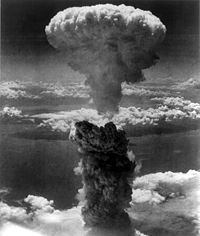
[Image of atomic bomb exploding over Nagasaki, Japan, August 9, 1945]