Showing posts with label innovation. Show all posts

Thursday, August 17, 2023

Seeing the Big Picture

 I know exactly where I was on the night of July 20, 1969. At 9:56 PM, Central Daylight Time, I was in front of our black-and-white television set along with the rest of my family. We were part of the 600+ million people around the world doing exactly the same thing at that same moment. 


Apollo 11 Moon Landing Live Broadcast 

Neil Armstrong went down the ladder of the Lunar Lander and stepped off the last step onto the lunar surface. Humanity had put a footprint on the moon. The sense of history-in-the-making was palpable to everyone watching. It was astonishing -- mind-boggling, really -- that we could be watching something happening in almost real-time from a distance of 238,000 miles on another celestial body!

I'm not certain, but our television was probably no more than 27 inches. I remember it was contained in a plastic box which probably weighed fifty pounds because of the heavy cathode-ray picture tube. Long before the internet or even cable television, television signals arrived via an antenna. The picture was often grainy. Color television had been introduced in the late 50s but it was still expensive and my parents didn't own a set. Color broadcasts were limited to selected programming, I remember that NBC introduced theirs with the colorful peacock logo. 

But color television made no difference that night because NASA had only installed a black-and-white video camera on the Lunar Lander. Color video would have taken too much weight and too much power. We were still thrilled to be watching. 

What made me think of all this was that I recently came across a photograph of NASA Mission Control at the Houston Space Center. On the large screen on the wall, you can make out the same black-and-white image of the first moon walk. Today, we think nothing of large video displays and it barely catches our attention.

Large Panel Display in Mission Control

But like everything else associated with the Space Program of that era, even the video displays were state-of-the-art. There were no color LED panels that now fill every niche of our lives. The conventional broadcast video technology of the day was created using the cathode-ray tube. But a display of the size in Mission Control would have required a cathode-ray tube with an enormous glass enclosure weighing tons and needing immense power. So how did NASA create such a display?

The answer was revealed to me when I posted the Mission Control photograph to a Facebook group dealing with old technology. People commented almost immediately about the video display. It was created with a technology called Eidophor. I had never heard of it. 

A little more researching on Wikipedia and YouTube enlightened me further on what this was all about. What you see in the photo of Mission Control is only the front portion of a much larger room. Behind the wall was another room at least as large and painted matte black. Technicians called it the Bat Cave.  The equipment needed to project these displays filled the room as you can see in the schematic below. 
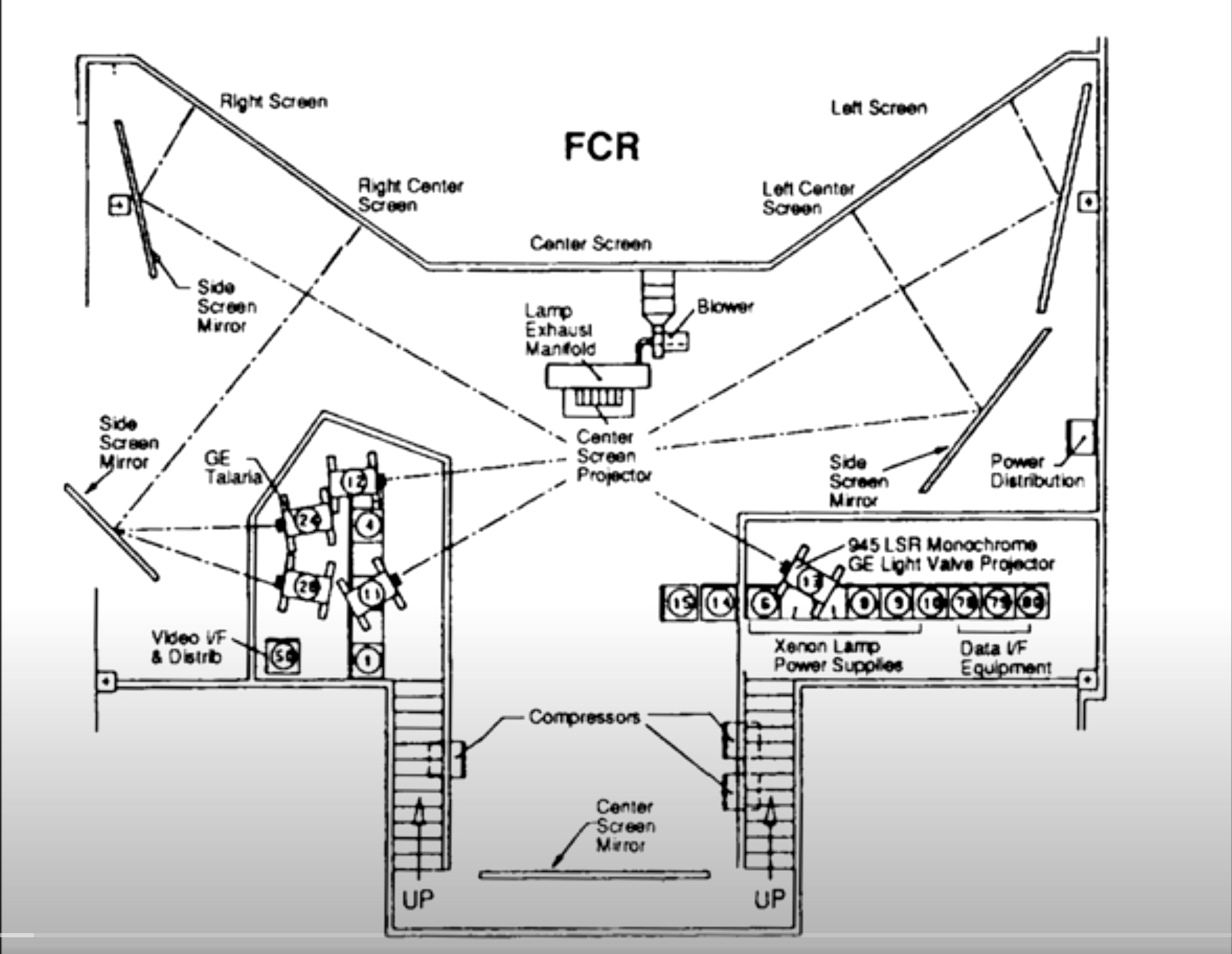
Layout of Bat Cave

The Eidophor projectors themselves were marvels of technology as can be seen in the drawing. Read Wikipedia if you want to know more. 


Schematic of Eidophor Projector


These projectors were around for a while beyond the Apollo missions and were used for sports events, rock concerts, and other large-screen applications. By then they had shrunk considerably from the NASA days but were still formidable hardware systems.

Refined Eidophor System


Today, flat-screen LED and OLED technology is so good that an 8K image can be displayed for a fraction of the cost and a fraction of the power. Cameras on spacecraft have also improved so much that we can now watch full-color, hi-def video in virtually real-time. 

On Feb. 18, 2021, the Mars Rover, Perseverance, made an extremely complex and completely autonomous landing as we all watched both the descent vehicle and the Rover as the maneuver was accomplished. We might even have been watching on our Smartphone while sitting at a local coffee shop enjoying a latte. 


We have come a long, long way in fifty years. Sadly, almost no one could tell you where they were on Feb. 18, 2021 when Perseverance landed. We take so much for granted.  Time for a refill of my coffee. 

"Making the simple complicated is commonplace; making the complicated simple, awesomely simple, that's creativity." 
- Charles Mingus

Tuesday, November 20, 2012

The Curta Peppergrinder

I hate to admit it, but I came of age in the era of the slide rule. To be more precise, I had a Post Versalog that I proudly used throughout my undergraduate engineering days at the University of Michigan. No, I did not hang it on my belt nor did I have a pocket protector for my pens. Slide rules were just the tools of the trade if you were in a computationally-intensive academic discipline. I still have my slide rule in a box somewhere in the basement.

Just after I entered grad school in 1974, electronic calculators made their debut. HP lead the way but they were expensive and a lot of engineers didn't like the RPN (Reverse Polish Notation) method of computing. I had a Texas Instruments SR-51 programmable calculator. I still have that, too.  Why? I knew that they would eventually become iconic symbols of a computing past that was rapidly evolving.

It surprised me to learn recently of an even earlier iconic mechanical calculator called a Curta. I had never heard of it or even seen a picture of one but a little digging on the internet last night brought a wealth of information about this little marvel.


The Curta was developed in Europe around the time of World War II by an engineer named Curt Herzstark. Herzstark was born in 1902 and had a natural aptitude for engineering. Herzstark's father owned a mechanical calculator company in Vienna before the war and Curt worked for the company. When the Nazis occupied Austria in 1938 under the so-called Anschluss, the factory was converted to making military supplies. Still, things remained relatively stable until 1943 when the war started going very badly for the Nazis on many fronts. Curt Herztark was arrested for being sympathetic to Jews (he was half-Jewish himself even though he was raised as a Christian). He eventually was sent to the notorious Buchenwald concentration camp near Weimar, Germany. He was assigned to work as a slave laborer in an adjacent factory. His engineering talents were recognized and he was put to work in the office doing design work. While there, he told the factory supervisors of patents he had been awarded in 1938 for a miniature hand-cranked mechanical calculator that could perform the four basic math functions very efficiently.  Intrigued, his supervisors set him to work to perfect his design. The camp commandant planned to give one to Hitler as a gift of appreciation after Germany won the war.

Herzstark set to work immediately and produced a complete set of working drawings by the time Buchenwald was liberated by the Allies on April 11, 1945. With the Soviets  on the verge of occupying that part of Germany, Herzstark fled to Austria. He immediately began to seek funding to build his design. Eventually, he found support from the Prince of Liechtenstein who was trying to establish a post-war manufacturing base in his tiny country.

Curt Herzstark produced his namesake calculator (Curta means offspring of Curt) from 1947 to 1970 when, like the slide rule, mechanical devices gave way to electronic calculators. The Curta was nicknamed the Pepper-mill for its obvious resemblance to that culinary device.

Curta's were expensive ($125 to $175) but very compact and highly accurate. Their size made them popular with airplane pilots and rally race car navigators. Over 140,000 of the devices were made during their heyday. You can still find them on eBay for prices in the one to five thousand dollar range.

Curt Herzstark died on October 27, 1988 in Vienna. He had lived through some of the worst of times to see his ideas validated and embraced by a world rapidly moving forward towards high-speed computation. If I were ever so lucky as to find one of these little beauties for a reasonable price, it would join my Post Versalog and SR-51 as a reminder of what came before.

Wednesday, November 7, 2012

Technology: The Central Issue in the Election

It's the morning after. The people have spoken and the people say they can't agree on either who should lead them or on what the real issues are.  By a narrow slice of the popular vote (but a strong majority in the electoral vote), President Obama returns to the White House for a second term. But looking at the Red State - Blue State map of the country shows just how differently people feel in broad swaths of the country.

The drumbeat of this last election was jobs and the middle class - the economy.  But that is only the symptom. One cause of our distress is the unstoppable forward flow of technology.  Technology gives us our prosperity but (reflecting the economist Joseph Schumpeter's famous phrase) it also brings creative destruction.  The unemployed (and worse, the unemployable) might argue that destruction is never creative.

Technology raises our standard of living. We enjoy the benefits of the technology every day of our lives. Most of us love new technology. We are willing to stand in line for hours to get the newest iPhone or iPad. We love our DVRs, our internet, our reliable cars, and our ATMs.  We notice the loss immediately when there is a temporary power blackout. When a big natural disaster occurs, as just happened with Hurricane Sandy, we are literally off the grid. We can no longer function without the technologies that support us.

Technology, like time, moves in only one direction: forward. Older technologies are replaced with better versions or are made entirely obsolete by new technologies.  It is that change that brings so much disruption.  People whose skills are based on an old technology lose their jobs. They don't have the skills for the economy enabled by the new technology. It is not that they need to somehow just get retrained to do the same job using a little newer technology. The old job is gone forever, replaced by technology. It's the same story whether you think of a manufacturing job now automated by robotics or a bank teller replaced by a computer-enabled ATM.  The bank teller can't take a computer class and compete with the ATM. Technology has simply wiped out the need for the human teller.

And so this election which seemed on the surface to be about jobs and the economy is really about how to cope with changing technology. How do people find work in the new economy when they lack the skills needed? The answer is always the same: re-education.  People need to get themselves retooled just as their former workplaces have been retooled.  This is by no means easy. Most people have mortgages, children to support, bills to pay. How do you they gain new skills when they can barely put food on the table?  I believe this is one of the most important issues we face in the coming decades. Because technology isn't going to take a breather. It isn't going to stop at this point and say in effect, "Time-out to catch up." The engine of creative destruction will continue to inexorably plow forward. The single skill that everyone should learn is the ability to continually re-educate ourselves. Obsolescence is not a theoretical discussion. It is critical to putting food on the table.

Technology contributed to this election in more subtle ways than simply displacing workers with automation. The very nature of new, computerized technology allowed financial institutions to play fast and loose with our money in unprecedented new ways. The result was the financial meltdown.  But that same technology provides the ability to attract foreign investments and allows more effective competition in global markets. But if you just lost your home to a mortgage foreclosure, foreign investments seem irrelevant. It feels like an economic problem, not a technology issue.

So where do we look for relief from problems that are enabled by new technology? Still newer technology will bring some relief but also new problems.  We will need everyone to understand these issues more clearly. We will need the means to continually redevelop job skills. We will need better schools for our children that prepare them for this exponentially-changing world. We will need more ways to retool in mid-life. We will need the leadership at every level - business, government, community - that helps us to manage the inevitable changes ahead.

While I might sound naively utopian, I believe that it can be done. Why? Because we have done this over and over again in our history. Think of the changes that occurred when manufacturing was first industrialized in the 19th century. Think of the impact of electrification, the automobile, and the internet. All these have made our lives immeasurably better. But they made many skills obsolete. We don't need telegraph operators or buggy whip makers. We have managed our way somehow through the changes. We will continue to do so. It has never been easy. But I believe in technology and I believe even more, I believe in people's ability to adapt.

Sunday, July 8, 2012

The Automatic (Rail) Road Machine

As I wrote in my last blog, machines that can lay an entire road in one operation are now a reality. I just came across a video of such a machine.

The video below shows a multi-part machine which lays high-speed railroad tracks. The video was shot in Europe but a similar machine is being used to lay tracks on the high-speed rail line between St. Louis and Chicago.  According to the source that I saw, these are the only two such machines that exist in the world. It's quite an operation. Give it a look:


[A "Hat's Off" to my sister-in-law, Peggy, for bringing this to my attention.]

Saturday, October 8, 2011

In Defense of Steve Jobs

It seems that everyone with any sort of digital soapbox has felt the need to write about Steve Jobs.  I was particularly interested to read a couple of articles that tried to either make or dispel the idea that his impact on society equalled that of Thomas Edison or Henry Ford.

I think Walter Mossberg of the Wall Street Journal might have started the comparison in a very personal article he wrote about the thoughtful and personal side of Steve Jobs.  Rick Newman at US News and World Report picked up on the theme but threw mostly cold water on the comparison of Jobs to either Edison or Ford. Even the Christian Science Monitor got into the act with a followup article to Newman's.  At this particular moment in time, the loss of a leader in any field is felt acutely and the loss of someone with as many proven leadership skills as Steve Jobs is perhaps all the more strongly felt amongst the rest of us.

Of course, only history will be able to sort out the contributions of Mr. Jobs. But it seems safe to at least question some of the aspersions that Rick Newman made in his piece. Mr. Newman writes of Edison:

By the late 1800s, Thomas Edison developed an electric-lighting system that literally turned darkness to light and ushered in sweeping second- and third-order changes, from the improvement of working conditions in factories everywhere to safer homes no longer lit by candles.

Thomas Edison was a persistent, egocentric, dynamic leader of highly skilled technologists whom he employed to help create his vision for new products. (Sounds kind of like Steve Jobs to me.)  He never pursued anything without thinking about its likely commercial impact. He was a master of managing his image in the media. His work on the incandescent light was innovative not because he found a filament that could endure long durations of being heated, but because he envisioned that to make lighting successful he would have to build the whole system. This included the dynamos, the distribution wiring, the switching, and the end appliance - the electric light. That he pulled it off was a testament to his determination and persistence in the face of many, many hurdles.

Having said that, Edison didn't get it right when it came to extending his vision. He defended his direct current (DC) approach in the face of Tesla's clearly better alternative of alternating current (AC). AC power could be distributed without losses over much greater distances than could DC power. Edison even went so far as to mount a public relations campaign against AC power as being much more dangerous than DC. To prove his point, he was instrumental in the development of the electric chair for executing criminals. In the end, it took another generation of innovators beyond Edison and Tesla to make commercial lighting a reality for most people. Samuel Insull, who made commercial electricity a reality in Chicago, was the first of many of these innovators who built large electric distribution systems to bring power to the people.

Edison didn't get candles out of the home. Most people in the late 19th century were lighting there homes with either piped in gas or with kerosene. Factories were often lit by simply more windows or if night work was required, lighting was provided by arc lamps which predated Edison's invention of the lightbulb.

So who gets the credit?  Edison for the first embodiment of an electric lighting system or Tesla or Insull?  The answer is, of course, all of them, not just Edison alone.  If Edison hadn't developed his system, someone else would have done it within the next five to ten years. It was the focus of too many innovators who wanted to be first to show the new power of electricity.

Henry Ford is a different case but he also shares many similarities to Steve Jobs. Ford was neither a particularly talented machinist or even all that literate. What he did have in spades was the ability to envision a new type of automobile and the charisma and passion which attracted really good engineers to work with him to make it a reality. His first focus was not on a car for the masses but on racing cars (which were the earliest means of demonstrating automotive technology and reliability). He was a partial-founder of two automobile companies that failed to achieve his vision. It was only when he decided to be the founder of his own company - where he controlled the vision - that he began to succeed.

His first cars were not particularly different from scores of other startup auto companies. Everyone was selling to a customer who had the means to spend several thousand dollars on a car. Ford's genius was to see that if the cost of the car could be reduced dramatically, a mass market could emerge for the automobile for the first time. Ford not only hired great engineers, he hired a great business manager, James Cousins, to manage the finances of his company. Ford didn't invent the assembly line. That idea emerged from his engineers touring the disassembly lines of the Chicago meat packing plants. Ford provided the single-minded focus to pursue the dream of a mass market car when everyone else told him he was crazy. The result was the introduction of the Model T in 1908 (This was not his first model. There had already been Models A through S before the T came along).

Ford was a true innovator. He was the first to recognize the value of vertical integration in the automotive industry - owning everything from the iron mines to the steel mills to the final assembly plants in the giant River Rouge complex. Ford pioneered the five dollar day for his workers - not just to have them earn enough money to be able to afford a Model T but to get them to not quit (employee turnover on those first assembly lines was in the hundreds of percents).  Ford's vision proved to be correct and his company dominated the industry. But unlike Steve Jobs, Henry Ford did not die young. He lived long enough to have his initial vision become an impediment to Ford Motor Company's future. He would not give up on the Model T even when it was outdated and sales were plummeting. He micromanaged his son, Edsel's, period of running the company after Henry ostensibly retired. It would take Ford's grandson, Henry II, to put the company back on track.

So the traits that seem to recur in these three men of different eras and different industries are incredible vision, an awe-inspiring sense of determination, dictatorial decision-making, charisma, passion, and an ability to hire the best and the brightest and give them the environment to create. Each had the ability to see a future, not a future that others couldn't see, but a future which was holistic - one that went further than just one product to see what was needed to make it valuable to millions of people.

So in defense of Steve Jobs, I think he will, indeed, go down in history as being in the same league as Thomas Edison, Henry Ford, and a host of other visionaries who have helped to create the world we live in.  His legacy will be felt for generations in the digital devices that are the offspring of the iPods, iPhones, and iPads.  His legacy will be felt in the digital animation studios that come after Pixar.  His sense of what the market needed was truly remarkable. But even more remarkable was his willingness to bet the company on his vision - not once but over and over again.   Steve Jobs was the quintessential American Innovator.  Even though I never met the man, I will miss him.

(Disclaimer: I have been a longtime user of Apple products. I am typing this on my iMac desktop computer.)

Wednesday, September 21, 2011

That Should Still Be Us

I saw an article in our local paper, the Raleigh News and Observer, entitled, Industries Fear New Wage Rules. The article was exploring the new wage rules that are being imposed by the Department of Labor on industries that hire immigrant workers on H2-B, temporary work visas.  Wages are projected to increase, on average, almost 50 percent - from $7.43 an hour to $11.18 an hour under the new rules. The higher wage is in line with the minimum wage paid in most regions. The reporter interviewed a number of small industry owners such as oyster processors, reforestation services, and even hotel owners for the impact of the upcoming change in the law. Not surprisingly, the owners are not happy, feeling that the increase in the wages they will have to pay will drive many of them out of business. Not a good deal.

But what struck me in the story was a couple of paragraphs in the article:

Employers say that they rely on foreign workers for the dirty, back-breaking tasks that Americans aren't willing to do - even with the current high unemployment rate.  And, they stress, they're required to document their efforts to hire Americans before the government permits them to hire foreign workers.

Further on, the article states:

Susan Pentz, 60, who along with her husband owns the 18-room Harborside Motel on Ocracoke Island, has been bringing in two housekeepers each tourist season for the past decade. She turned to foreign workers, she said, after struggling to hire locals and discovering that those she was able to hire soon quit or showed up only when they felt like it. "The bottom line is, I ended up cleaning the rooms because... no wanted to do that kind of manual labor," Perez said.

I read this article just after I finished reading Tom Friedman's and Michael Mandelbaum's new book, That Used to Be Us: How America Fell Behind in the World It Invented and How We Can Come Back. The authors of the book are trying to get us to focus on the multiple forces are in play that are causing us to slide from the leadership position we have enjoyed since at least the end of World War II.


The Big Challenges in their minds are:


  1. Globalization and  the Information Technology Revolution
  2. The Return of Strong Middle Class Jobs
  3. Rising National Debt and the Deficit
  4. The Need for Green and Clean Energy
They spend quite a bit of time documenting each of these areas in what amounts to a rehash of other news articles and their own past opinion pieces. Still, the case is compelling that these are. indeed, major issues that need to be addressed.

To address these issues, they outline what they call the Five Pillars of Prosperity:

  1. Providing much better public education for more and more Americans
  2. Continuing to build and modernize our infrastructure
  3. Keeping America's doors open to immigration
  4. Government support for basic R&D
  5. Implementing limited but necessary regulation on private economic activity
The authors make the case that we basically got fat and happy when we won the Cold War.  At just that moment, we should have been redoubling our efforts to compete in a global economy. Instead, we borrowed our way to an unsustainable way of life.  But the bills have now come due on both a personal and national level. Worse, the current political system is so broken as to prevent any meaningful action to address the Big Challenges. 

Their solution? They think we need a strong, centrist, third-party Presidential candidate. They acknowledge from the outset that the candidate most likely won't win. But the candidate could force whoever does win to take note of their more centrist platforms. They even suggest three past third-party candidates who did just that - Theodore Roosevelt and his Bull Moose candidacy to continue to build Progressive reforms in 1912, George Wallace in 1968 who forced Washington to pay attention to the South, and Ross Perot in his 1992 bid to address national budget deficits (they didn't mention Ralph Nader).  Each of these candidates caused the incoming President to enact reforms that the Third-Party candidate strongly campaigned to bring to the nation's attention. The authors call this strategy political Shock Therapy. 

And what does all this have to do with the history of technology? Everything. This country was built on the backs of immigrant labor manning the steel mills and garment sweatshops. The entrepreneurs who built American business developed countless new technologies that changed our way of life. Think telephones, automobiles, televisions, personal computers, and cell phones. To make all of these objects that we now take for granted required more and more skilled labor in the factories. A Middle Class with rising expectations that their lives would be better, and their children's lives better yet, was born, at least in part from a strong public education system. By comparison, for the last decade, data indicates that the Middle Class has not advanced economically one dime. In fact, they may be worse off than they were ten years ago.

Technology and democracy have always played key roles in making the United States a place where people wanted to live. For many in the Third World, it still holds that attraction. But I agree with Friedman and Mandelbaum - something needs to change and change fast. We are well past the dithering stage. 

The immigrant workers who come to North Carolina to take temporary jobs are looking for a better life, just as millions of immigrants did before them. They are willing to do what Americans are not, and I'm not just talking about the menial jobs they do. They are willing to leave their home country and families to try to make a little better living than they can at home. How many of our own, even highly-educated people, are willing to leave their country for better opportunities in China or India?  Not as many as those who come the other way for poor wages and lousy living conditions. 

Let's try to get technology back to producing the jobs we need to help all of us be in the position where we can look forward to a better future.  We are still the best hope for a brighter world. 

Thursday, August 25, 2011

Self-Similarity: Fractals and People

Last night, I was watching a rerun of a PBS Nova program on fractals entitled, Hunting the Hidden Dimension. I don't think the full episode is online at the moment but you can see the trailer here. (As I look at the preview image below, the full episode may be available via the link below the preview).


Watch the full episode. See more NOVA.


The essence of fractals is the concept of self-similarity - the idea that patterns repeat themselves at ever smaller dimensions. The discoverer of fractals, Benoit Mandelbrot, was initially chastised by his mainstream mathematical colleagues as  a bit of a nut. These patterns weren't real, they said, they were more like an entertaining parlor game. Those days are long gone, of course, and fractals (and their associated concept) Chaos theory are now being used to investigate everything from thunderstorms to heart arrhythmias.  In fact, Mandelbrot's initial insight into the nature of fractals came from his investigation of noise patterns on long distance data transmission lines while at IBM Research Labs.  The patterns are everywhere once you know how to look for them. 

As I was listening to the narrator talk about Mandelbrot's initial rejection by his colleagues, I began to think about the nature of groups and how they come to all conform to certain ideas that make up the status quo. Could it be that groups of people follow some of the same concepts you find in fractals? Let's look at a couple of hypothetical examples.

What if you have two university professors, both highly respected in their fields. One carefully chooses his or her grad students on the basis that they are bright, are seemingly willing to take their direction very closely from the professor, and are relatively conformist in nature. The other professor also wants bright grad students but hires non-conformists and students that have some strong ideas of their own they want to pursue.   

The first lab is going to really churn out productive research that augments the professors views. The ideas will be tight and reinforcing.  The students are self-similar to the professor and so a pattern of conformity emerges.  When they graduate, they go out into the academic world and what do they do? The look for students like themselves and the pattern is replicated again and again. The field begins to develop norms that are much based on self-similar thinking as they are on the underlying science. 

The second professor has a few mavericks in his lab.  Not everyone but a few. These people mix it up and challenge the professor and the other students to look at their way of seeing the problems. The lab is probably a little less successful at churning out papers but every now and then a new idea emerges that comes from the lack of self-similarity. After the mavericks graduate, they go forth in a new academic position and try to hire a few mavericks of their own.  More new ideas emerge.

The reality of the way people are made is that far more of us are conformists than mavericks. It is much easier to get along in the world if you are self-similar than different. Hence, conformist thinking dominates and the Mandelbrot's of the world have to push back hard to be heard. 

The same is true, by the way, in corporations. The pressure to conform to the company's culture can be very high in a large and established corporation.  Certainly, you can see examples where this is not the case in tech startups but in general, once a company has a formula for making money, it likes to keep making money. The business leaders feel they know the formula and don't want to mess with it. Non-conformists are not welcome. 

So the principle of self-similarity that drives fractals may also drive human group dynamics.  Mavericks pay a high price for their independence. But in many cases, like that of Benoit Mandelbrot, the world is far better for it. 

Friday, November 12, 2010

Fail Early, Fail Often? Not.


Business is full of pithy aphorisms.  One that you hear frequently is meant to be a mantra for innovation: Fail early, fail often.  The idea behind this little nugget is to experiment with many variations on an idea without investing much in any of them.  Get out there and get market feedback as quickly and as cheaply as you can.  Sounds like good advice, doesn't it?

I spent my career working with inventors and not many of them attempted to fail -- early or otherwise.  And they certainly didn't want to fail often.  That was a one-way ticket to unemployment or at least being moved into a position where they couldn't spend the company's money quite so easily.  Inventors work more from the old saw: If at first you don't succeed, try, try again.  The first time out, their invention is a flop.  The second time it might be an even bigger fiasco.  But the dedicated inventor "knows" that their idea is just what is needed to make the world a better place (and make them a boatload of money).  They might finally even get an idea out that does the technical job but the money is another story.

The histories of technology and innovation are filled with stories of inventors who pioneered a new area only to go bankrupt.  Often, a savvy business person was watching in the wings waiting for market conditions to improve or shift.  Then with the biggest risks of invention out of the way, they would turn it into a money-making venture by better marketing or more efficient manufacturing.  And what of the inventor?  Often, these intrepid souls would be on to their next great idea.

Are inventors naive?  Are they over-confident about their ideas or abilities?  Why do they continue in the face of such daunting odds?  It seems to me that inventors have two drives: to shepherd their wonderful idea into the world and to get rich doing it.  At their core, they are made up of creativity and optimism.  They have a great inner eye that lets them see a new and untested idea before others can see it.  Their energy comes from their need to create.  They are more akin to artists than engineers.

But the same characteristics that makes a great inventor makes for a really lousy business person.  The business mind is focused on efficiency, scale, and profit.  Business has its own form of creativity but it shares little with that of the inventor.  Once an invention has proven itself, the business person wants nothing to do with further change.  Change is wasteful.  Change is inefficient. Now the drive is to get it out at the lowest possible cost.

It more often happens that an inventor thinks that he or she can also be a great business person than vice versa.  Business can't be that hard, can it?  The invention is the hard part, right? Most business people that I know don't often mistake themselves to be inventors.  The clear, cold thinking that makes them good at business puts a quick stop to any naive beliefs that they can also excel as inventors.

Inventors need business people to commercialize their ideas.  But without inventors the New New would never happen.  It is a symbiotic relationship.  The business people get most of the money, of course.  But the inventors get something equally valuable to them - the freedom to continue to invent.  And the cycle continues.

Thursday, November 4, 2010

Technology Winners and Losers from the Mid-Term Elections

The people have spoken.  But what the people have said is a little harder to understand.  Imagine a room of ten thousand people who on the count of three are urged to shout out their favorite program for technology funding.  The resulting noise from the diverse answers would be hard to decipher.   The only thing of which we can be certain is that the emphasis will change.  So what are some of the potential winners and losers in the next couple of years?  What government funding is likely to get enhanced or reduced as the centers of political power realign once again in Washington, DC?  Here's a few of my predictions:


The Winners:


  1. Defense and weapons systems.  
  2. Materials technologies that drive the electronics industry
  3. Oil exploration technology
  4. Clean coal
  5. The National Labs (again, with a focus on defense)
  6. Pharmaceutical research
The Losers:

  1. Stem cell research
  2. Alternative energy sources
  3. Climate research
  4. NASA
  5. Energy efficiency
The shifts in emphasis every two to four years play havoc on meaningful progress towards any research goals.  Most of these research programs are based in universities and National Labs.  Proposing and funding a program can take years.  Staffing with faculty and post-docs can take almost as long.  By the time a program gets set up and gains some momentum, it can find itself running out of gas during even the first refunding cycle.  We are constantly sub-optimized to progress as far and as fast as we can.  In a sense, everyone loses from the short-term reordering of research priorities.

Of course, nothing lasts forever, nor should any particular line of research be immune from changes in priorities.  Still, the need to achieve a minimum level of continuity - perhaps a decade - should be factored into setting research objectives.  Our future depends on it.

Thursday, September 9, 2010

Realtime Innovation

I have been seeing the buzz around Google's new instant search service called Google Realtime.  I hadn't tried it so I wandered over there this morning to see for myself.  The search box looks much the same as the standard Google search window but the results come from blogs, tweets, and other social networking sites and are displayed in near-realtime.

I typed in "innovation" and sat back to watch the action.  I wasn't disappointed.  A new posting containing the word "innovation" would pop up on average every three seconds.


 It was mesmerizing to see this flow of consciousness being spewed forth - all in the name of innovation.  Most of the torrent of returns were tweets - some from companies but many from bloggers who seem to be pushing innovation as a way to get consulting gigs.

The Google site itself is somewhat innovative but you get the same effect of watching the stream if you monitor Twitter or Facebook for a time.  But the effects of aggregation take Google Realtime to another level.

The question that I am struggling with is whether all of this gushing of web consciousness on innovation helps anyone become more innovative?  A debate team taking the Pro position might argue that this shows how much innovation is a part of our collective consciousness, how easily we can cross-pollinate ideas, or how much more easily we can find other people who can help us achieve some specific goal.  The team for the Cons would say this isn't dialogue, it is a monologue with people spewing forth tweets simply in an attempt to be visible, that the people who are really innovating aren't spending their time tweeting, they're actually innovating, or that the chatter actually contributes to less innovation because it is so distracting.

Having read quite a bit about this history of technology and innovation, I come away more on the side of the Cons than on the side of the Pros.  It seems to me that most innovators have a single-mindedness that shuts out all extraneous voices.  I think about John Fitch and the first steamboat, or Oliver Evans automating the first flour mill, or Henry Ford and his plan to put America on wheels with the Model-T, of even more recently, Steve Jobs bringing us a succession of "gotta-have" Apple products.  True innovators are tuning the noise out while they doggedly press forward against all the naysayers.

I remain convinced the we have many innovators today, just as we have had them throughout our history.  They just aren't getting carpal tunnel syndrome from overuse of their thumbs on their Blackberries, tweeting away constantly.  There is a place for all the latest tweets.  I write them myself on my companion Facebook and Twitter pages.  But this is more akin to journalism than it is to innovation.

Now, if you will excuse me, I have some tweets I have to get out.

Sunday, August 29, 2010

Waves of Innovation, Waves of Materials

I am continually reminded in my readings of just how important new materials are to innovation, especially the major waves of innovation.  Unlocking the possibilities in a new material releases endless opportunities for inventors and entrepreneurs to exploit.  We even note a new material era almost like chapter-headings in the history of technology:  the Iron and Steel Age, the Petroleum Age, the Polymer Age, the Age of Silicon. Material revolutions underlie a multitude of other major innovations from automobiles to plastics to microchips.

The common thread in all these earlier ages was that the raw materials to enable these waves of material innovation were abundant.  The very success of the early ventures into a new material - oil drilling, for example - led to ever-increasing investment to find more sources of untapped oil reserves.  For the last 150 years or so, it seemed like we could never run out.

But Earth is a finite place and the cost of retrieving raw materials has to rise as the difficulty in getting at them increases.  Deep-water oil drilling is one very glaring example in the news lately.  The supplies of rare metals used in microchip doping lies in only a few places on the planet and most of them could become inaccessible if the political winds change in the future.

I recently came across a very interesting interactive graphic  entitled "How Much is Left?" on Scientific American's web site that was designed to make you think about the limits of our planet's resources.  The interactive links are well worth exploring.

If new materials drive innovation, what can we expect if the raw materials are themselves limited?  It seems a no-brainer that we will focus more and more on finding ways to economically extract materials from renewable resources.  Some of this will driven by a desire for cleaner, greener technologies.  But most of  the impetus will be that it is the only way to sustain production of some materials.  The commercial gates will open when rising costs from shrinking supplies of the old materials exceed the diminishing costs of sustainable materials.  It will not be viable unless it is driven by economics rather than ideology.

So the next wave of material innovation may be less about how we exploit some new raw material and more about how we replace ever-more-scarce natural materials.  The difference this time is that the new raw materials will be sustainable indefinitely.  We better hope that is true because the alternative isn't pretty to think about.

Monday, August 23, 2010

When Google and Apple Are as Passe as Ford


Virtually every list of the most innovative companies in the world list Google and Apple in the top two or three slots.  Both companies are there for a reason - their products and services are cutting edge and customers can't get enough of them.   Look at the lines out the door at the Apple Store when the iPad and the iPhone4 were introduced. Look at the ever-increasing reach of Google.  From search engines, it has branched out into operating systems for cellphones (Android), web browsers (Google Chrome), and online office suites (Google Docs), not to mention Gmail, Google Books, Google Maps, Google Earth, Google News, YouTube... you get the idea.

But that edge in the cutting edge moves.  What was the cutting edge one hundred years ago now brings a yawn.  While Google and Apple bask in the warm glow of innovation accolades today, in a hundred years they will most likely be history.  I was reminded of this as I was reading Douglass Brinkley's book, "Wheels for the World: Henry Ford, His Company, and a Century of Progress."  Brinkley writes of the heady days of early Model T production when Ford couldn't build their cars fast enough:

The astounding pace of change at Ford Motor Company in 1914 made it the most glamorous, most widely discussed company in America, if not the world. It was not merely that Ford was trying so many things in so many arenas, nor even that it was succeeding with most of them.  What attracted the admiration and envy of outsiders was the brimming confidence Ford Motor exuded. The public's fascination with Henry Ford's maverick role lay in part in his overt image as an iconoclastic, oddly nineteenth-century presence in the twentieth century's most up-to-date business. It seemed that through modern industry Ford had reopened the American frontier.  His company was more than a profit-making enterprise; it was a pioneer's domain, where old assumptions about business were cast off in favor of new notions.  As on any frontier, money did not make for heroes, and Ford Motor had started with very little money.  The company did not rely on established connections, either, remaining as stubbornly independent as it had on the day it was founded. Ford Motor proved that creating a fresh new world out of the industrial domain rested on only two crucial qualities: competence and confidence. (p. 180)

If you changed Ford Motor to Google or Apple in the above quote, you would have a pretty good description of what makes these companies great today. Henry Ford reminds me most of all of Steve Jobs.  Ford was a megalomaniac with his vision of the car for the masses.  He alienated almost everyone around him including those who helped him form the company.  He began to believe that he alone was the arbiter of automobile innovation.

Maybe it takes that kind of drive and vision to have the absolutely phenomenal results that innovative companies create.  Within ten years of Ford Motor Company's founding in 1903, Henry Ford was second in personal wealth to only John D. Rockefeller.  Ford sold more cars in 1914 than the next ten producers combined!  The Model T changed the face of America as surely as Apple and Google are changing it again today.

[Photo and logos from Wikipedia]

Friday, August 13, 2010

Enabling a Revolution, Enabling Wealth

I saw a column by Rich Karlgaard this morning in Forbes entitled "How the Cheap Revolution Confuses Policymakers".  Karlgaard's title is a little misleading.  His article mostly focuses on how Moore's Law has driven down the cost of all things silicon and made the resulting products cheap.  (Moore’s Law refers to the fact that the number of transistor elements on a chip have doubled roughly every two years.) Making products cheap and affordable has made some people very, very rich.  Karlgaard tries to pull biotechnology advances into Moore's Law. But it is a bit of a stretch to say that biotechnology has made medicine cheap. 

Nonetheless, I subscribe to at least part of his thesis.  Some new technology platforms change everything.  They change how we live, how we work, who is rich, and who is poor.  Some technology platforms are so powerful that they can elevate nations to world leadership and relegate others to a has-been status.  Not all new technologies do this, of course  What sort of technology platforms can have such powerful effects?

The key is to be found in technologies with the broadest power to reach deeply into our world and change areas that would have never even occurred to the original developers. Here are a few examples that pop to mind:

The Printing Press - Gutenberg developed movable type so that he could print indulgences and bibles and make a few bucks. The printing press allowed for mass communication that changed the course of history.  Do you think Johannes could have foreseen the power and reach of his invention?  The Enlightment would never have happened, or happened much more slowly, without the printing press. 

Iron and Steel Processing - The Medieval world was one built of wood and stone. The discoveries (mostly) in England of how to smelt iron and later steel cheaply and in high volume had a dramatic impact that reached into every part of the lives of people in the 18th and 19th Centuries.  Without the ability to produce iron and steel cheaply, there would have been no steam engines, no railroads, no modern bridges, ships, or skyscrapers.  Those who controlled the steel mills became fabulously wealthy.  Those who worked in the mills had lives of misery.

The Automobile - This is an assemblage of inventions and materials (including the internal combustion engine, cheap fuel, steel, and rubber) that gave everyday people the ability to travel where they wanted, when they wanted at very low cost.  Whole industries were created to build and service automobiles and trucks. The highway system changed the face of the country just as suburbs changed the nature of our towns and cities.  Who was rich?  Auto and oil magnates, steel executives, and rubber company CEOs. 

The point I am trying to make is that some inventions have the ability to have very broad utility. They have uncounted ways of being exploited for products and services and hence for profits.  If there is a way to exploit one of these technologies, some entrepreneur will find it.

I would agree with Karlgaard on how pervasive the Silicon technology has been.  Look at who became wealthy.  The list includes chip company founders, personal computer execs, internet execs, venture capitalists, and social networking company founders. Less obviously but just as importantly, the wealth of bankers and financiers is tied directly to the enablement of silicon technology. Without computing, the world of instantaneous and complex finance would be impossible. 

What will be the next powerful technology platform?  If I knew, I would have my money there and I wouldn't be broadcasting my answer.  But I don't know.  I would hazard an educated guess, however.  It will be a new material.  I don't know if that will be a nano-material or a DNA-based, self-assembling material, but it will be some sort of material that opens doors that can't even be conceived of today.  My other prediction is that this next new material technology is a long way off and will take even longer to exploit.  Fundamental technologies are like that.  

Karlgaard writes of the Cheap Revolution but all powerful technologies have made things cheap.  But not all technologies have the capability to create such a profound impact.  That's why when we experience one, it is dubbed a "revolution".  We are still riding the Information Revolution.  Who knows what the next will be called?

[All pictures from Wikipedia]


Saturday, July 24, 2010

Bethlehem Steel Blues

I was browsing through a website called SnagFilms which hosts documentaries and I came across a three-minute film on the sad aftermath of the failure of Bethlehem Steel in 2003.  This short video is worth a look.

Watch more free documentaries

The deep sadness in this film piqued my curiosity about this very successful company and its namesake town of Bethlehem, Pennsylvania.  Wikipedia has a great overview article on the company.  Fortune Magazine did a post-mortem on the company's demise back in a 2004 issue which was worth a quick read. 

The steel industry was once the bellwether of American industrial health.  Bethlehem Steel provided the steel for the Golden Gate Bridge and the Empire State Building, among a long list of other American icons.  It was not only one of the largest of the U.S. steel producers, it was also one of the largest ship-building and railroad car manufacturers in the country.  Now, the original steel mill site in Bethlehem is bare ground except for a new casino.  In some bitter twist of fate, the construction of the casino was delayed for a shortage of... you guessed it... steel.

What went wrong?  The answer is both complicated and simple.  The complicated answer involves the emergence of cheaper steel from newly-built mills in Japan and Europe following World War II, the dependence of U.S. industry on trade barriers for protection rather than reinvesting for innovation, arrogant management, huge legacy costs for retiree healthcare benefits, and a steelworkers union that refused to give an inch to a management that was equally obstinate.  The simple answer is that the steel industry ran its natural course and we no longer need to make steel.  That simple answer, like most simple answers, is also wrong.

Lehigh University has done a great job putting together a website called Beyond Steel that goes into many different aspects of the manufacturing and cultural history of the region.  I especially liked this picture of Bethlehem management taken in 1950.
You don't have to see any detail to know that this was an old, white guy's club. 

Unfortunately, we don't seem to learn much from the life cycles of companies and industries.  The early risk takers give way to the managers who drive up efficiency which leads to the management that pays itself enormous salaries for what seems like their God-given success which precedes the bankruptcy experts who dismantle the enterprise after it crashes.  We are seeing it now in banking.  The auto companies have also been recently knocked down a notch by their own arrogance.  The jury is still out  to see if they survive the long term.  After all, it took Bethlehem Steel almost thirty years to die.

But as the first film shows, often the biggest cost to a community is the disruption to families that have lived there for generations.  In the end, when a company fails, everybody loses.  Everybody.  If you look back at that picture of management, you can just make out five little statuettes on the back wall of the auditorium.  They represent the Customers, Employees, Management, Shareholders, and Suppliers.  Every one of them lost out. 

And we are left building casinos on old industrial sites which form a kind of scab on what was once the healthy corpus of our economy.  But, what the hell, this time around, the odds are with the house.
Enhanced by Zemanta

Saturday, April 17, 2010

The Aging of Innovation in America

[Image of Edison's lightbulb from patent application of 1880]

As individuals, it is pretty easy to know when we have passed our prime.  If we are lucky, the first sign isn't that we read our obituary in the paper.  It shows up in little things: pants that seem to have shrunk, skin that seems to hang a little looser, difficulty in remembering what I had for dinner last night, stairs that seem to have gotten steeper.  We fight it or we deny it, but biology has the last word.  And everyone passes beyond their prime at some point.

How about an economy, or more specifically, the American economy?  Nations grow and decline like all things based on living systems.  Where's the United States on the curve?  What is the equivalent of a "sagging chin line" for an economy?  Three things come immediately to mind.  One is the rate of growth of the economy, with the operative word being "rate".  This is the good-old Gross Domestic Product, or GDP, statistic. A second is innovation, which is one of the key drivers of growth. This is a little trickier to measure objectively.  Patents might be a measure but most studies say they are not a good surrogate for innovation. The third is a steadily increasing personal income.  If people aren't finding themselves any better off over time, people catch on to that fact quickly.

I have seen a number of articles recently that make me seriously worry about where we are as far as the country's economic maturity is concerned.  We seem to be, more and more, rushing into a period of serious aging as though we had blown the diet and stopped going to they gym for a little toning. The most recent article I saw was Business Week's annual list of the 50 Most Innovative Companies.  In an accompanying article, the Business Week reporters, Michael Arndt and Bruce Einhorn,  wrote:

The shift [in U.S. innovativeness] is more apparent when this year's class is compared with the first ranking in 2005. Back then, only six of the Top 20 were headquartered outside the U.S., vs. 13 of 25 this year. In addition a third of 2005's American champs—such names as 3M, Starbucks, and eBay—no longer make the Top 50.

The article also reports that most management in Asian companies treat innovation as a high priority with over 90 percent stating that they plan to invest in increased innovation efforts.  U.S. managers, by comparison, are planning similar investments in only 48 percent of the companies interviewed.

It's nice to see that Apple, Google, Microsoft, and IBM are the top four on the 2010 list.  But this isn't nearly enough to offset the relative losses which show up not only in innovation rankings but in 2.4 million off-shored manufacturing jobs in the last decade.

Looking at my other two leading indicators, GDP in the U.S. has been decreasing for the past six years - well before the current recession began.  Personal income adjusted for inflation has been flat for a decade or more.


All in all, our Economic Report Card is definitely looking more like a C- than something that might get us into the National Honor Society.  But it is not enough to simply rant about needing more innovation (although venting can be useful at times).  I might have thought that the near total collapse of the auto, banking, and housing industries would raise some serious concerns about the viability of the economy and our competitiveness.  I wonder what it will really take to get us to pay attention?

In the past, the American economy grew not because there were calls from Washington or from editorials to be more innovative.  The economy grew and innovators had an impact because there were opportunities to exploit.  Innovators and entrepreneurs saw unmet needs and worked their tails off to fill the need.  It's still happening.  Apple, Google, Microsoft, and IBM all employ lots of very smart people.  The problem is that the rest of the economy, the manufacturing and service economy that pulled up the middle class has been farmed out to low-wage countries.  That's the gap that has to be filled.  How do we bring innovation to create jobs that pay decent wages for the people in the middle-class of a post-industrial society?  I don't know the answer but I think it is the right question.  That's at least a start.

Friday, April 2, 2010

Text 2.0: Coming Soon to a Book Near You

Tomorrow brings the launch of the iPad.  The first experience comments coming back from various sources make the device seem even more promising than I had first thought.  Of course, there is so much hype around this at the moment that it is hard to see the iPad clearly for it might or might not become.  What is undeniably true is that we are in the middle of a sea change in the way we interact with what we experienced before as words on paper.  While we might lament the lack of innovation in other parts of our economy, there is ample evidence of innovation being alive and well in rethinking our reading experience.

Now comes another level of innovation being dubbed Text 2.0.  Imagine if your book knew what words you were looking at on the page/screen.  What would that mean?  A group in Germany has been experimenting with just such a concept and has put together a really interesting little video to give you a sense of the power of such technology.

I saw this first at a blog called Becoming-A-Writer-Seriously and then at an old favorite, TechCrunch.  Enjoy.