Sunday, January 23, 2011

Floating Palaces

 [Note to readers: with this post, I am now offering images that can be enlarged by clicking on them. Often, the detail in the enlarged image greatly enhances the beauty of the picture. If the image can be enlarged, the mouse arrow will change to a hand when hovered over the image.]

Floating Palace: you don't hear the term much anymore but at one time it was the supreme compliment for a passenger-carrying ship.  Rich paneling, gilded fixtures, lush carpeting, detailed Corinthian columns supporting a dome or skylight, grand staircases - a Floating Palace had all of these and more.   Often (but not always), the words were used to describe an ocean liner. The steamboats which plied America's lakes and rivers in the 19th century also cultivated business by offering sumptuous furnishings and decor.

Scanning the fascinating photographs in the Library of Congress archives, I came across this photo which seemed filled with a melancholy for the past. The image was entitled, "Old Boats Beached to Rot Away, New York City."

Old Boats Beached to Rot Away

This photo is part of the Detroit Publishing Company archive at the LOC.  The date could only be determined to be sometime between 1900 and 1910.  The large steamboat in the left background can be easily seen to be the the Drew in this enlargement of a segment of the picture below:


Steamer Drew
 The poignancy of the image captured my imagination and I wanted to know more.  I did a little googling and learned that the Steamer Drew was built in 1865-66 for the People's Line, a company that operated steamboats on the Hudson River between New York City and Albany.  The line specialized in so-called "night boats", steamboats with sleeping cabins to accommodate overnight trips. The Drew might have been named for Daniel Drew, one of the shrewdest steamboat operators and Wall Street investors of the 19th century but I couldn't find documentation for this and there was already an earlier steamboat named the Daniel Drew sailing the Hudson.

The Drew cost $800,000 to build, an enormous sum in the closing days of the Civil War, and was equipped to handle the tastes of even the wealthiest of clients. The ship was almost 400 feet in length and had 284 staterooms on three tiers of decks.  The ship was powered by a vertical walking-beam engine having an 81 inch cylinder with a 14 foot stroke.  That is a massive single-piston engine!  Steam to feed the engine was supplied by two boilers mounted out on the external edges of the ship behind the paddlewheels.  In the photo above, the boilers and side-mounted paddlewheels have already been stripped off the old ship.

Ad from 1900 magazine
The Drew sailed without incident for over 30 years with its sister ship, the Dean Richmond. In the fall of 1896,  the new steamboat, Adirondack, was added to the People's Line. The Drew continued to carry passengers for a few more years but was finally retired in August of 1901.  The ship was sold to J.H. Gregory of Perth Amboy, New Jersey to be scrapped.  Unfortunately, the retired steamship burned to the waterline from a fire of undetermined origins on July 2, 1902.  The picture above must date from sometime between August 1901 and July 1902. If you look closely at the image, you can see some men in the wreckage near the bow of the ship.  Were these workmen or were they vagrants looking for something to plunder and were perhaps the source of the fire?

Further searching of the Library of Congress archives turned up a beautiful Currier and Ives print of the Drew that was published in 1876 at the height of her glory.


 The external boiler is clearly visible on the near side of the ship behind the paddlewheel.  In fact, the semi-circular box that enclosed the upper half of the paddlewheel was a work of art in its own right.  As you can see in the magnified view below, the paddlebox was painted to mimic the interior ceiling of the Pantheon in Rome, complete with painted sculptures on either end of the arc.


  The Drew was only one of hundreds of steamboats that sailed the Hudson in the century following Robert Fulton's steamboat, North River (often called the Claremont), which first sailed in 1807.  Many of these ships, including the Drew, became legends in their own time.  We have nothing like them today except perhaps the ever-bigger oceangoing cruise ships that have become small cities on water. They, too, are Floating Palaces but somehow they seem to lack the grace of the old steamboats of the Hudson.  The real Queens of the Waters are gone forever.
Enhanced by Zemanta

Sunday, January 16, 2011

Outside the Box

Ships have been with us for a long time. We all know what they look like - a long rectangular box with a pointed bow and rounded stern. A few structures somewhere on the top of the long box to provide a place for the crew to live and to operate the ship.  A smokestack sticks up somewhere - usually towards the rear of the ship.  What could be more ordinary?  But why does it have to be that way? Why not think, if you allow me the little pun, outside the box?

Take a look at the ship in the picture below.  Something just looks... well... different about this ship, doesn't it?  Whose slightly delirious dream was this?

Steamer A.D. Thompson
Library of Congress Collections


The ship in the picture is the A.D. Thompson and it is a class of ship known affectionately to those who sailed them as a whaleback.  Whalebacks were never used for whaling.  Most of them (but not all) sailed on the Great Lakes.  The name (nickname, really) came from the shape of the hull which looked like a whale's back sitting low in the water when the ship was fully loaded.  The name was intended to be descriptive, even complimentary.  If you look at the way the bow comes to a little flat point, you can immediately understand the origin of the other, more derogatory nickname - the pigboat.

The whaleback design was the brainchild of ship's master, serial-entrepreneur, and inventor, Alexander McDougall. McDougall was born in Scotland in 1845.  His parents emigrated to the Lake Huron region of Ontario when he was a young boy.  His father died when McDougall was only ten and he took up a variety of odd jobs to help feed his family. By his late teen years, he had signed on as a deckhand on a Great Lakes freighter.  Being talented and hardworking, he rose rapidly and got his ship master's license when he was just 25, one of the youngest captains on the Great Lakes.

In the latter decades of the 19th century, the Great Lakes were the Northern highway for bulk freight traffic as lumber, iron ore, and grain were shipped from the western regions to the population centers in the East. The Great Lakes were home to hundreds of ships.  At first, these were schooners and other forms of sailing ships, but steam engines rapidly took over as the means to power these ships.  The size of the ships wasn't initially limited by the steam engines, it was limited by the small canals, channels, and locks that the ships had to navigate.  To increase the amount of tonnage that could be hauled on each trip, smaller ships began towing small barges (sometimes called consorts). McDougall was an experienced captain and he knew the difficulties of pulling these unpowered hulls, often through large waves and high winds.  Towing a barge could be a decidedly tricky task, more-so as the weather got bad.

McDougall began thinking about how to design a better barge. He wanted the most volume for the least perimeter, the least resistance to winds and waves, and a shallow-draft design that could be moored at docks with only a limited depth of water.  His innovation was his patented hull design, later dubbed the whaleback.  McDougall built his first consort, named simply Hull No. 101, over the winter of 1887-1888.  It was a technical success. But when McDougall tried to raise capital to build more consorts using his novel design, he was met with derision by the experienced businessmen around the Great Lakes.  Undaunted, he headed to New York where he enlisted the financial backing of several Eastern capitalists including John D. Rockefeller.

Two whaleback consorts in tow out of Poe Lock
Sault Ste. Marie, Michigan
Library of Congress Collections

McDougall founded the American Steel Barge Company in 1889 and began building his cheap, efficient barges in Duluth, Minnesota. After he had built five whaleback consort vessels, McDougall moved his entire shipbuilding operation next door to Superior, Wisconsin.  In 1890, McDougall built his first self-powered whaleback steamer, the Colgate Hoyt (named for one of his first financial backers).  This ship cost just a little more than twice the cost of one of his unpowered barges and could steam at 16 knots - very respectable for its day.

In 1893, McDougall built his only whaleback passenger ship, the Christopher Columbus.  The ship was used to ferry passengers from downtown Chicago, six miles south to the World's Columbian Exposition.  Following the Exposition, the passenger ship was placed in regular service between Cleveland and Chicago.

S.S. Christopher Columbus
Only Whaleback Passenger Ship Ever Built
While McDougall's innovative vessels proved themselves to be workable, the design never caught on.  Whalebacks suffered from a few practical limitations: the curve of the hull made the hatch openings smaller than on conventional ships and barges. This also made the hatches more prone to being bent in the loading and unloading process.  The hatches were expensive to repair. The design also lacked a protected passageway below decks from the front to the back of the ship making it difficult for the crew to communicate in rough weather (remember that this was before radio was invented).  Mostly though, the design just didn't look good to the more established shipping company owners.  The American Steel Barge Company was eventually absorbed into the American Ship Building Company in the late 1890s.

McDougall, ever the entrepreneur, didn't limit himself to ship design.  He operated a company that managed over a thousand stevedores on various Great Lakes docks. He owned an insurance company that wrote policies on Great Lakes shipping. He sat on the board of directors of several electric companies. And in 1899, after selling the whaleback company, he bought the Collingwood (Ontario) Shipbuilding Company, reorganized it, and ran it successfully for many more years building conventional ships.

McDougall died in 1924.  While his vision of a new type of hull did not have the impact that he had hoped for, he was able to demonstrate that his technical ideas were highly workable.  The whaleback ships were gradually scrapped out over the years.  One, the Thomas Wilson, lies at the bottom of Lake Michigan just outside the Milwaukee harbor entrance and is a popular diving destination.

Now, only one whaleback remains in existence.  The S.S. Meteor has been slowly rusting away as a museum ship in Superior, Wisconsin, where it was built in 1896.  When she's gone, none of these daring and innovative ships will remain.  But the old photos still tell the tale of the days when the whalebacks were the talk of the Lakes.

S.S. Meteor
Superior, Wisconsin

Sunday, January 9, 2011

The Early Automobile Era: 1895 - 1910

Library of Congress Image
Detroit Publishing Company Collection

The story of America and the automobile has been going on for over a century.  We love our cars.  We love the sense of freedom they bring.  But it is much, much more complicated than that. Cars are modes of transportation, status symbols, a way to express who we want to be, and one of the mainstays of our economy. They have changed how and where we live, how we work, who we know, and even how some of us will die.

Let's play a little association game.  Don't try to be to self-conscious about this. Just remember the first thing that pops into your head when I say a word.  Ready?

Automobile

Now don't edit it.  What image came to mind - because it will most likely be an image.  Here's another:

Model-T

Did you think Henry Ford?  Old-fashioned?  How about these words:

General Motors

The quick image, now.  Bailout? Your father's Oldsmobile/Chevrolet/Buick? Crappy quality?

We could play this game forever and in fact, Americans a century ago could have played the same game. The automobile began to encroach on our collective and historic lives as far back as 1895 but the wheel really got rolling (bad pun intended) in the first few years of the 20th century. How some of that happened is the focus of a now out-of-print book entitled,  America Adopts the Automobile, 1895 - 1910, written by James J. Flink and published by the MIT Press in 1970.

 I came across this book in a used bookstore and I just had to buy it.  Something about those founding days of the automobile industry fascinate me.  Actually, the founding days of any industry fascinate me - but I digress.   The years covered in Flink's book were a period when we were thunderstruck by this glorious machine and willingly made the Faustian bargain to trade our very souls to become (in the term of the day) automobilists. Flink, who was not a historian of technology but a historian of American culture, wrote a number of books about the automobile but this was his first and it is a good one.

This is not the usual book of over-hyped color photos of "American Classics".  It is a thoughtful look at many aspects of how automobiles so rapidly became embedded in every aspect of our lives.  In his 300+ page book, Flink used as his primary sources most of the motoring periodicals of the day such as Horseless Age,  Motor Age, and The Motor Way.  He also referenced a number of books written shortly after this embryonic period when first hand knowledge of the beginnings of the automobile industry was still abundant.  There's plenty of data here and also some nice black-and-white car ads and car images that come out of the magazines of the day.

Why was the automobile so quickly adopted? Most people saw very quickly that an automobile was cheaper and a heck of lot easier to keep (not to mention less cranky) than a horse pulling a buggy.  For some occupations (such as the family doctor), the automobile allowed a more rapid and reliable way to get around town.  Contrary to our usual image of early automobiles broken down on the side of the road, they were in fact quite reliable even in their earliest designs.  What wasn't reliable was the tires on the car which gave endless reasons to the automobilist to curse until the tire technology finally began to catch up to the rest of the vehicle.  Those early trips were measured more in number of tires changed than in miles per gallon.

Flink covers topics such as how and when automobiles first began to be licensed.  At first, automobile registration was perennial.  Do it once and you were done.  Pretty quickly this proved to be impractical - not to mention the loss of tax revenue from annual renewals.  In the earliest days, automobilists had to license their car in every state in which they planned to drive.  Similar issues surrounded licensing of drivers.  Not surprisingly, this came about after a few hot-headed drivers managed to mow down some pedestrians and wreak havoc on the local horse-and-buggy traffic.

Licensing and regulatory issues were just some of the reasons that local automobile clubs formed quickly in the first decade of the century. Clubs formed to allow enthusiasts to share their passion for the car but also to band together to build garages and maintenance facilities.  In that first decade, townspeople didn't have garages and their automobile was more often a Sunday drive hobby.  They needed a place to park.  It was later that people began to recognize that their cars would get them to work more comfortably than they could get there on the streetcar.  If the owner was wealthy enough to own a stable behind the house, Ol' Dobbin was turned out and the shiny new Hupmobile or Packard took his place.

Flink spends some pages discussing why the gasoline-powered automobile quickly came to dominate the steam and electric cars of those early days. He also describes the chaos of the early manufacturing market with literally hundreds of companies jumping in to try to catch the wave.  How could so many people afford to start auto-making companies?  The early car manufacturers had an ideal set of business conditions.  People went crazy for cars and every car built was sold before it hit the end of the assembly line.  All purchases were strictly cash and people lined up to plunk down their money. The auto companies were essentially assemblers who bought almost everything from suppliers and demanded that the suppliers bear the cost of all the parts inventory.  Hence, very little capital was needed to get into the auto assembly business in this early stage.  That all changed, of course.  When Henry Ford introduced the Model-T in 1909, the jig was up for many of those still in the game.  More than that, most of the early car makers had focused on building higher priced (and more profitable) cars for the middle and upper-class markets. By 1909, these markets were already saturated and the game was then to build a reliable, low-cost car for the mass market.

The book doesn't go beyond the introduction of the Model-T.  The outcome of that era, though,  is still evident everywhere we look: suburbs, a vast network of highways, acres of parking lots, air pollution, and roadside carnage. But there is no going back.  Last week the venerable Ford Motor Company, which introduced the Model-T in 1909,  announced its first all-electric car.  GM already has the Chevy Volt and hybrids are becoming so common as to be non-events.  Our love of the automobile will go on but it will never be the same as those days in the first decade of the 20th century that Flink so ably describes. Maybe the same will be said for our own day with the excitement about the internet and the social networking of the world.  It looks great from here.  We shall see... or rather our great-grandchildren shall see.

Wednesday, January 5, 2011

Of Photos and History

I love old photographs.  They show the technologies of the past in ways that words often fail to convey. My last post described the Shorpy website which features a variety of images, mostly beautifully cleaned up images, from the Library of Congress Archives.  I wanted to highlight two other websites I came across recently that are mashups of Google Maps and historical photos.


The first website is historypin.  This recent entry out of the UK provides a unique way to combine old historical views (worldwide) of street scenes with the more recent Street Views available in Google Maps.  The historical images can be switched on and off to allow you to see them superimposed on the way the street looks like today.  The site encourages users to upload their own images although in the current beta release version uploads are limited to five per user. There is also a place to annotate the photos under what the site calls Stories. The site has a little over 29,000 photos "pinned" at this point and is definitely worth a look.  There is a map view that lets you enter an address to see if there are any photos in locations that interest you.  Your best bet at this point is to look at the larger cities.


The second website, similar in concept, is SepiaTown.  This site also encourages you to upload your own images and shows the historical image in a side-by-side comparison with the current Google Street View of that location.  The website allows viewers to leave comments or share the photos through various social networking sites.  SepiaTown is also a relatively new entry and I haven't seen much in the way of posted comments but the photos are interesting and seem distinct from those on historypin.

All of these site are getting at a new way of social networking historical images. If they can get enough users, the power of the network will allow all of us to benefit with the accumulated knowledge that is in our collective heads.  I hope they live long and prosper.  But I think these sites are just the beginning experiments in how to plumb the depths of our knowledge about the more recent past. The pictures are interesting but they lack so many other ways in which they could be made even better.  For example, how about building links to Wikipedia articles or automating a simple Google search of keywords.  Which brings up another point: none of these sites allow tagging the images which would help to build out a set of images.  Other connections could include the vast libraries of online images in Flickr, Picasa, or any number of other photo sharing websites.  Online databases of historical newspaper articles could supplement the images in some cases. Just some thoughts.

If you know of any other websites like these or have any other suggestions on how sites like these could be improved, I would appreciate hearing about them.  Drop me a comment!

Wednesday, December 1, 2010

Shorpy: Crowd-Sourced History

New Amsterdam Theater, New York City,
circa 1905, from www.shorpy.com
http://www.shorpy.com/node/9430
A couple of days ago, I had the pleasure of coming across the website Shorpy.com.  I'll let you read on the site where the name came from.  The webmaster (Dave - not Shorpy) has restored hundreds of old photos from the Library of Congress, particularly the Detroit Publishing Company collections.

The Detroit Publishing Company's major business was photochromic post cards.  These were colorized versions of black-and-white images that were produced before color film became commercially viable.  Post cards became the rage in the early years of the 20th century because Congress had passed the Private Mailing Card Act in 1898 which allowed post cards to be mailed for a penny (as compared to the standard rate of two cents for letters).  The post card collecting frenzy lasted through World War I but had run its course by the early '20s.  The Detroit Publishing Company declared bankruptcy in 1924 and was liquidated in 1932.  The good news was that through the generous donations of the Edison Institute and the Colorado Historical Society, tens of thousands of the company's original 8x10 glass-plate negatives ended up at the Library of Congress where they have been digitized and put online.

Dave (aka, Shorpy) spends hours cleaning up the scanned high-resolution, glass plate negatives using Photoshop and publishes the "hi-def" images on his website for your viewing pleasure.  And indeed, it is a pleasure. The clarity of these restored images is breathtaking.  It is hard to overstate the impact of the clarity of the photographs.  If you are so inclined, you can even purchase prints of your favorite images from the website.

Like everyone who comes to this website, the first thing that caught my attention was the clarity and size of the images.  But the website - in a stroke of "social networking" genius - allows viewers to post comments about the images.  As you might expect, quite a few comments simply express appreciation.  But more than a few offer great followup detail on the images, identifying buildings, automobiles, clothing styles, business history, and personal details.  The site essentially crowd-sources history.  The fact that viewers take the trouble to go out and find these details is itself quite amazing.

Shorpy is, of course, not the only website that allows crowd-sourced history.  The Internet Archives is another great place to see and comment on old films, books, and images.  Google Books lets users post reviews of out-of-print volumes. These sites (and others) seem to me to be a new way to teach history in a very interactive format. Think of what might happen if kids were given assignments to link to these images and research and post additional details.  The Library of Congress itself is missing out on a significant opportunity by not providing a place for comments as Shorpy and others have done.

This all works, of course, where there is something visual to share (even if that visual material is original text).  Photography was invented just before the Civil War hence photo archives of older events are just not possible.  But there are thousands of high-quality engravings in old books accessible through Google Books and the other websites and many old documents still exist and could be easily scanned.  The web offers a truly unique opportunity to mine our collective knowledge base and invites the all-important aspect of deeper engagement by sharing.

My hat is off to Shorpy.  What a great way to build and share enthusiasm for the past.

Post script:  The images from the Detroit Publishing Company are free for use at the Library of Congress website.  The LOC's original high-resolution scanned images are often faded and have blemishes and hence need the kind of treatment that Shorpy provides to achieve the same visual impact.

Friday, November 12, 2010

Fail Early, Fail Often? Not.


Business is full of pithy aphorisms.  One that you hear frequently is meant to be a mantra for innovation: Fail early, fail often.  The idea behind this little nugget is to experiment with many variations on an idea without investing much in any of them.  Get out there and get market feedback as quickly and as cheaply as you can.  Sounds like good advice, doesn't it?

I spent my career working with inventors and not many of them attempted to fail -- early or otherwise.  And they certainly didn't want to fail often.  That was a one-way ticket to unemployment or at least being moved into a position where they couldn't spend the company's money quite so easily.  Inventors work more from the old saw: If at first you don't succeed, try, try again.  The first time out, their invention is a flop.  The second time it might be an even bigger fiasco.  But the dedicated inventor "knows" that their idea is just what is needed to make the world a better place (and make them a boatload of money).  They might finally even get an idea out that does the technical job but the money is another story.

The histories of technology and innovation are filled with stories of inventors who pioneered a new area only to go bankrupt.  Often, a savvy business person was watching in the wings waiting for market conditions to improve or shift.  Then with the biggest risks of invention out of the way, they would turn it into a money-making venture by better marketing or more efficient manufacturing.  And what of the inventor?  Often, these intrepid souls would be on to their next great idea.

Are inventors naive?  Are they over-confident about their ideas or abilities?  Why do they continue in the face of such daunting odds?  It seems to me that inventors have two drives: to shepherd their wonderful idea into the world and to get rich doing it.  At their core, they are made up of creativity and optimism.  They have a great inner eye that lets them see a new and untested idea before others can see it.  Their energy comes from their need to create.  They are more akin to artists than engineers.

But the same characteristics that makes a great inventor makes for a really lousy business person.  The business mind is focused on efficiency, scale, and profit.  Business has its own form of creativity but it shares little with that of the inventor.  Once an invention has proven itself, the business person wants nothing to do with further change.  Change is wasteful.  Change is inefficient. Now the drive is to get it out at the lowest possible cost.

It more often happens that an inventor thinks that he or she can also be a great business person than vice versa.  Business can't be that hard, can it?  The invention is the hard part, right? Most business people that I know don't often mistake themselves to be inventors.  The clear, cold thinking that makes them good at business puts a quick stop to any naive beliefs that they can also excel as inventors.

Inventors need business people to commercialize their ideas.  But without inventors the New New would never happen.  It is a symbiotic relationship.  The business people get most of the money, of course.  But the inventors get something equally valuable to them - the freedom to continue to invent.  And the cycle continues.

Friday, November 5, 2010

The Inexorable March Towards the Virtual

Second Life, The Sims, video games: the virtual world seems to be taking an ever-stronger hold in the high-tech world we live in.  Some people seem to feel even more comfortable in the virtual world, where they can craft new and different identities through their self-invented avatars.  But it's not hard to hear the murmured fears about how much time some people spend in these Neverlands rather than being grounded in reality.  The people that inhabit these binary universes are thought to be somehow just a bit whacky.

But these fears of the virtual are not new.  The move from the physical world to a more virtual world has been going on for a very long time.  I was reminded of this as I was reading T.J. Stiles National Book Award-winning biography, The First Tycoon, The Epic Life of Cornelius Vanderbilt.  In the first decades of the 19th century, the economy consisted of individual proprietors and limited partnerships.  As the first corporations began to be chartered to build canals and railroads, the concept of what constituted a business began to become untethered from the hard and comforting reality of the physical world.  The structure of the corporation not only created a new entity that had a legal life of its own (including legal immortality), the stock issued by the corporation began to move away from an accounting-based recognition of the value of the corporation's real property.  Stocks began to be issued for financial reasons and were now free to seek their value in the open market.  This uncoupling of what used to be considered "real" for something more intangible created great angst in the general public.  Shares that were issued for financial reasons were considered to be "watered stock", an expression that derives from the trick of old drovers who would would let their cattle over-drink just before being weighed to determine their market value.  What did stock represent if not the total capital assets of the corporation?  If it couldn't be taken apart and sold, many felt it wasn't real.  Things like an existing customer base, brand recognition, or know-how were considered to be intangibles and hence of no monetary value.  People like Cornelius Vanderbilt helped to move the country forward into a new era, a more virtual era, through his creation of the New York Central and Hudson River Railroad.

The march to the virtual continued during the Civil War when the lack of enough gold in the U.S. Treasury made it impossible to procure all that was needed to fight the war.  The Greenback was issued as legal currency and it set off a wave of negative reaction that went on for decades.  Why should a piece of printed paper be worth something?  It wasn't either gold or silver.  It was just... paper.  We moved another step towards a more virtual world.

When Samuel Morse invented the telegraph, communication took a giant step towards the virtual.  No longer would long-distance communication require either people or a written document moving from place to place to carry information.  Information could now move instantaneously, unfettered by the limitations imposed by geography.  The same sense of uncoupling followed the introduction of the telephone and the phonograph.  Edison was known as The Wizard of Menlo Park, not because of his lightbulb, but because his phonograph took the physical world of sound and somehow encapsulated it so that it could be reproduced at will.

So many of our technologies have a component of abstraction to them; photography, motion pictures, radio, and television all uncoupled the real from the virtual.  With the blooming of the Information Age, we have moved to virtual money through ATMs, cash cards, and PayPal.  We make friends through social networks such as Facebook and MySpace.  We chat through text messaging, tweets, instant messaging, and video calls.  We shop on the internet without giving it a second thought.  We fight our wars using pilots who fly Predator aircraft through virtual links halfway around the planet.  The boundaries blur rapidly.

As surely as there is an Arrow of Time that moves in only one direction, there is also an Arrow of the Virtual which moves ever more away from what we like to call the Real World.  The rate of change often exceeds our capacity to cope.  We feel disoriented and apprehensive as we are pried loose from the old objects of our security.  But what was uncomfortable to one generation is taken for granted in the next.  Our world of 2010 is only a way station on the journey to something that will seem even more disconnected from what we think of as real.  Maybe the comfort in all of this is to realize that it is not only natural, it is inevitable.  People will feel just as comfortable (and uncomfortable) with the world of 2110 as people felt in 1910.   Maybe the secret is to relax and try to enjoy it.

Thursday, November 4, 2010

Technology Winners and Losers from the Mid-Term Elections

The people have spoken.  But what the people have said is a little harder to understand.  Imagine a room of ten thousand people who on the count of three are urged to shout out their favorite program for technology funding.  The resulting noise from the diverse answers would be hard to decipher.   The only thing of which we can be certain is that the emphasis will change.  So what are some of the potential winners and losers in the next couple of years?  What government funding is likely to get enhanced or reduced as the centers of political power realign once again in Washington, DC?  Here's a few of my predictions:


The Winners:


  1. Defense and weapons systems.  
  2. Materials technologies that drive the electronics industry
  3. Oil exploration technology
  4. Clean coal
  5. The National Labs (again, with a focus on defense)
  6. Pharmaceutical research
The Losers:

  1. Stem cell research
  2. Alternative energy sources
  3. Climate research
  4. NASA
  5. Energy efficiency
The shifts in emphasis every two to four years play havoc on meaningful progress towards any research goals.  Most of these research programs are based in universities and National Labs.  Proposing and funding a program can take years.  Staffing with faculty and post-docs can take almost as long.  By the time a program gets set up and gains some momentum, it can find itself running out of gas during even the first refunding cycle.  We are constantly sub-optimized to progress as far and as fast as we can.  In a sense, everyone loses from the short-term reordering of research priorities.

Of course, nothing lasts forever, nor should any particular line of research be immune from changes in priorities.  Still, the need to achieve a minimum level of continuity - perhaps a decade - should be factored into setting research objectives.  Our future depends on it.

Saturday, October 30, 2010

The Pontiac GTO

I came of age in the '60s.  George Lucas' 1973 paean to the rock-and-roll era, American Graffiti, (set in 1962 Modesto, California) was a near-perfect reflection of our 1960's obsession with cars and speed.

I read an article in the New York Times today that proclaimed the end for GM's Pontiac.  It made me sad - but I was not surprised.  Pontiac has been languishing for years in the backwaters of the troubled automaker.  Pontiac died a quiet death at age 84.  But like many obituaries of older folks whose family show a picture of the Dearly Departed from their younger years, I want to remember the Pontiac when it was young and vibrant.

Pontiac introduced their compact car line, dubbed the Tempest, in the Fall of 1960.  The first Tempest was intended to be a fuel sipping family hauler.  That first year, the car had an innovative drivetrain with the transmission from the Corvair mounted in the rear to flatten the hump in the middle of the front passenger compartment normally created by the transmission. By 1963, the car had grown from Compact to Intermediate class and like all cars of that era, higher-performance engines became an option.  The transmission moved back up front to take the beefed-up torque of these larger engines which had a 326 cubic-inch displacement. These small V8s were a hit with consumers and the restyled 1964 Tempest Lemans was offered with a factory option for the larger-bore-in-the-same-block, 389 cubic-inch V8.  This true Muscle Car was the brain-child of Pontiac's Chief Engineer, John DeLorean, and was dubbed the Pontiac GTO.

The 1964-65 GTO's remain at the pinnacle of desirable collector cars.  Restored to pristine condition, these hunks of mid-60s steel can easily bring over $100,000 at auction.  I would guess that most of the buyers are guys my age who always dreamed of owning one of these exotic machines from their long-ago youth.  In my high school years, I thought the GTO was second only to the Corvette as the coolest car on the road.  I never could have bought one, of course.  I could barely afford the tiny Honda CB160 motorcycle that was my only way of getting around.  But I was luckier than most.  I had the right high school friend.

1965 Pontiac GTO Couple

1965 Pontiac LeMans Convertible

The first year after graduating from high school, my best friend had managed to buy a 1965 deep burgundy GTO convertible by working out a loan with his very lenient father.  The '65 GTO had (and maybe still has) the best body style of any car in its class.  The over-under, forward-raked headlights and the clean grill looked as though it could just knife the air.  The bulge on the GTO's hood looked like a pair of flared nostrils.  The four-on-the-floor (with the white billiard-ball shift knob) was the lever to All Power.  The lines were clean and uncluttered - unlike so many cars of the day - and beautifully proportioned.

I got to drive this car... once.  Well, maybe twice.  But the time I remember was when I was driving it in the high school homecoming parade with one of the princesses sitting up on the convertible boot in the back seat.  My friend, the owner, couldn't drive because he was in another float in the same parade and had asked me to take the wheel.  I did my very best to look totally bored with the experience.  (Such a Guy Thing at age 18.) Never once did I let on that I wanted to do handsprings down the middle of the street because I felt SO COOL!  My Fifteen Minutes of Fame had arrived.  My biggest challenge was not inadvertently popping the very stiff clutch and send my homecoming princess flying off the trunk lid or stalling the car in the middle of the parade. I managed without mishap.

I didn't get my own car until a couple of years later.  It was not a Pontiac GTO.  It was a used VW Bug that struggled to get up to highway speed.  The GTO was definitely another kind of automobile and I will always remember it fondly.  It was iconic.  It defined the times.  Pontiac went on to get older, heavier, slower. (Sounds like what happened to us.)  Now, it is gone.  But when I see these classic GTOs at a car show, I still want to grin.   They were fun in a way that cars today can never be.  At least, not to me.

Tuesday, October 26, 2010

The Art of Technology

Technology always exists within the culture.  Technology also shapes the culture in ways both subtle and obvious.  But technology would have been one of the last subjects of interest to early 19th century American artists.  The Back Story of America was the opening of a virgin continent, the taming of the wilderness, and the westward expansion that was for some our Manifest Destiny.

The earliest landscape artists painted bucolic scenes of the Hudson River Valley - from which they drew their group identity, becoming known as the Hudson River School.  Technology in the landscape was hard to see even in the 1820s.  There might be a steamboat in the distance on the Hudson but most often painters such as Thomas Cole (1801 - 1848) painted their landscapes without machines.  But even Cole payed tribute to the settling of the land in his 1836 painting, The Oxbow (The Connecticut River near Northhampton).  Cole's painting is seen as one of the first clear visual statements of the difference between the settled land with well-tended farms (as seen on the right) and the yet unspoiled but ominous wilderness (on the left).

Thomas Cole, The Oxbow, 1836
Metropolitan Museum of Art, New York

Railroads came to America in 1829.  The railroad became the embodiment of technology change made visible, or to use Leo Marx's phrase, the railroad was "the machine in the garden."  Artists still didn't make technology a prominent feature in their paintings but it did start to have some presence, perhaps being represented by a distant steam locomotive seen in the far distance.  The landscape itself still dominated.  

As the 19th century progressed, the emerging place of technology became self-evident.  Artists began to be commissioned for paintings featuring technology as the main subject.  This was clearly the case with what has come to be seen today as the best example of 19th century technology art, "The Lackawanna Valley," by George Inness (1825 - 1894).

George Inness, The Lackawanna Valley, ca. 1855
National Gallery of Art, Washington, DC
This painting has an interesting history.  It was apparently commissioned by the directors of the Delaware, Lackawanna, and Western Railroad either for use in advertising or to decorate the walls of the company's offices. No one knows for sure. Inness was only about 30 years old when he painted it and was newly returned from an extended stay in Europe.  The scene depicted is of the Lackawanna's engine house (the round building in the center distance) in Scranton, PA. The picture is an idealized rendition of (what was in reality) a much flatter and uglier landscape as can seen in contemporary photographs of Scranton. But the picture places the train smack dab in the center and the engine house prominently in the distance.  Despite these placements, the landscape still speaks of tranquillity and the rural life.

Apparently, the railroad directors didn't much like the picture.  There is no mention of it in any surviving records and there are no engravings made from it for advertising.  When Inness had been in France, he had become enthralled with the Barbizon School of painting which was moving away from the older style of the Hudson River School. Inness was paid $75 to paint the work, money he desperately needed at this early stage in his career.  There isn't even agreement on the date of the painting or its original title.  It has become popularly known as The Lackawanna Valley but it was never named that by the artist.  It might have been painted in 1857, rather than 1855, because that was the year that the engine house was completed.  

Many decades latter, in 1891, George Inness was in a junk shop in Mexico City and he found his painting (which was quite large at 34 in by 50 in) piled in a corner.  The shop owner told Inness that he had acquired it in a load of old office furnishings.  Inness bought his old painting back for a few dollars, which is the only reason we have it at all.  The painting now hangs in the National Gallery in Washington, DC as one of the great masterpieces of 19th century American art. 

Technology both creates culture and is created by culture. From time-to-time, I hope to put some other artwork on the blog. It helps me, at least, to see the world as a whole.

Reference:

The Railroad in American Art, Representations of Technological Change, Edited by Susan Danly and Leo Marx, The MIT Press, 1988.


Tuesday, October 19, 2010

Why Not Technology News?

Disclaimer:  After a glass of wine and watching the network news on television, I decided to have an "Andy Rooney Moment" and bitch.  (For those of you who don't know who Andy Rooney is, he's on CBS's 60 Minutes but you can get a sense of his style here.)

______________

If you want to find stories about what's new in science, just open almost any newspaper or magazine.  The New York Times has a whole section on Tuesdays.  Scientific American, Science, Nature, Discover, and a host of other media outlets have a constant parade of what's new in most scientific areas, including stories, blogs, Tweets, and Facebook listings.

But what if you are more interested in technology?  Well, if you are talking "hi-tech" - which is to say the web, cellphones, social networking, e-readers, or a host of other personal technology - you don't have much trouble finding out the latest news.  Everybody runs stories.  David Pogue in the NY Times is a big source for me but so is Gizmodo, Tech Crunch, CNET, and a boat load of other websites.

I find most of the hi-tech stuff interesting but not very inclusive.  If I want to know what's new in other technology areas (which includes virtually any area other than electrical engineering and computer science), I  have to do some digging.  Even Popular Science and Popular Mechanics come up short when it comes to the cutting-edge of new, non-silicon technology.  Why is that?  Why is science and hi-tech news so easy to come by yet other technology news so hard to find?  Don't get me wrong, I don't begrudge any of these other areas their news streams.  People should know something about science and certainly most of the younger crowd wants to know what's the New New in wireless and personal tech.

But we seem to have hit the Yawn Threshold when it comes to other technologies.  It doesn't seem to matter whether they launch a Space Shuttle or complete an enormous bridge across the Colorado River (as they just did), you would be hard pressed to know anything like this is happening.  And yet, it is this very same technology that underpins so much of our lives.  You might think that Green Energy news would be everywhere but it gets buried under the deluge of social networking and political noise on the web.  Same goes for the fact that our economy is in shambles because we are losing our older technology base (read: manufacturing economy) that kept this country going for the last century.

I realize that this sounds a bit jaded, especially from a blogger who writes about the history of technology.  While I admit to being biased, I think that most people can find something of interest in the technology that makes the world they live in possible - even if it is only from the human interest side of the story.  Maybe you even want to protest against a technology but at least you might be better informed about it. And some positive news might just get some kid interested in a great career path.  I would love to see a front page headline in the major newspapers of this country with something like, "Largest Solar Installation in the World Goes Online."  But I'm not holding my breath.

______________

Post-Disclaimer:  When the wine imbibed is metabolized, a sense of calm returns... for better and for worse.

Saturday, October 16, 2010

The Panorama: IMAX of the 19th Century

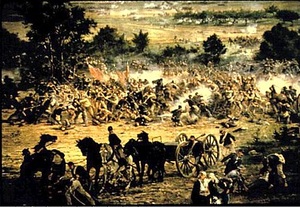
No matter what direction they looked, the battle raged around them.  The agony of the dead and dying, the chaos of Pickett's Charge, the noise, smoke and confusion was everywhere visible.  The sense of being there was overwhelming, yet the scene they observed had happened 20 years earlier.  The time machine that transported them there was a cyclorama.

A couple of days ago, I came across a reference to Louis Le Prince who was the inventor who had been credited as being first to create a motion picture.  I put a link up on my Facebook TechAlmanac to his two-second, 1883 film entitled "Roundhay Garden Scene." I started reading a little more about Le Prince and learned that he had emigrated from France - first to England and then to New York - in the mid-1880s. One of his jobs was to manage the Monitor and Merrimac Panorama exhibition.  I had never heard of a cyclorama so I started doing a little investigating.  What I found was a fascinating history of a form of entertainment that mesmerized those in the late 19th century who saw such a display.

Panoramas (also interchangeably called Cycloramas) were gigantic paintings that were displayed inside specially-constructed round buildings so that the painting completely surrounded the viewer.  The painting could be 350 to 400 feet in circumference and 25 to 40 feet high.  The viewers would typically climb stairs to a high platform in the center of the building so that their viewpoint was that of being on a high hill.  Often, the panorama was also combined with real foreground elements such as trees, fences, or (if it was a military scene) cannons and other armaments.  The illusion of being in the painting was said to be overpowering.

The cyclorama was patented by and Englishman named Robert Barker in 1787.  Barker was the first to coin the term panorama from which the adjective "panoramic" entered the lexicon in 1813.  Barker's first panorama was a view of Edinburgh. He later displayed a second panorama of London as seen from the roof of Albion Mills and it was wildly successful.  Hundreds more such scenes followed by other artists and were displayed across England and Europe.

In the United States, the first panorama was painted by John Vanderlyn in 1818 and was entitled, "A View of the Palace and Garden of Versailles".  The painting was originally displayed in a special building in New York City called the Rotunda. The panorma has survived and is now housed in a round hall at the Metropolitan Museum of Art.  It is one of only three historical panoramas that can still be seen in this country.

Paul Phillippoteaux
The second and perhaps the most famous is "The Battle of Gettysburg" which was painted in 1883. The panorama captured the scene on July 3, 1863, the third and final day of the epic battle, at the time that Confederate General George Pickett commanded a charge of 12,500 troops against an entrenched Union positions.  The result was a bloodbath for the Confederates with over fifty percent rate casualties. The cyclorama painted was painted on commission from Chicago investors by French artist, Paul Dominique Phillippoteaux and a team of other artists. It was first displayed in Chicago on Oct. 22, 1883 to critical acclaim.  As painted, the original was 365 feet in circumference and 42 feet high. Three copies of the Gettysburg Battle were subsequently created by the artist and his team for display in other cities. The first copy, which opened a year later in Boston, found its way years later to the Gettyburg National Military Park in Pennsylvania. It has been displayed there since 1912. It was recently renovated and moved to a brand new exhibition building in the Park.

A Portion of the Gettysburg Cyclorama

The third existing historical cyclorama is titled "The Battle of Atlanta" and is on display in Atlanta, GA.  While this battle depicts the North's victory in Atlanta, it is still cherished as a reminder of the Confederacy's resistance to the decimation of Atlanta by General William Tecumseh Sherman.

There were many more of these huge paintings that were shown in traveling displays to hundreds of thousands of people.  Some titles included "The Battle of Shiloh", "The Battle of Second Manassas", and (the one that got me going in the first place) "The Battle of the Monitor and Merrimac". You might think that it would be hard to lose paintings this large.  After all, the combined paintings making up the cyclorama usually weighed about 10,000 pounds and, even rolled up, would have been 30 to 40 feet long.  Some were lost to fire, others were undoubtedly thrown out when the fashion for these paintings passed. Still others were cut up to make smaller paintings for framing.

One interesting footnote came to light almost in my backyard.  An artist named Joseph Wallace King of Winston-Salem, NC became obsessed with finding one of the missing Battle of Gettysburg cycloramas and stayed on the hunt for decades.  In the 1960s, he got word that one of them might be in a warehouse in Chicago.  When he went to the location, he was told that the old warehouse had burned down a few years before but he went in to the new one and found a fire-blackened back wall.  For whatever reason he thought there might be something behind the wall and talked the owner into letting him punch a hole through to check.  Behind the wall lay one of the stored copies of the Gettysburg cyclorama.  He bought the painting and brought it back to Winston-Salem and unrolled the paintings end to end in the Bowman Gray football stadium.  They even had to take the goal posts down to put all the pieces end to end. King died in 1996 while trying to get the paintings restored and redisplayed.  He bequeathed the cyclorama to Wake Forest University.  In 2007, three unidentified investors from Raleigh bought the painting from the University for a reported $10 million and are seeking other investors to restore and display it.

Cycloramas were the IMAX of their day.  They provided a spectacle and an immersive experience that took viewers to other places and other times.  In the days before motion pictures, they must have been truly extraordinary.  But like every technology, these massive paintings became a dated form of entertainment.  The painting that was found in the old Chicago warehouse was last displayed at the Chicago World's Fair in 1933 and was a Midway attraction, not even one of the major exhibits.

I wonder what the next century will bring in immersive experience.  With the rate of acceleration of virtual reality software it is likely that we will get to the point where we will be able to inhabit places indistinguishable from the real world.  We are almost there now. I can imagine a future virtual theater recreating an even more powerful rendition of the Battle of Gettysburg.  On the other hand, there have been so many battles since that epic conflict that it might be hard to chose which battle to recreate.

Further reading:

Saving the IMAX of its Day - American Heritage Magazine
The Velaslavasay Panorama
Official Website of the International Panorama Conference with lists of other panoramas by country.

Monday, October 11, 2010

Grand Challenges: Keys to Future Training

How do you know when a new technology is becoming mainstream?  Conversely, what trends can you afford to ignore?  Where are the signals that suggest permanence - or at least a long run?  I wouldn't put my money on media hype.  The New-New can very quickly be about as appetizing as yesterday's oatmeal.

One sure indicator of a technology that is here to say is the emergence of training programs.    When employers are looking for skilled people, it is safe bet that the early risks of new technologies have passed.

If you look back at technology history, you can see the pattern.  In the late 1400s, the craft of printing exploded.  Printing was taught as a legitimate craft complete with guilds and master craftsmen.  In the 19th century, engineering emerged as a recognized discipline that was capable of far more than what had been the domain of the earlier military engineers.  Huge public works like the Erie Canal were built in the early 1800s by self-taught surveyors.  By the latter half of the century engineering, lead by civil engineering, was a mainstay at many larger colleges.  Specialty schools were founded which focused solely on science and engineering (e.g., MIT, CalTech, RPI, etc.).  In the last thirty years the emergence of the discipline of computer science has attracted students who wanted to work on the cutting edge of technology.

So what are the new training programs that are emerging that foretell the next wave of mainstream technology?  A quick scan of leading technology universities hints at some directions but one organization that cuts across many of the leading institutions is the National Academy of Engineering.  The leadership of the NAE has pulled together a list of what it calls Grand Challenges that represent some of the major issues facing our global society.  Here's the list:


  1. Make solar energy economical
  2. Provide energy from fusion
  3. develop carbon sequestration methods
  4. Manage the nitrogen cycle
  5. Provide access to clean water
  6. Restore and improve urban infrastructure
  7. Advance health informatics
  8. Engineer better medicines
  9. Reverse-engineer the brain
  10. Prevent nuclear terror
  11. Secure cyberspace
  12. Enhance virtual reality
  13. Advance personalized learning
  14. Engineer the tools for scientific discovery


When I looked over the list, it didn't seem to me that all these challenges were defined from the same altitude.  Some are very broad (e.g., prevent nuclear terror), while others are down in the trenches (enhance virtual reality).  But some broad themes emerge and these would be good bets for training for the future.  I would categorize the themes as energy, the environment, better health care, security, and retooling learning.

Energy and the environment are no brainers.  If we don't start to take these seriously, we will be in a world of hurt. The trick is to move mega-issues like these down into actionable projects which demand trained people.  There is, however, the little matter of who will write the paychecks?  The most sustainable solution is for private enterprise to emerge as a leader but at this stage it will take a public-private partnership to prime the pump.

Better health care is not new but two forces are coming into play to change the game.  The first is the diminishing viability of the old health care model.  This encompasses everything from HMOs to the pharmaceutical drug discovery model (which, as they say, is busted).  The cost increases in the current model are just not sustainable.  But help may be on the way in the form of sophisticated heath informatics to outline better and more cost-effective treatment protocols.  Bioinformatics is at the core of genomic medicine.  Computational power will have even higher leverage in health care in the future.

Another theme in the Grand Challenges is retooling learning.  Again, forces are in direct collision.  The current public education system in this country is failing miserably.  Government initiatives that demand uniform testing may be of some help but the bigger problem is that society, and particularly the family, are being redefined in the Age of Globalization.  On the positive side, virtually every college in the country now has so-called distance learning.  If you don't care about college credit, they even give away courses for free on the web.  The Gates Foundation is focusing billions on improving public education as they research new tools and techniques.  In the end, however, education takes individual concentration and effort.  No amount of technology replaces the desire to learn.

If I were going to college today, choosing a path from the Grand Challenges list would be a good place to start.  In the end, however, it is good to remember that every training and college program is willed into being by a demand for people with particular skills - skills where the demand outstrips the supply. We need to do all we can to make sure the demand is there.  The supply will follow naturally.