Showing posts with label manufacturing. Show all posts

Sunday, July 22, 2012

Are We Losing Our Ability to Fix Things?

I read Louis Uchitelle's essay in Sunday's New York Times entitled, A Nation That's Losing Its Toolbox. Mr. Uchitelle's piece laments what he perceives to be the loss of the ability of the average American to work with his or her hands to fix things - whether things around the house, or the family car, or even on the job.  He describes legions of Home Depot shoppers who need in-store training on how to fix a faucet or install a replacement window. He equates this loss to the diminishing ability of Americans to innovate through a hands-on, we-can-fix-anything attitude.  Mr. Uchitelle believes that this loss shows up "in the wistful popularity of books like 'Shop Class as Soulcraft' by Matthew M. Crawford." [I read Mr. Crawford's book a couple of years ago and I thought it mostly a scree against white-collar workers.]

In the same issue of the Times was a second article entitled, How a Cellphone's Case Can Imitate Its Maker, by Randall Stross.  The article delves into the differences in the difficulties of repairing smart phones and ePad devices depending on the manufacturer. In his column, Mr. Stross focused on a web-based company called iFixit which sells online manuals and tools to change cellphone batteries, replace cracked touch screens, and make other repairs to our electronic paraphernalia. As a bad example Mr. Stross cites the iPhone 4 which is put together with special screws specially designed by Apple to be unremovable without a special screwdriver. Enter iFixit which sells not only said screwdriver but replacement screws that work with the ordinary variety of torquing tools. iFixit calls their product the "Liberation Kit".  Their claim is that anyone can replace an iPhone battery in less than five minutes.

I was struck by the completely different attitudes in these two articles. One laments the loss of handyman capabilities while the other celebrates that we can indeed do-it-ourselves. Which is the truer picture?  I would suggest that the lack of fix-it knowledge is a least as much a function of manufacturers designing products that can't be easily repaired as it is that we are losing our desire to fix things. Take the automobile as a prime example. Most men (I'm not being sexist, it just seemed to work this way) used to know how to change the oil in their cars and if pressed could replace the spark plugs, points, air filters, and maybe even the brakes. Today, the entire motor is hidden under a one-piece shroud that envelops virtually the whole engine compartment making access nigh-on impossible. The engine is carefully monitored and controlled by several computers which are no longer accessible or adjustable with the wrenches and screwdrivers found in most toolboxes.  We now are informed of the status of the inner workings of the engine only when we get the dreaded Check Engine Light illuminated on the instrument panel.  Even then, you need an engine analyzer to read the computer error codes to see what might be bothering your ailing vehicle.

But despite my experience, given the tools and the knowledge, a lot of people are willing to give some reasonable repairs a try. Not everyone, of course. Not everyone fixed their cars even in the days of the Model T.  But I would argue that most people with a little encouragement will try to repair things that seem within the knowledge of someone with a normal amount of mechanical aptitude. We like to fix things. The reason fix-it shops have disappeared is not because we don't like fixing things, it is because most things are not designed to be fixed. Open the average DVD player these days and you find a box with one electronics board that does everything, some injection molded plastic parts that are ultrasonically welded together and a cheap optical laser to read the DVD. None of this can be repaired if it has a problem. The only solution is to junk it.

It used to be different. When radios and tvs had vacuum tubes, even drug stores had so-called tube testers that allowed a homeowner to check a tube to see if it needed replacing and sold the tubes on the spot! There was a company called Sam's that used to sell extensive repair manuals and schematics for every radio and television set made (all in the USA, by the way). Shop manuals for cars were commonly sold to car owners.  Most home owners had at least a few books around on DIY subjects.

So I'm not buying Mr. Uchitelle's argument that people just don't seem to know how to do anything these days. Give them the tools and a little instruction and people can do some amazing things for themselves. To prove my point, I would refer Mr. Uchitelle to the growing popularity of "maker fairs" and magazines such as Make which celebrate a whole new generation of DIYers. The internet is bursting with websites that teach people how to do everything from changing an iPhone battery to repairing a furnace. I'm not worried about our hands-on, can-do attitudes going away any time soon. We are still a nation of doers.

Thursday, December 29, 2011

Small Can Be Beautiful

I realize that the title of this post is something of a rip on E.F. Schumacher's book, Small is Beautiful, but small is not always beautiful. Sometimes small just leads to being crushed.  I started thinking about this when I was listening to an interview on the Diane Rehm Show on NPR. She was talking to  Stanford historian, Richard White, about his book, Railroaded: The Transcontinental and the Making of Modern America.

In his book, White lays out the mostly-sordid business history of the building of both the Transcontinental Railroad and other major expansions of the railroads in the late 19th Century. Railroads were the first large corporations in America. It was not possible to build something as capital intensive as a railroad without major investment. It was also not possible to operate such a large enterprise without layers of management. The Transcontinental Railroad was built mostly through political favors, bribes, and kickbacks. There was no business reason at the time of the Civil War that could justify building a rail line through mostly unpopulated areas. But the railroad got built because there was money to be made in railroad construction costs, land grants, and subsidies.

My purpose here is not to revisit the seamy sides of the railroad business. What got me thinking was how the railroads were once the dominant transportation system in the United States - at least for passenger travel. The over-used term of the time was how railroads "collapsed time and space", and it was true. Travelers depended on the railroads to get where they wanted to go. And in the late 19th Century, you could get almost everywhere on a railroad. Of course, you had to travel on the railroad's timetable and if the town you wanted to get to wasn't on a rail line, you were on your own.

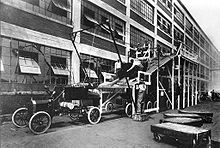
Model-T Assembly Line
At the end of the 19th Century, a laughably obscure technology began its unstoppable derailment of railroad passenger travel.  I refer, of course, to the automobile. From the very beginning, people loved the idea of being able to decide where and when to travel. Roads of the day weren't great, but people started to lobby for better roads. When Henry Ford's assembly line made the Model T affordable to almost every middle-class family, the automobile exploded onto the roadways.  For trips under a hundred miles, people would drive rather than take the train. They could leave on their own schedule and get to any town served by a road - even a bad road.  The family didn't have to have invest in a massive corporation to be able to drive. The large corporations like Ford Motor Company put the individual in charge of their own transportation.  It took decades, but gradually the railroads stopped running passenger trains and the country is now laced with interstate highways that carry the bulk of ground travel.  In the end, the individual would rather have control than give it to a large corporation. Small can be beautiful,

A second example is the main frame computer. When computing  came of age after World War II, it was the large companies like IBM that controlled the industry.  Once again, development was helped by government support - mostly from the Defense Department. Users were allowed limited access to these huge computing machines, mostly through leases to other corporations and universities.  The large capital required to build and operate these machines called for huge corporate investments and specialized technical people to operate the machines.

Then in the early 1980s, the personal computer became available from both Apple and IBM (and a host of smaller players). Computing was now available directly to the individual without an intermediary. People loved it. PCs were found in more and more homes and businesses. The individual became empowered and took control of computing virtually overnight. It didn't take the decades it took to move from the railroads to the automobile. Within a decade, PCs were ubiquitous. And those PCs when hooked to the emerging network called the internet gave people even more individual freedom to communicate and create thousands of new uses for the personal computer. Today, personal computers are in your pocket, in your smart phones, and tablets are becoming the new laptops. Given a choice, people will always opt for more control of their technology.

With these examples in mind, I started to muse about what the next big waves of personal control might be?  The starting point is to look for high capital intensity today. What demands a large corporation to provide the capital to make the technology possible?  I think it would be fair to eliminate those corporations that supply network services like power and oil companies. But even as I write this I think of Skype which has done a lot to eat into the phone companies' business. Maybe the two areas that might come to pass next are manufacturing and health care.

Right now, if you want a new widget, you have to look for someone who makes it and offers it for sale. But 3-D printing is changing the paradigm. Now, you can design or scan an object and send it directly to a 3-D printer that can pop a widget out in nothing flat. The technology is still early and you won't find a 3-D printer in your neighbor's house but give it a decade or two and see where we are. I predict that  manufacturing is going to undergo a sea change - and that sea change which will put more power into the hands of the individual.


The second area that comes to mind is health care. Right now, hospitals and clinics are capital intensive. Most people have to go to a physical facility to talk to a nurse or doctor. Medical records are closed for both privacy and competitive reasons. I think the forces of personal computing and the internet are going to change the way a lot of health care is practiced.  Small sensors built into your smart phone or tablet will measure your physical status and convey it to a doctor who will make electronic "house calls" to you via video links. For most minor situations, you will no longer have to go to the clinic or hospital to be seen.  Even for major procedures like surgery, you will be able to choose an expert who might live half-way around the world to do your procedure via robotic surgery.  Health care is ripe for change due to its taxing infrastructure and exploding costs.

People want control of their lives and technologies. New technologies that give them the sense of control at affordable costs will be rapidly embraced.  The world awaits the next waves of change. Small can be beautiful.

Wednesday, September 21, 2011

That Should Still Be Us

I saw an article in our local paper, the Raleigh News and Observer, entitled, Industries Fear New Wage Rules. The article was exploring the new wage rules that are being imposed by the Department of Labor on industries that hire immigrant workers on H2-B, temporary work visas.  Wages are projected to increase, on average, almost 50 percent - from $7.43 an hour to $11.18 an hour under the new rules. The higher wage is in line with the minimum wage paid in most regions. The reporter interviewed a number of small industry owners such as oyster processors, reforestation services, and even hotel owners for the impact of the upcoming change in the law. Not surprisingly, the owners are not happy, feeling that the increase in the wages they will have to pay will drive many of them out of business. Not a good deal.

But what struck me in the story was a couple of paragraphs in the article:

Employers say that they rely on foreign workers for the dirty, back-breaking tasks that Americans aren't willing to do - even with the current high unemployment rate.  And, they stress, they're required to document their efforts to hire Americans before the government permits them to hire foreign workers.

Further on, the article states:

Susan Pentz, 60, who along with her husband owns the 18-room Harborside Motel on Ocracoke Island, has been bringing in two housekeepers each tourist season for the past decade. She turned to foreign workers, she said, after struggling to hire locals and discovering that those she was able to hire soon quit or showed up only when they felt like it. "The bottom line is, I ended up cleaning the rooms because... no wanted to do that kind of manual labor," Perez said.

I read this article just after I finished reading Tom Friedman's and Michael Mandelbaum's new book, That Used to Be Us: How America Fell Behind in the World It Invented and How We Can Come Back. The authors of the book are trying to get us to focus on the multiple forces are in play that are causing us to slide from the leadership position we have enjoyed since at least the end of World War II.


The Big Challenges in their minds are:


  1. Globalization and  the Information Technology Revolution
  2. The Return of Strong Middle Class Jobs
  3. Rising National Debt and the Deficit
  4. The Need for Green and Clean Energy
They spend quite a bit of time documenting each of these areas in what amounts to a rehash of other news articles and their own past opinion pieces. Still, the case is compelling that these are. indeed, major issues that need to be addressed.

To address these issues, they outline what they call the Five Pillars of Prosperity:

  1. Providing much better public education for more and more Americans
  2. Continuing to build and modernize our infrastructure
  3. Keeping America's doors open to immigration
  4. Government support for basic R&D
  5. Implementing limited but necessary regulation on private economic activity
The authors make the case that we basically got fat and happy when we won the Cold War.  At just that moment, we should have been redoubling our efforts to compete in a global economy. Instead, we borrowed our way to an unsustainable way of life.  But the bills have now come due on both a personal and national level. Worse, the current political system is so broken as to prevent any meaningful action to address the Big Challenges. 

Their solution? They think we need a strong, centrist, third-party Presidential candidate. They acknowledge from the outset that the candidate most likely won't win. But the candidate could force whoever does win to take note of their more centrist platforms. They even suggest three past third-party candidates who did just that - Theodore Roosevelt and his Bull Moose candidacy to continue to build Progressive reforms in 1912, George Wallace in 1968 who forced Washington to pay attention to the South, and Ross Perot in his 1992 bid to address national budget deficits (they didn't mention Ralph Nader).  Each of these candidates caused the incoming President to enact reforms that the Third-Party candidate strongly campaigned to bring to the nation's attention. The authors call this strategy political Shock Therapy. 

And what does all this have to do with the history of technology? Everything. This country was built on the backs of immigrant labor manning the steel mills and garment sweatshops. The entrepreneurs who built American business developed countless new technologies that changed our way of life. Think telephones, automobiles, televisions, personal computers, and cell phones. To make all of these objects that we now take for granted required more and more skilled labor in the factories. A Middle Class with rising expectations that their lives would be better, and their children's lives better yet, was born, at least in part from a strong public education system. By comparison, for the last decade, data indicates that the Middle Class has not advanced economically one dime. In fact, they may be worse off than they were ten years ago.

Technology and democracy have always played key roles in making the United States a place where people wanted to live. For many in the Third World, it still holds that attraction. But I agree with Friedman and Mandelbaum - something needs to change and change fast. We are well past the dithering stage. 

The immigrant workers who come to North Carolina to take temporary jobs are looking for a better life, just as millions of immigrants did before them. They are willing to do what Americans are not, and I'm not just talking about the menial jobs they do. They are willing to leave their home country and families to try to make a little better living than they can at home. How many of our own, even highly-educated people, are willing to leave their country for better opportunities in China or India?  Not as many as those who come the other way for poor wages and lousy living conditions. 

Let's try to get technology back to producing the jobs we need to help all of us be in the position where we can look forward to a better future.  We are still the best hope for a brighter world. 

Wednesday, March 9, 2011

The Triangle Shirtwaist Fire


Three stories of ten-floor building at the corner of Greene Street and Washington Place were burned yesterday, and while the fire was going on 141 young men and women -- at least 125 of them mere girls -- were burned to death or killed by jumping to the pavement below.
The building was fireproof. It shows now hardly any signs of the disaster that overtook it. The walls are as good as ever; so are the floors; nothing is the worse for the fire except the furniture and 141 of the 600 men and girls that were employed in its upper three stories.
Most of the victims were suffocated or burned to death within the building, but some who fought their way to the windows and leaped met death as surely, but perhaps more quickly, on the pavements below.    New York Times, March 26, 1911.

I had missed the recent American Experience film on the Triangle Shirtwaist Fire but I was able to view it on the PBS Video website.  I highly recommend spending an hour watching it.  This program seems to be all the more pertinent to me as I continue to read about the daily struggles of unionized government workers in many states - starting with Wisconsin. They are, of course,  not fighting for safer working conditions but they are trying to hold onto long-fought-for collective bargaining rights.  The bitter irony of the workers at the Triangle Shirtwaist Company is that even though they had led a strike by New York City garment workers in 1909 for union representation, they never achieved it for themselves.  The owners, Isaac Harris and Max Blanck, would simply not permit any "meddling" in their control of the business.  Harris and Blanck were later tried and acquitted of manslaughter charges connected to the fire.  They went on to collect a lucrative insurance settlement and continued in the garment business. They were fined repeatedly for operating their factories under unsafe working conditions.

Asch Building in New York where fire occurred
on second to top floor still stands today.
Photo from Wikipedia.

Society benefits greatly from technology.  More often than not, that technology is made available through companies which compete fiercely against each other in the marketplace. The argument that nothing should fetter the owners of a business with regulatory burdens that might make them less competitive simply cannot be supported in the face of the tragic consequences that can so easily befall their employees.  Reasonable regulations and collective bargaining are not evils. They are part of the cost of doing business in a complex society. It is always a balance.  What should be regulated and what should be left to the market?  What voice should workers have compared to owners or managers?  While there is no lasting answer to these questions, it seems that we are once again tilting towards excessive power - and excessive rewards - on the side of owners and managers.

Sunday, January 9, 2011

The Early Automobile Era: 1895 - 1910

Library of Congress Image
Detroit Publishing Company Collection

The story of America and the automobile has been going on for over a century.  We love our cars.  We love the sense of freedom they bring.  But it is much, much more complicated than that. Cars are modes of transportation, status symbols, a way to express who we want to be, and one of the mainstays of our economy. They have changed how and where we live, how we work, who we know, and even how some of us will die.

Let's play a little association game.  Don't try to be to self-conscious about this. Just remember the first thing that pops into your head when I say a word.  Ready?

Automobile

Now don't edit it.  What image came to mind - because it will most likely be an image.  Here's another:

Model-T

Did you think Henry Ford?  Old-fashioned?  How about these words:

General Motors

The quick image, now.  Bailout? Your father's Oldsmobile/Chevrolet/Buick? Crappy quality?

We could play this game forever and in fact, Americans a century ago could have played the same game. The automobile began to encroach on our collective and historic lives as far back as 1895 but the wheel really got rolling (bad pun intended) in the first few years of the 20th century. How some of that happened is the focus of a now out-of-print book entitled,  America Adopts the Automobile, 1895 - 1910, written by James J. Flink and published by the MIT Press in 1970.

 I came across this book in a used bookstore and I just had to buy it.  Something about those founding days of the automobile industry fascinate me.  Actually, the founding days of any industry fascinate me - but I digress.   The years covered in Flink's book were a period when we were thunderstruck by this glorious machine and willingly made the Faustian bargain to trade our very souls to become (in the term of the day) automobilists. Flink, who was not a historian of technology but a historian of American culture, wrote a number of books about the automobile but this was his first and it is a good one.

This is not the usual book of over-hyped color photos of "American Classics".  It is a thoughtful look at many aspects of how automobiles so rapidly became embedded in every aspect of our lives.  In his 300+ page book, Flink used as his primary sources most of the motoring periodicals of the day such as Horseless Age,  Motor Age, and The Motor Way.  He also referenced a number of books written shortly after this embryonic period when first hand knowledge of the beginnings of the automobile industry was still abundant.  There's plenty of data here and also some nice black-and-white car ads and car images that come out of the magazines of the day.

Why was the automobile so quickly adopted? Most people saw very quickly that an automobile was cheaper and a heck of lot easier to keep (not to mention less cranky) than a horse pulling a buggy.  For some occupations (such as the family doctor), the automobile allowed a more rapid and reliable way to get around town.  Contrary to our usual image of early automobiles broken down on the side of the road, they were in fact quite reliable even in their earliest designs.  What wasn't reliable was the tires on the car which gave endless reasons to the automobilist to curse until the tire technology finally began to catch up to the rest of the vehicle.  Those early trips were measured more in number of tires changed than in miles per gallon.

Flink covers topics such as how and when automobiles first began to be licensed.  At first, automobile registration was perennial.  Do it once and you were done.  Pretty quickly this proved to be impractical - not to mention the loss of tax revenue from annual renewals.  In the earliest days, automobilists had to license their car in every state in which they planned to drive.  Similar issues surrounded licensing of drivers.  Not surprisingly, this came about after a few hot-headed drivers managed to mow down some pedestrians and wreak havoc on the local horse-and-buggy traffic.

Licensing and regulatory issues were just some of the reasons that local automobile clubs formed quickly in the first decade of the century. Clubs formed to allow enthusiasts to share their passion for the car but also to band together to build garages and maintenance facilities.  In that first decade, townspeople didn't have garages and their automobile was more often a Sunday drive hobby.  They needed a place to park.  It was later that people began to recognize that their cars would get them to work more comfortably than they could get there on the streetcar.  If the owner was wealthy enough to own a stable behind the house, Ol' Dobbin was turned out and the shiny new Hupmobile or Packard took his place.

Flink spends some pages discussing why the gasoline-powered automobile quickly came to dominate the steam and electric cars of those early days. He also describes the chaos of the early manufacturing market with literally hundreds of companies jumping in to try to catch the wave.  How could so many people afford to start auto-making companies?  The early car manufacturers had an ideal set of business conditions.  People went crazy for cars and every car built was sold before it hit the end of the assembly line.  All purchases were strictly cash and people lined up to plunk down their money. The auto companies were essentially assemblers who bought almost everything from suppliers and demanded that the suppliers bear the cost of all the parts inventory.  Hence, very little capital was needed to get into the auto assembly business in this early stage.  That all changed, of course.  When Henry Ford introduced the Model-T in 1909, the jig was up for many of those still in the game.  More than that, most of the early car makers had focused on building higher priced (and more profitable) cars for the middle and upper-class markets. By 1909, these markets were already saturated and the game was then to build a reliable, low-cost car for the mass market.

The book doesn't go beyond the introduction of the Model-T.  The outcome of that era, though,  is still evident everywhere we look: suburbs, a vast network of highways, acres of parking lots, air pollution, and roadside carnage. But there is no going back.  Last week the venerable Ford Motor Company, which introduced the Model-T in 1909,  announced its first all-electric car.  GM already has the Chevy Volt and hybrids are becoming so common as to be non-events.  Our love of the automobile will go on but it will never be the same as those days in the first decade of the 20th century that Flink so ably describes. Maybe the same will be said for our own day with the excitement about the internet and the social networking of the world.  It looks great from here.  We shall see... or rather our great-grandchildren shall see.

Monday, August 23, 2010

When Google and Apple Are as Passe as Ford


Virtually every list of the most innovative companies in the world list Google and Apple in the top two or three slots.  Both companies are there for a reason - their products and services are cutting edge and customers can't get enough of them.   Look at the lines out the door at the Apple Store when the iPad and the iPhone4 were introduced. Look at the ever-increasing reach of Google.  From search engines, it has branched out into operating systems for cellphones (Android), web browsers (Google Chrome), and online office suites (Google Docs), not to mention Gmail, Google Books, Google Maps, Google Earth, Google News, YouTube... you get the idea.

But that edge in the cutting edge moves.  What was the cutting edge one hundred years ago now brings a yawn.  While Google and Apple bask in the warm glow of innovation accolades today, in a hundred years they will most likely be history.  I was reminded of this as I was reading Douglass Brinkley's book, "Wheels for the World: Henry Ford, His Company, and a Century of Progress."  Brinkley writes of the heady days of early Model T production when Ford couldn't build their cars fast enough:

The astounding pace of change at Ford Motor Company in 1914 made it the most glamorous, most widely discussed company in America, if not the world. It was not merely that Ford was trying so many things in so many arenas, nor even that it was succeeding with most of them.  What attracted the admiration and envy of outsiders was the brimming confidence Ford Motor exuded. The public's fascination with Henry Ford's maverick role lay in part in his overt image as an iconoclastic, oddly nineteenth-century presence in the twentieth century's most up-to-date business. It seemed that through modern industry Ford had reopened the American frontier.  His company was more than a profit-making enterprise; it was a pioneer's domain, where old assumptions about business were cast off in favor of new notions.  As on any frontier, money did not make for heroes, and Ford Motor had started with very little money.  The company did not rely on established connections, either, remaining as stubbornly independent as it had on the day it was founded. Ford Motor proved that creating a fresh new world out of the industrial domain rested on only two crucial qualities: competence and confidence. (p. 180)

If you changed Ford Motor to Google or Apple in the above quote, you would have a pretty good description of what makes these companies great today. Henry Ford reminds me most of all of Steve Jobs.  Ford was a megalomaniac with his vision of the car for the masses.  He alienated almost everyone around him including those who helped him form the company.  He began to believe that he alone was the arbiter of automobile innovation.

Maybe it takes that kind of drive and vision to have the absolutely phenomenal results that innovative companies create.  Within ten years of Ford Motor Company's founding in 1903, Henry Ford was second in personal wealth to only John D. Rockefeller.  Ford sold more cars in 1914 than the next ten producers combined!  The Model T changed the face of America as surely as Apple and Google are changing it again today.

[Photo and logos from Wikipedia]

Saturday, July 24, 2010

Bethlehem Steel Blues

I was browsing through a website called SnagFilms which hosts documentaries and I came across a three-minute film on the sad aftermath of the failure of Bethlehem Steel in 2003.  This short video is worth a look.

Watch more free documentaries

The deep sadness in this film piqued my curiosity about this very successful company and its namesake town of Bethlehem, Pennsylvania.  Wikipedia has a great overview article on the company.  Fortune Magazine did a post-mortem on the company's demise back in a 2004 issue which was worth a quick read. 

The steel industry was once the bellwether of American industrial health.  Bethlehem Steel provided the steel for the Golden Gate Bridge and the Empire State Building, among a long list of other American icons.  It was not only one of the largest of the U.S. steel producers, it was also one of the largest ship-building and railroad car manufacturers in the country.  Now, the original steel mill site in Bethlehem is bare ground except for a new casino.  In some bitter twist of fate, the construction of the casino was delayed for a shortage of... you guessed it... steel.

What went wrong?  The answer is both complicated and simple.  The complicated answer involves the emergence of cheaper steel from newly-built mills in Japan and Europe following World War II, the dependence of U.S. industry on trade barriers for protection rather than reinvesting for innovation, arrogant management, huge legacy costs for retiree healthcare benefits, and a steelworkers union that refused to give an inch to a management that was equally obstinate.  The simple answer is that the steel industry ran its natural course and we no longer need to make steel.  That simple answer, like most simple answers, is also wrong.

Lehigh University has done a great job putting together a website called Beyond Steel that goes into many different aspects of the manufacturing and cultural history of the region.  I especially liked this picture of Bethlehem management taken in 1950.
You don't have to see any detail to know that this was an old, white guy's club. 

Unfortunately, we don't seem to learn much from the life cycles of companies and industries.  The early risk takers give way to the managers who drive up efficiency which leads to the management that pays itself enormous salaries for what seems like their God-given success which precedes the bankruptcy experts who dismantle the enterprise after it crashes.  We are seeing it now in banking.  The auto companies have also been recently knocked down a notch by their own arrogance.  The jury is still out  to see if they survive the long term.  After all, it took Bethlehem Steel almost thirty years to die.

But as the first film shows, often the biggest cost to a community is the disruption to families that have lived there for generations.  In the end, when a company fails, everybody loses.  Everybody.  If you look back at that picture of management, you can just make out five little statuettes on the back wall of the auditorium.  They represent the Customers, Employees, Management, Shareholders, and Suppliers.  Every one of them lost out. 

And we are left building casinos on old industrial sites which form a kind of scab on what was once the healthy corpus of our economy.  But, what the hell, this time around, the odds are with the house.
Enhanced by Zemanta

Saturday, April 17, 2010

The Aging of Innovation in America

[Image of Edison's lightbulb from patent application of 1880]

As individuals, it is pretty easy to know when we have passed our prime.  If we are lucky, the first sign isn't that we read our obituary in the paper.  It shows up in little things: pants that seem to have shrunk, skin that seems to hang a little looser, difficulty in remembering what I had for dinner last night, stairs that seem to have gotten steeper.  We fight it or we deny it, but biology has the last word.  And everyone passes beyond their prime at some point.

How about an economy, or more specifically, the American economy?  Nations grow and decline like all things based on living systems.  Where's the United States on the curve?  What is the equivalent of a "sagging chin line" for an economy?  Three things come immediately to mind.  One is the rate of growth of the economy, with the operative word being "rate".  This is the good-old Gross Domestic Product, or GDP, statistic. A second is innovation, which is one of the key drivers of growth. This is a little trickier to measure objectively.  Patents might be a measure but most studies say they are not a good surrogate for innovation. The third is a steadily increasing personal income.  If people aren't finding themselves any better off over time, people catch on to that fact quickly.

I have seen a number of articles recently that make me seriously worry about where we are as far as the country's economic maturity is concerned.  We seem to be, more and more, rushing into a period of serious aging as though we had blown the diet and stopped going to they gym for a little toning. The most recent article I saw was Business Week's annual list of the 50 Most Innovative Companies.  In an accompanying article, the Business Week reporters, Michael Arndt and Bruce Einhorn,  wrote:

The shift [in U.S. innovativeness] is more apparent when this year's class is compared with the first ranking in 2005. Back then, only six of the Top 20 were headquartered outside the U.S., vs. 13 of 25 this year. In addition a third of 2005's American champs—such names as 3M, Starbucks, and eBay—no longer make the Top 50.

The article also reports that most management in Asian companies treat innovation as a high priority with over 90 percent stating that they plan to invest in increased innovation efforts.  U.S. managers, by comparison, are planning similar investments in only 48 percent of the companies interviewed.

It's nice to see that Apple, Google, Microsoft, and IBM are the top four on the 2010 list.  But this isn't nearly enough to offset the relative losses which show up not only in innovation rankings but in 2.4 million off-shored manufacturing jobs in the last decade.

Looking at my other two leading indicators, GDP in the U.S. has been decreasing for the past six years - well before the current recession began.  Personal income adjusted for inflation has been flat for a decade or more.


All in all, our Economic Report Card is definitely looking more like a C- than something that might get us into the National Honor Society.  But it is not enough to simply rant about needing more innovation (although venting can be useful at times).  I might have thought that the near total collapse of the auto, banking, and housing industries would raise some serious concerns about the viability of the economy and our competitiveness.  I wonder what it will really take to get us to pay attention?

In the past, the American economy grew not because there were calls from Washington or from editorials to be more innovative.  The economy grew and innovators had an impact because there were opportunities to exploit.  Innovators and entrepreneurs saw unmet needs and worked their tails off to fill the need.  It's still happening.  Apple, Google, Microsoft, and IBM all employ lots of very smart people.  The problem is that the rest of the economy, the manufacturing and service economy that pulled up the middle class has been farmed out to low-wage countries.  That's the gap that has to be filled.  How do we bring innovation to create jobs that pay decent wages for the people in the middle-class of a post-industrial society?  I don't know the answer but I think it is the right question.  That's at least a start.

Wednesday, December 2, 2009

Transportation Systems: Centralize or Decentralize?


I have commented from time to time on these pages about transportation.  Most recently, my musings have been about the well-understood insight that speed collapses distance. It also increases our sensitivity to time.  We have the railroads to thank for the first modern example of this phenomenon.  The network of rails which crisscrossed the country in the middle of the nineteenth century united the country in a way that would have been impossible just a few years earlier. With the increased speed of transportation, the whole trajectory of the country's development shifted westward and took on an east-west orientation as opposed to the north-south orientation that had dominated the earliest days of independence.

What I hadn't fully appreciated was how the railroads tended to be a centralizing force in the development of the United States.  The huge capital investments and the need to maximize the amount of freight carried on every train led to some cities growing to dominance as the railroad lines coalesced on regional hubs.  Chicago is probably the best example of a city that grew from virtually nothing to a metropolis due to this centralizing effect.  Farmers wanting to get their crops to market needed railroads.  The railroads that fanned out west of Chicago provided just such a transportation network.  The produce (especially grain) from the Western farms was then transported on trunk railroads to the East.  Like Chicago, those cities which had some early advantage in the developing railroad network in a region tended to grow much more rapidly.


Highway transportation networks of the twentieth century had just the opposite effect.  Farmers and manufacturers were no longer governed by the fixed schedule of the railroads.  Trucks could be scheduled to pick up and deliver freight at any time and in any location, even those far removed from the railheads.  As a result, the earlier concentrations of industry began to drift away from the small number of hub cities.  Manufacturers moved their operations to be closer to their sources of supply, or nearer their markets, or to access cheaper labor.  The result has been a rebalancing of the differences between some of the earlier metropolitan leaders and their former junior cities.


Technology creates patterns and just as easily an even newer technology can fundamentally change those patterns.  Over the last twenty to thirty years, we have been living in a different pattern yet again: globalization.  Now the patterns of transport and connections span the globe.  The lure of cheap labor, capital incentives, and the low cost of ocean transport has resulted in industry after industry moving their operations offshore.  And as already mentioned, transportation is again at the heart of some of those influences.  This time, the transportation revolution has been in container ships which have dramatically lowered the cost of shipping manufactured goods of all kinds.

What new patterns will emerge next?  Surely, we will continue to see changes.  Perhaps these changes will span decades and hence be less immediately apparent.  But it is impossible to imagine that we are now living in a static world.  If I was trying to predict what the future patterns might be, I would put some of my money on watching innovations in transportation systems.  No matter how much we move into the Knowledge Economy, we still need physical products and they have to arrive where we can purchase them.

Monday, November 23, 2009

Interchangeability

I am reading Nature's Metropolis by William Cronon (Norton, 1991).  The central thesis of the book is that cities like Chicago are shaped by their outlying economies of farming, lumbering, and livestock and, in turn, the cities shape those outlying economies.  It is a symbiotic relationship in which a city is not possible without the country around it or vice versa.  But the book also brought up a related topic which intrigues me: interchangeability.  We live in a world where interchangeability is so deeply ingrained in our culture that we don't even think about it.  Need an oil change?  Any service station will have a filter that fits your engine.  Need to replace a light bulb?  Every bulb is designed to fit a standard socket.  What amazes us now are things that are not interchangeable.  These are almost by definition hand-crafted and very expensive.

You might say that interchangeability dates all the way back to Johannes Gutenberg and his invention of moveable type.  Any letter could, after all, be put in any position along a line of type.  But the extension of that idea to other devices dates back more to 18th century France.  A French artillery officer with the wonderful name of Lieutenant General Jean Baptiste Vaquette de Gribeauval came up with the idea of standardizing all of the parts in the French Army's canon inventory.  His ideas were not fully implemented, but another Frenchman, Honore Blanc, actually began mass-producing muskets from interchangeable parts in 1790.  Thomas Jefferson met Blanc while Jefferson was the United States Ambassador to the French Court.  He communicated the idea back to the War Department because it would allow the production of a large quantity of weapons without having to have a large number of skilled gunsmiths.  America just didn't have that many skilled craftsmen to meet the demand for a large order.

About this same time, Eli Whitney (yes, the same Eli Whitney of cotton gin fame) started to get interested in making rifles for the U.S. Government.  It seemed a more lucrative business than the cotton gin which had more or less been stolen from him by patent pirates.  Whitney came to Congress with a load of parts which he claimed were made identically and assembled rifles by randomly selecting parts from different barrels.  The Congress was duly impressed and placed an order which Whitney took eight years to complete.  The trouble was, Whitney's so-called interchangeable parts had all been carefully filed by skilled craftsmen to make them fit together but they were not truly produced to interchangeable tolerances.  Others got into the game and the first truly interchangeable device built in America was a clock made by Eli Terry in 1816 from mass-produced wooden parts.  There were others who rightfully deserve the credit for the first firearm made from interchangeable metal parts including John Hall and Simeon North.


But my thoughts when reading Cronon's book were not about guns.  Interchangeability in the world of Chicago came in two other major forms.  The first was making wheat interchangeable.  In the early days of farming, every farmer sent his grain to market in sacks and those sacks were transported all the way from the Midwestern prairies via Chicago to New York or other eastern destinations without ever leaving their burlap.  A farmer could have gone to the final destination and gotten his exact wheat back if he had wanted to do so.  The revolution that was invented in Chicago was interchangeable wheat that was based on grading all wheat to certain standards.  Now, wheat from different farmers could be mixed together at a grain elevator without compromising the value of the grain.  Number 1 Winter Wheat was supposedly the same no matter what farm produced it.  Grain could now be shipped in bulk much more quickly and efficiently by automated equipment like grain elevators and automated loading and unloading equipment.  It was no longer necessary to haul each sack of grain on and off intermediate modes of transportation (such as wagons, railroad cars, and ships).  This seemingly small change not only made the physical processes work better but it gave rise to the commodity markets of the Chicago Board of Trade.  It really was revolutionary.  The volume of business skyrocketed.

A second example that came out of the book was standardized lumber dimensions.  With the advent of lumber cut to dimensions such as 2 inches by 4 inches or 2 inches by 8 inches, building could now be put together almost like Erector Sets in what became known as balloon-frame construction (because the frame was so light compared to older post-and-beam construction).  Standardization brings efficiency and efficiency brings economy.  We could never afford all the modern conveniences that make up our world were it not for this pervasive idea of interchangeability.  It is everywhere, not just machines.  As long as something functions within a certain defined set of parameters, it can be substituted for something else that fits the same parameter space.  If two things are not interchangeable, you know there is at least one parameter (which might even be an esthetic one) which is not the same.

Interchangeability was the power that allowed Gutenberg to revolutionize printing.  Interchangeability remains one of the most powerful ideas in our modern world.

Saturday, June 13, 2009

Alexander Hamilton, Founder of SUM Town


Ask someone whose portrait is on the ten dollar bill and you will probably get an answer like Abraham Lincoln or Benjamin Franklin. In fact, it is Alexander Hamilton, first United States Secretary of the Treasury and a Founding Father of our country. Hamilton even lead three battalions of troops at the Battle of Yorktown.

Hamilton believed in a strong central government as well as industry and trade as the basis for a vital country. One of the ideas that he championed was the formation of the first public-private corporation in the United States. The Society for the Establishment of Useful Manufactures (or SUM) received a corporate charter from the New Jersey legislature in 1791. A survey of possible waterpower-driven manufacturing locations identified the Great Falls of the Passaic River in New Jersey as the best site to build the new enterprise.


To provide a place for the working people to live, the town of Paterson, NJ was founded next to the falls. It was named after William Paterson, governor of the state -- a wise political move to help build support. Some of the charter members wanted to name the town after Hamilton but he would have none of it. In fact, Hamilton would not participate financially in order to avoid a conflict of interest, even though he had championed the idea. The corporate charter allowed for a subscription of up to a million dollars in capital, a huge undertaking for that time. Leading business men subscribed to the stock and the first factories were built and put into operation to produce textiles. Other products planned included iron wire and even straw hats.

Paterson was the first planned industrial community in the United States. The original plan for the town was proposed by Pierre L'Enfant, the same architect who laid out the plans for Washington, D.C. L'Enfant was soon replaced, however, as his plans were viewed as much too grandiose for the needs of the industrial town. A much more pragmatic plan was undertaken to guide the building of the new town.

Alas, all did not go well. The first head of the SUM corporation embezzled much of the money. The mills never became profitable due to small manufacturing volumes and extended start-up costs. The waterpower capability of the falls was over-estimated. And mismanagement fouled up much of the remainder. By 1796, the project was closed down and Paterson became a virtual ghost town.

But all did not end there. As the technology matured, new factories were opened on the Passaic by independent businessmen who leased the water rights from the Society. The Society actually turned a tidy profit on its real estate and water rights deals. Paterson was even the first site for Samuel Colt's manufacturing of firearms in 1835 (although Colt later moved his business to Connecticut). Paterson continued to prosper through the next 150 years as a manufacturing center.

The story has a tragic ending for Hamilton as well. In July of 1804, Hamilton was mortally wounded in a duel with the Vice President, Aaron Burr. Burr had taken offense at a supposed derisive comment Hamilton had made about Burr and demanded a pistol duel. Evidence suggests that Hamilton deliberately missed Burr but Burr had every intention of killing Hamilton who was shot in the lower abdomen. Burr was charged with murder but never tried. He fled to South Carolina but later returned to Washington, D.C. to complete his term as Vice President.

American Experience on PBS has a great biography of Hamilton which you can watch online here.

Saturday, June 6, 2009

Automotive Sculpture


I was browsing through some photographs recently that I had taken at an old car show. I came across this picture which shows the logo that adorned the radiator of an old automobile at the show. If you look beneath the three knights you can see the word "Graham". I became idly curious about Graham cars and started doing a little digging to find out more.

The Graham brothers (there were three of them) came from an Indiana farm background and near the turn of the 20th century they got involved with a glass-making factory. The company was one of the predecessors of what eventually became Libby-Owens-Ford (LOF) that became a major supplier of safety glass to the automotive industry. The brothers got interested in manufacturing light trucks based on modifying Ford's Model-T's. Eventually, they set up their own truck manufacturing business and began supplying trucks to Dodge. Dodge bought the brothers out but they weren't out for long. The Grahams took their profits and bought the recently-defunct Paige Motor Car Company and renamed it (surprise) the Graham-Paige Motor Company. They began producing cars in the late twenties when there was still a little "roar" left in the economy. By 1930, they had dropped the Paige part of the name and the cars became badged as simply Graham (although the public continued to call them Graham-Paige).

So what was the symbolism of the logo? The icon on the radiator in my photo was designed for the Grahams by the (then) well-known Chicago sculptor, Laredo Taft (1860 - 1936). Now I became curious about Mr. Taft. Digging around, I found the following:

The badge is meant to represent the three Graham brothers as valiant white knights that come to the rescue of troubled car companies. I guess the brothers actually felt that way about themselves.

Taft, as it turns out, usually designed much bigger works starting with statues on the Horticultural Building in the 1893 Chicago World's Columbian Exposition. His largest work is a 126 foot-long sculpture in Washington Park in Chicago, entitled Fountain of Time.


The sculpture honors the 100 years of peace that had endured between the U.S. and Great Britain beginning with the Treaty of Ghent in 1814. It shows 100 figures at all stages of life parading past Father Time. Taft even put himself in the sculpture as you can see in this photo.


The sculpture itself is inspired by Henry Austin Dobson's poem, "Paradox of Time". The poem contains the line:

Time goes, you say? Ah no, Alas, time stays, we go.


But I digress. Back to the Graham boys. Time was not kind to the Graham Automobile Company. The company creaked on through most of the Great Depression losing money every year except 1933. By 1940 with World War II approaching, the company switched to government contracting and became profitable. No Graham cars were ever built again. Even then, curiously, the government rescued car makers from total demise!

So my photo of the radiator ornament taught me a lot. I now know something about the Grahams, Lorado Taft, and the unlikely connections between technology and art. Who would have guessed?

Thursday, May 28, 2009

Is Enterprise Going Non-Linear?


I just finished reading an older but still well-written book on American technology and enterprise entitled (appropriately enough), A History of American Enterprise, by John M. Dobson. Dobson was a professor at Iowa State University and he wrote the book in 1988 as a text for undergrads. Dobson did a great job of summarizing how technology and enterprise worked hand-in-hand from colonial days up to his time. Now that twenty more years have elapsed, it is interesting to see how the next couple of unwritten chapters have played out: the Gulf War, the Booming 90's, the dot com crash, 9/11, the Iraq and Afghanistan Wars, and now the bursting of the housing bubble and the deepest recession since the Great Depression. Clearly, this has not been a very stable period.

In reading this history, I was struck by how much more volatile recent times seemed to have been. Boom and bust cycles have always been a part of our history, of course. So have crooks, moguls, builders, and innovators. No, what struck me was that sometime around the 1970's, the system seemed to have moved from being reasonably understandable to being very volatile, almost chaotic in the mathematical sense of the term. The U.S. was moving into a post-industrial economy that was based more on imported products. Finance and services were rising as a total share of employment. Globalization was driving more and more businesses to outsource jobs and functions. In many ways, all these things were linear extensions of what had come before. Companies have always sought lower labor costs and more technology to automate their operations. Something else seemed to be happening that was quite different from the past.

I believe that the U.S. economy went into a new period in history because of two related things that reached some sort of critical mass in the late 70's and early 80's. The first (and the main driver) was the advent of ubiquitous, high-speed computer information networks. These networks not only opened the door to new financial products and services but they also allowed clever traders to generate profits on momentary differences in security prices across markets (arbitrage) that could never have been realized by human traders. These profits brought about the second change. The seemingly unstoppable ability to make easy money in financial trades invited huge sums of money into the market. More and more people and institutions felt like they were being left behind by traditional investment plans and the uncertain future of Social Security. The massive amount of money that was then traded in increasingly complex and split-second automated transactions essentially took us into a world where no one clearly understood or had sufficient control of business cycles. Some of this is becoming visible only now as people try to untangle the web of securitized mortgages and credit default swaps and other even more complex vestiges of the current melt-down.

I realize that there were dozens of other things going on during that time; Reagan supply-side economics, de-regulation, the explosion of wireless technology and the World Wide Web to name just a few. Part of complex, non-linear systems is that small inputs can create large and unexpected outputs. But I do believe that the system somehow slipped beyond the immediate control of real, breathing people. The question is not whether we will return to the "good old days". We will never go back to pre-automation. We wouldn't want to if we could. The question is whether future systems can be built with enough intelligence to limit the damage that can occur when huge sums are traded across the globe in microseconds. I believe that our systems will get smarter, partly because someone will figure out how to make a buck by helping them to do so. I also think that regulation is the human version of technology control systems. They are there to provide checks and balances to the operation.

I believe that the long view of history and technology provides us with a much needed antidote to the 24-hour business news cycle. When I read books like Dobson's, I see that there have been periods when we have accomplished great things and other periods when we seemed to have lost our rudder. Hopefully, we will be coming out of our current downturn soon. And you can be sure that technology will play a vital role as it always has.

[Photos: Top picture is a Lorenze Attractor from Chaos Theory. Bottom is a Televideo computer terminal. Both from Wikipedia.]

Sunday, March 29, 2009

George M. Pullman: Force for Progress or Corporate Despot?

And the sons of Pullman porters, and the sons of engineers,
Ride their fathers' magic carpet made of steel...
- Steve Goodman


He was buried at night in a reinforced crypt with tons of concrete poured on top of his casket to protect it from desecration by those who hated him. He was the American idyll, the self-made man. In his life, he changed the way people traveled, he built his vision of a planned community, and he was the center of one of the most bitter labor struggles of his era. His name was George Mortimer Pullman.

Pullman’s name has become eponymous with three things: railroad sleeping-cars, the village he created to house his factory workers outside of Chicago, and the bitter labor strike of 1894.

George Pullman was born in western New York in1831. He left school when he was 14 and worked for a time in his brother’s cabinet-making business. He was an ambitious kid with a natural talent for business. While still in New York, his father, a builder, had contracted to move local buildings that were in the way of a project to widen the Erie Canal. When his father died unexpectedly, George took over the contracts and successfully completed the work. He took those building-moving skills with him to Chicago. The young city was built on a low-lying swamp. Entire blocks needed to be raised to afford better drainage and sewer function and Pullman was one of the men who was contracted to raise the buildings and streets. While on an early train trip, he experienced the primitive conditions on early railroad cars which had only rough bunks for sleeping. In his own discomfort, he saw opportunity. He began building a better sleeping-car but the Civil War interrupted his early plans as all available manufacturing resources were turned to the war effort.


Pullman went to the Colorado gold fields during the Civil War. After raising capital in a dozen business ventures related to the mining industry, Pullman returned to Chicago and began building the most luxurious sleeping-cars of his day. His cars cost four times what a normal passenger-car cost. They made long, grueling railroad trips not only tolerable but comfortable. Pullman slowly signed up one railroad after another to put his sleeping-cars in their passenger trains. But unlike other car manufacturers, Pullman never sold his cars to the railroads, he leased them and managed them directly. He was the first to hire special sleeping car porters to make up the beds at night. These Pullman Porters were almost always black men from the south. While he paid them lower wages than he would have had to pay to whites, his wages were much better than most blacks could earn in other occupations. By leasing the cars, he insured not only the quality of the service (and hence repeat customers) but he also was able to move his cars between railroads to balance changes in seasonal demand.


In the early 1880’s with his business needing new and enlarged manufacturing facilities, Pullman decided to build a huge new factory complex outside of Chicago. To optimize the output of his workers, he envisioned an ideal community with everything that his workers would need. It would also be free of the vices found in other cities. He worked with a young architect, Solon Spencer Beman, and a landscape architect, Nathan F. Barrett, to design his planned community. It was named, naturally enough, Pullman, Illinois. Pullman never considered anything more than a prudent business investment. It was expected to return a profit and increase the productivity of his workers. While the town looked wonderful and visitors marveled at the architecture, the workers themselves grew to hate it. They had no say in the administration of their town, the rents were high, and any discussions of organizing labor was severely repressed.

The Panic of 1893 was brought on by speculation and overbuilding of railroads. As railroads failed, a recession set in and orders for Pullman cars plummeted. In 1894, Pullman laid off two-thirds of his workforce and cut the salaries of the remainder by 25 percent. He didn’t, however, reduce his rents or the costs of food and other necessities in the town of Pullman. When his employees appealed to him to either cut the rents or reinstate their wages, he refused to negotiate. Many of his workers were getting paychecks, after withholding for rent, of only a few pennies to feed their families.

Eugene V. Debs had been organizing the American Railway Union to bring together the less-skilled workers of the nation’s railroads (the skilled workers formed brotherhoods which did not participate in the subsequent strike actions). The ARU organized the Pullman workers and George Pullman immediately closed his doors and laid off even those workers who did not join the union. Pullman was repeatedly asked to go to arbitration to settle the strike but he steadfastly refused. The strike eventually disrupted the U.S. Mail service which was primarily carried by train. Because the ARU had members nation-wide and because Chicago was the major rail hub, the strike started to impact rail service across the country. The disruption of the mail gave President Grover Cleveland an excuse to send in Federal troops to break the strike. A dozen strikers were killed in the battles that followed and millions of dollars were lost in damages to buildings and property. But the strike was broken, as was the union. Debs was arrested, convicted and spent six months in prison.

George Pullman became one of the most hated faces of the Gilded Age. He died three years later in 1897 of a heart attack. It was the residual hostility from the Pullman Strike that resulted in his burial at night to protect his body from desecration.

The deep unrest between labor and capital was not resolved by the Pullman Strike. It seems to me that the story essentially repeated itself with Henry Ford who first raised his workers up with the five dollar day and then tried to ultimately deny them a decent living which lead to the violent River Rouge Strikes of 1937. But at least one good thing came out of the Pullman Strikes and other labor unrest of that period. Labor Day was created as a national holiday in June of 1894 both to commemorate the working class of the country and to dampen the hostilities between labor and capital.

George Pullman was an entrepreneur, a visionary thinker, and a social experimenter. Pullman was not, however, someone who could see that it was in his best interest and the interest of his company to arbitrate his differences with his workforce. His intractable position cost many people, himself included, dearly.

Post Script: Following his death, the courts forced the Pullman Company to divest itself of its real estate holdings, and the town of Pullman was annexed into the city of Chicago. You can still visit the neighborhoods today. See this link on Flickr.