Showing posts with label health. Show all posts

Thursday, December 29, 2011

Small Can Be Beautiful

I realize that the title of this post is something of a rip on E.F. Schumacher's book, Small is Beautiful, but small is not always beautiful. Sometimes small just leads to being crushed.  I started thinking about this when I was listening to an interview on the Diane Rehm Show on NPR. She was talking to  Stanford historian, Richard White, about his book, Railroaded: The Transcontinental and the Making of Modern America.

In his book, White lays out the mostly-sordid business history of the building of both the Transcontinental Railroad and other major expansions of the railroads in the late 19th Century. Railroads were the first large corporations in America. It was not possible to build something as capital intensive as a railroad without major investment. It was also not possible to operate such a large enterprise without layers of management. The Transcontinental Railroad was built mostly through political favors, bribes, and kickbacks. There was no business reason at the time of the Civil War that could justify building a rail line through mostly unpopulated areas. But the railroad got built because there was money to be made in railroad construction costs, land grants, and subsidies.

My purpose here is not to revisit the seamy sides of the railroad business. What got me thinking was how the railroads were once the dominant transportation system in the United States - at least for passenger travel. The over-used term of the time was how railroads "collapsed time and space", and it was true. Travelers depended on the railroads to get where they wanted to go. And in the late 19th Century, you could get almost everywhere on a railroad. Of course, you had to travel on the railroad's timetable and if the town you wanted to get to wasn't on a rail line, you were on your own.
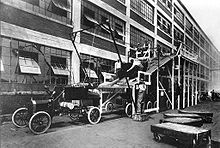
Model-T Assembly Line
At the end of the 19th Century, a laughably obscure technology began its unstoppable derailment of railroad passenger travel.  I refer, of course, to the automobile. From the very beginning, people loved the idea of being able to decide where and when to travel. Roads of the day weren't great, but people started to lobby for better roads. When Henry Ford's assembly line made the Model T affordable to almost every middle-class family, the automobile exploded onto the roadways.  For trips under a hundred miles, people would drive rather than take the train. They could leave on their own schedule and get to any town served by a road - even a bad road.  The family didn't have to have invest in a massive corporation to be able to drive. The large corporations like Ford Motor Company put the individual in charge of their own transportation.  It took decades, but gradually the railroads stopped running passenger trains and the country is now laced with interstate highways that carry the bulk of ground travel.  In the end, the individual would rather have control than give it to a large corporation. Small can be beautiful,

A second example is the main frame computer. When computing  came of age after World War II, it was the large companies like IBM that controlled the industry.  Once again, development was helped by government support - mostly from the Defense Department. Users were allowed limited access to these huge computing machines, mostly through leases to other corporations and universities.  The large capital required to build and operate these machines called for huge corporate investments and specialized technical people to operate the machines.

Then in the early 1980s, the personal computer became available from both Apple and IBM (and a host of smaller players). Computing was now available directly to the individual without an intermediary. People loved it. PCs were found in more and more homes and businesses. The individual became empowered and took control of computing virtually overnight. It didn't take the decades it took to move from the railroads to the automobile. Within a decade, PCs were ubiquitous. And those PCs when hooked to the emerging network called the internet gave people even more individual freedom to communicate and create thousands of new uses for the personal computer. Today, personal computers are in your pocket, in your smart phones, and tablets are becoming the new laptops. Given a choice, people will always opt for more control of their technology.

With these examples in mind, I started to muse about what the next big waves of personal control might be?  The starting point is to look for high capital intensity today. What demands a large corporation to provide the capital to make the technology possible?  I think it would be fair to eliminate those corporations that supply network services like power and oil companies. But even as I write this I think of Skype which has done a lot to eat into the phone companies' business. Maybe the two areas that might come to pass next are manufacturing and health care.

Right now, if you want a new widget, you have to look for someone who makes it and offers it for sale. But 3-D printing is changing the paradigm. Now, you can design or scan an object and send it directly to a 3-D printer that can pop a widget out in nothing flat. The technology is still early and you won't find a 3-D printer in your neighbor's house but give it a decade or two and see where we are. I predict that  manufacturing is going to undergo a sea change - and that sea change which will put more power into the hands of the individual.


The second area that comes to mind is health care. Right now, hospitals and clinics are capital intensive. Most people have to go to a physical facility to talk to a nurse or doctor. Medical records are closed for both privacy and competitive reasons. I think the forces of personal computing and the internet are going to change the way a lot of health care is practiced.  Small sensors built into your smart phone or tablet will measure your physical status and convey it to a doctor who will make electronic "house calls" to you via video links. For most minor situations, you will no longer have to go to the clinic or hospital to be seen.  Even for major procedures like surgery, you will be able to choose an expert who might live half-way around the world to do your procedure via robotic surgery.  Health care is ripe for change due to its taxing infrastructure and exploding costs.

People want control of their lives and technologies. New technologies that give them the sense of control at affordable costs will be rapidly embraced.  The world awaits the next waves of change. Small can be beautiful.

Monday, October 11, 2010

Grand Challenges: Keys to Future Training

How do you know when a new technology is becoming mainstream?  Conversely, what trends can you afford to ignore?  Where are the signals that suggest permanence - or at least a long run?  I wouldn't put my money on media hype.  The New-New can very quickly be about as appetizing as yesterday's oatmeal.

One sure indicator of a technology that is here to say is the emergence of training programs.    When employers are looking for skilled people, it is safe bet that the early risks of new technologies have passed.

If you look back at technology history, you can see the pattern.  In the late 1400s, the craft of printing exploded.  Printing was taught as a legitimate craft complete with guilds and master craftsmen.  In the 19th century, engineering emerged as a recognized discipline that was capable of far more than what had been the domain of the earlier military engineers.  Huge public works like the Erie Canal were built in the early 1800s by self-taught surveyors.  By the latter half of the century engineering, lead by civil engineering, was a mainstay at many larger colleges.  Specialty schools were founded which focused solely on science and engineering (e.g., MIT, CalTech, RPI, etc.).  In the last thirty years the emergence of the discipline of computer science has attracted students who wanted to work on the cutting edge of technology.

So what are the new training programs that are emerging that foretell the next wave of mainstream technology?  A quick scan of leading technology universities hints at some directions but one organization that cuts across many of the leading institutions is the National Academy of Engineering.  The leadership of the NAE has pulled together a list of what it calls Grand Challenges that represent some of the major issues facing our global society.  Here's the list:


  1. Make solar energy economical
  2. Provide energy from fusion
  3. develop carbon sequestration methods
  4. Manage the nitrogen cycle
  5. Provide access to clean water
  6. Restore and improve urban infrastructure
  7. Advance health informatics
  8. Engineer better medicines
  9. Reverse-engineer the brain
  10. Prevent nuclear terror
  11. Secure cyberspace
  12. Enhance virtual reality
  13. Advance personalized learning
  14. Engineer the tools for scientific discovery


When I looked over the list, it didn't seem to me that all these challenges were defined from the same altitude.  Some are very broad (e.g., prevent nuclear terror), while others are down in the trenches (enhance virtual reality).  But some broad themes emerge and these would be good bets for training for the future.  I would categorize the themes as energy, the environment, better health care, security, and retooling learning.

Energy and the environment are no brainers.  If we don't start to take these seriously, we will be in a world of hurt. The trick is to move mega-issues like these down into actionable projects which demand trained people.  There is, however, the little matter of who will write the paychecks?  The most sustainable solution is for private enterprise to emerge as a leader but at this stage it will take a public-private partnership to prime the pump.

Better health care is not new but two forces are coming into play to change the game.  The first is the diminishing viability of the old health care model.  This encompasses everything from HMOs to the pharmaceutical drug discovery model (which, as they say, is busted).  The cost increases in the current model are just not sustainable.  But help may be on the way in the form of sophisticated heath informatics to outline better and more cost-effective treatment protocols.  Bioinformatics is at the core of genomic medicine.  Computational power will have even higher leverage in health care in the future.

Another theme in the Grand Challenges is retooling learning.  Again, forces are in direct collision.  The current public education system in this country is failing miserably.  Government initiatives that demand uniform testing may be of some help but the bigger problem is that society, and particularly the family, are being redefined in the Age of Globalization.  On the positive side, virtually every college in the country now has so-called distance learning.  If you don't care about college credit, they even give away courses for free on the web.  The Gates Foundation is focusing billions on improving public education as they research new tools and techniques.  In the end, however, education takes individual concentration and effort.  No amount of technology replaces the desire to learn.

If I were going to college today, choosing a path from the Grand Challenges list would be a good place to start.  In the end, however, it is good to remember that every training and college program is willed into being by a demand for people with particular skills - skills where the demand outstrips the supply. We need to do all we can to make sure the demand is there.  The supply will follow naturally.

Wednesday, March 24, 2010

Innovation in Healthcare: For One and for All

Healthcare dominates the news of late.  But the stories are all about politics, partisanship, and money.  I would rather focus for a moment on the positive side of the picture - the incredible advances that have been made in healthcare in the last fifty years.  You can almost make a case that medicine as we know it was only invented in the last half of the 20th Century.  Think about the technologies that we take for granted:


  • Heart/Lung Bypass Machines for heart surgery
  • Cataract removal and lens replacement
  • Feasible organ transplantation because of anti-rejection drugs
  • Minimally-invasive surgery
  • CT Scanning
  • MRI
  • Anti-viral drugs
  • Vaccines
  • Cures for childhood cancers
  • Angiography
  • Coronary stents
  • Pacemakers
  • Joint replacements
  • Dental implants
The list goes on and on.  It is truly remarkable how far the medical sciences have advanced.  Most of this technology was developed in the United States, another measure of the innovation we have enjoyed in this country.

You might think of these technologies as being focused on individual health.  The biggest impact on longevity, however, continues to be due to public health:  clean water, sewage systems, clean air,  better nutrition, and mass vaccinations of the population are a few examples.  It seems to me that the talk of the last year to fund "shovel-ready" infrastructure projects could have been seen as a way to maintain and improve our public health.  Most of the water pipes in major cities are a century old and falling apart.  Same goes for the sewer systems.  Money spent on these projects would not only help unemployment, they would help maintain our public health.  Seems like win-win to me.  Innovations don't always come in shiny packages.  Some come right out of the faucet.